Zwetschgendatschi
Augsburg's flat sheet cake topped with halved plums
- Vegetarian
- Local name
- Zwetschgendatschi
- Served with
- Whipped cream
- Best eaten at
- An Augsburg café
- Pairs with
- Coffee
What it is
Zwetschgendatschi is a flat sheet cake that serves as the edible emblem of the city of Augsburg in Bavaria. Zwetschge is the southern German word for the oval prune plum, and Datschi a dialect word for a flat cake, probably from datschen, to press, as the fruit is pressed into the dough. Unlike many European pastries that rise high into layers, this one spreads wide and thin across a baking tray, creating a canvas for the fruit.
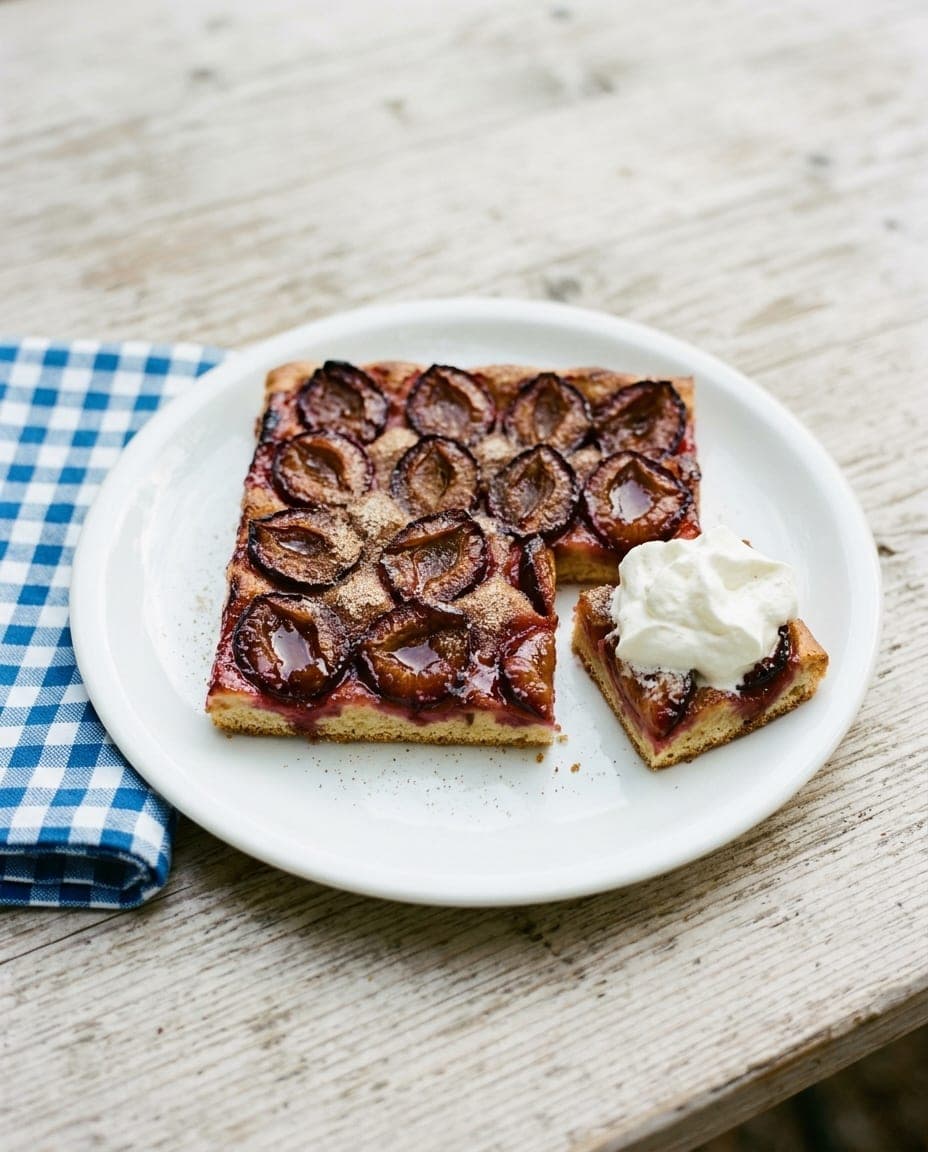
The visual identity of the dish is its most striking feature. The base is a thin sheet of dough, traditionally a light yeast dough or, in many modern versions, a crumbly shortcrust, spread across a large rectangular tray. On top, halved plums are arranged in tight, overlapping rows, set on edge with their cut sides facing up. The fruit covers almost the entire surface, creating a deep purple pavement that contrasts with the pale dough beneath. When baked, the plums soften but hold their shape, their skins wrinkling slightly while the flesh remains firm.
This is not a delicate confection meant for afternoon tea in a fine hotel. It is a rustic, generous offering from a Bavarian bakery or café kitchen, cut into large squares and served warm or at room temperature. The texture is soft and yielding, with the fruit providing a tart counterpoint to the sweet dough. It is a seasonal dish, appearing when the plum harvest arrives in late summer and early autumn.
Why Augsburg claims it
Augsburg has made the Zwetschgendatschi its own to such an extent that the city is nicknamed Datschiburg and its residents are sometimes referred to as Datschiburger, a playful nickname derived directly from the name of the cake. The pastry is considered a symbol of local identity, much like how Berlin is associated with currywurst or Paris with the croissant.
The cake has its roots in the farming traditions of southern Germany, where plum trees were abundant. Similar plum cakes are baked across Bavaria, Baden-Württemberg and much of the German-speaking world, but Augsburg claims the Datschi more loudly than anywhere else, and some even credit the city with inventing it. Over time, the Datschiburger turned a simple farm treat into a civic badge of honour.
The seasonal nature of the cake reinforces its status as a local event. When the plum season arrives in August and September, bakeries prepare the trays in large batches, and the sight of the finished cakes cooling on racks becomes a sign that summer is ending and autumn has begun.
How it is made
The base begins as a thin layer of dough rolled or pressed onto a baking tray. In some versions, the dough is a yeast variety that rises slightly to create a light, airy texture. In others, it is a shortcrust that remains firm and crumbly.
To prevent the fruit from making the base soggy, bakers often scatter a layer of ground almonds or fine breadcrumbs over the dough before adding the plums. This absorbs the juices released during baking. The Zwetschgen themselves are chosen not for their sweetness but for their firmness and tartness. They are oval fruits with deep blue-purple skin that retain their shape in the heat where rounder, juicier plums would collapse into a mush.
The fruit is prepared by halving and stoning it and arranging it in neat rows across the dough. The cut sides face up, creating a tight mosaic of golden flesh and dark skin. A dusting of sugar and cinnamon is often sprinkled over the top, either before or after baking, sometimes accompanied by a streusel topping that adds a crunchy contrast to the soft fruit. The result is a flat, fragrant sheet cake that is sliced into squares for serving.
How to eat it
Zwetschgendatschi is typically served as a dessert or a mid-afternoon treat in an Augsburg café. It arrives on a plate cut into generous squares, often still warm from the oven. The traditional accompaniment is a generous spoonful of fresh whipped cream, which softens the tartness of the plums and adds a creamy texture to the chewy dough.
The pairing with coffee is essential. A strong black coffee cuts through the sweetness of the cake and complements the fruit's acidity.
It is a dish meant to be eaten slowly. The large squares are often shared among a small group at a table in a traditional café. The focus is on the seasonal flavour and the communal act of eating something that is at its best only when the plums are ripe. In Augsburg, finding a café with fresh Zwetschgendatschi in August or September is considered a necessary part of a visit.
Curious facts
- A plum, not a damson. Zwetschgen are prune plums, oval fruits with firm flesh and deep blue-purple skin that hold their shape when baked; they are often called Italian plums in English.
- A civic nickname. Augsburg is nicknamed Datschiburg and its residents Datschiburger, a playful reference to the city's most famous pastry.
- Seasonal scarcity. The cake is at its best during the plum harvest in late summer, typically from August to September, making it a fleeting treat.
- The dry layer. Ground almonds or breadcrumbs are often scattered under the fruit to absorb juices and keep the base from becoming soggy.
- A local standard. Plum sheet cakes are baked across southern Germany and beyond, but nowhere is the Datschi as closely tied to civic identity as in Augsburg.
Where to try it
The best place to find Zwetschgendatschi is in an Augsburg café during the plum season. Traditional bakeries and coffee houses across the city prepare the cake fresh when the harvest arrives, and the scent of baking plums is easy to follow.
Outside the city, similar versions are baked throughout Bavaria and Baden-Württemberg, but the classic experience is tied to Augsburg itself. Many cafés serve the cake with whipped cream and coffee as a standard afternoon offering during the harvest months, making late summer and early autumn the time to seek out a square of this seasonal classic.
Where to try it
1 destination
 Camper Van Rentals
Augsburg
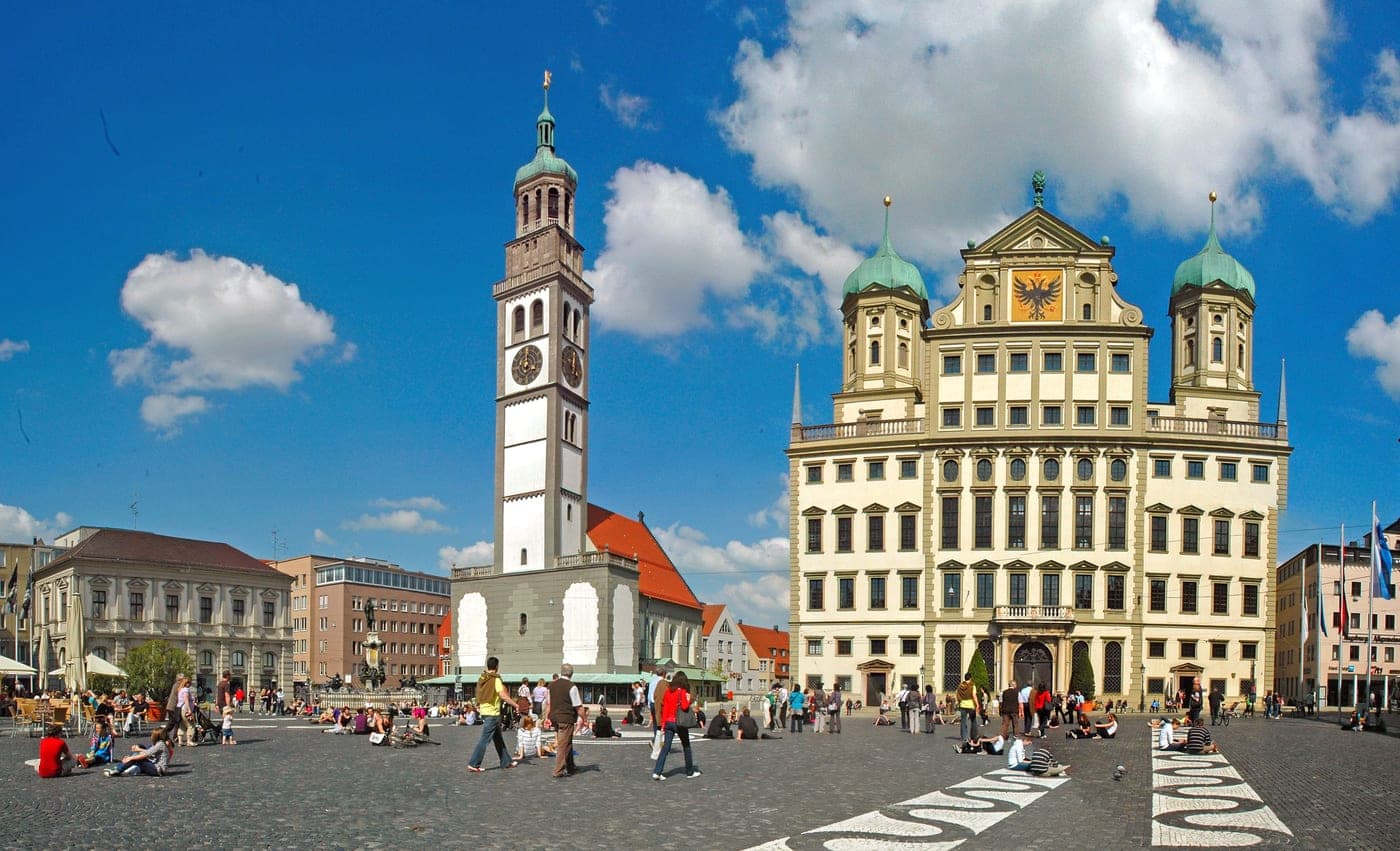
Ancient Roman city with Renaissance heritage and Fuggerei social housing
Camper Van RentalsHiking
1 region
 Cabins31 destinations
Bavaria
Bavaria is Germany's largest state, and one of its most varied. In the south, the land rises into the Alps, with peaks above Berchtesgaden and Garmisch-Partenkirchen, and lakes such as the Chiemsee and the Königssee nearby. Further north, the hills flatten into the Franconian wine country, where Silvaner and Müller-Thurgau vines cover slopes above the Main river. Between these two landscapes sit market towns, river cities, and castle villages that reward slow attention. Munich, the state capital, has its beer gardens, its baroque churches, and its markets selling Weißwurst in the morning. But much of Bavaria's character lives outside the capital, in places built for a quieter pace. Regensburg, on the Danube, keeps a medieval old town of narrow lanes, stone bridges, and merchant houses that once served river trade. Bamberg spreads across seven hills and several arms of the Regnitz river, and is known for its smoked Rauchbier, brewed in local taverns much as it always has been. Rothenburg ob der Tauber sits inside its own medieval walls, with half-timbered houses and a walkway along the ramparts that circles the whole old town. Franconia, in the north, is Bavaria's wine country. Vineyards climb the terraces above Würzburg and along the Main, and small wine villages sell their own vintages from cellar doors and courtyard taverns. The wine here is usually bottled in the round Bocksbeutel flask, a shape associated with the region. Cycling paths follow the river through the vines, linking one village to the next at an easy, level pace, past chapels, wine presses, and stone crosses set among the rows. In the Allgäu, close to the Austrian border, the town of Füssen sits below the castle hill of Neuschwanstein, built by King Ludwig II in the nineteenth century. The castle draws attention, but the surrounding countryside holds its own appeal: lakes, foothills, and villages where farming and dairy traditions continue much as before. Bavaria's lakes add another layer of slowness. The Chiemsee, the largest, can be crossed by boat to its island monasteries, where former royal buildings and quiet cloisters sit surrounded by water and reed beds. Smaller lakes near the Alpine foothills, such as the Staffelsee and the Ammersee, are ringed by paths used for walking and cycling rather than for speed. Food and drink run through the region's identity. Beer gardens, some centuries old, work on a simple principle: food brought from home, a beer ordered at the counter, a seat under chestnut trees for as long as the weather allows. Franconian taverns serve local wine alongside dishes built around potatoes, dumplings, and river fish. Bakeries sell pretzels still warm from the oven, and markets in towns like Nuremberg keep old traditions of spiced gingerbread and roasted sausages. A morning market in Regensburg, an afternoon among the Franconian vines, an evening in a Bamberg tavern: each has its own pace. Villages across Bavaria keep their own customs — wine festivals in Franconia, woodcarving and dairy traditions in the Alpine foothills. Mountains and vineyards, river cities and castle villages: Bavaria fits them into a single state, each within reach of the next.
CabinsCastlesHikingCamper Van Rentals