Weißwurst
A pale Bavarian sausage of veal and pork, poached and eaten before noon with sweet mustard
- Local name
- Weißwurst
- Served with
- Sweet mustard, pretzel
- Best eaten at
- A Bavarian Wirtshaus, before noon
- Pairs with
- Weißbier
What it is
Weißwurst, literally "white sausage", is one of the most distinctive culinary symbols of Bavaria, specifically associated with Munich and its surrounding countryside. It is a pale, unsmoked sausage made from minced veal and pork back fat, flavoured with parsley, lemon zest, mace and onion. The name refers to its colour, which remains white or cream because the meat is neither smoked nor cured. Rather than being fried or boiled hard, it is gently heated in hot water just below simmering point for about ten minutes, before being served piping hot.
The texture is soft and fine, lacking the snap of a dry sausage or the char of a grilled one. Because it contains no strong preservatives, the traditional rule dictates that it must be eaten before midday. This custom dates back to the era before refrigeration, when a fresh sausage made early in the morning would not keep well into the afternoon. While modern refrigeration has removed that need, many Bavarians still observe the tradition as a matter of local pride and habit.
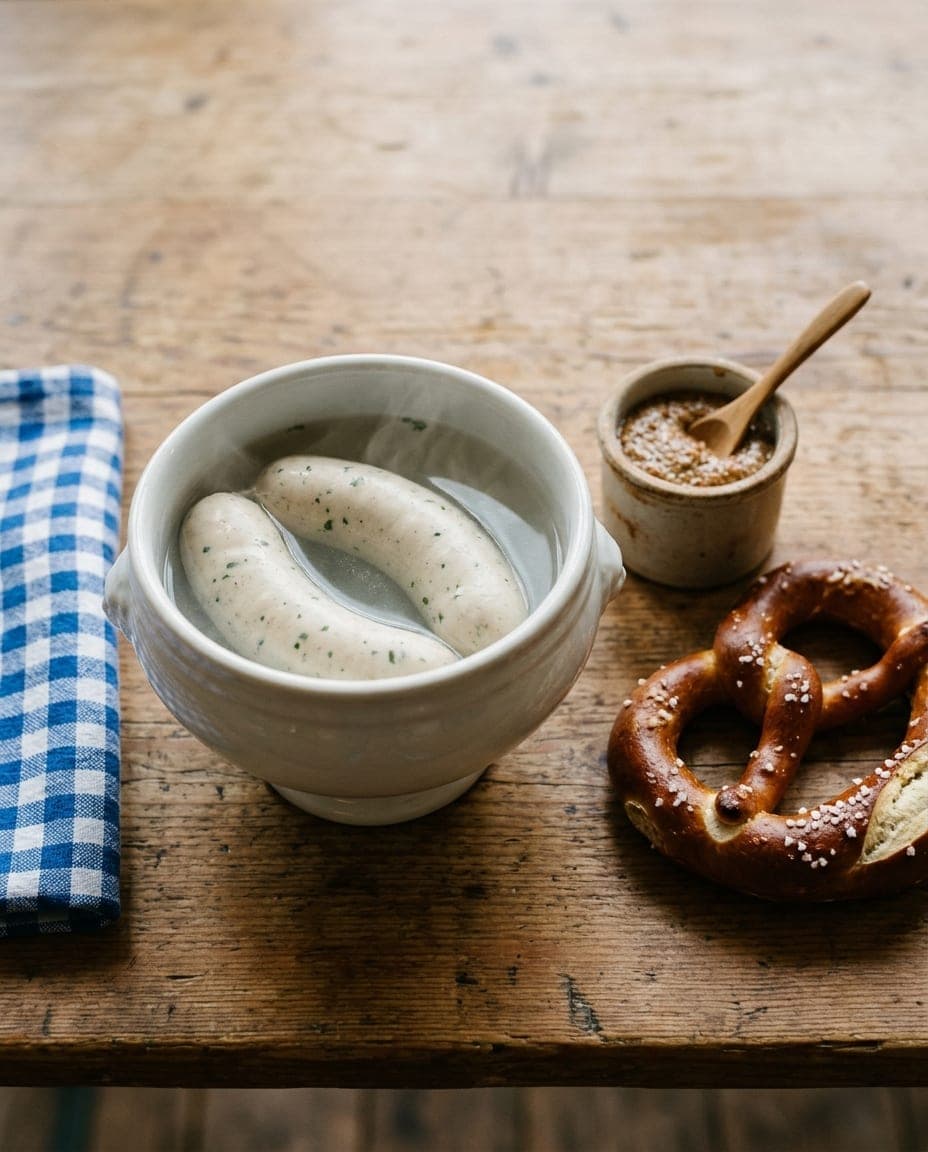
The dish is rarely eaten alone. It arrives in a tureen of its own hot water, accompanied by a soft pretzel known as a Brezn and a dollop of sweet mustard. The combination creates a simple but satisfying meal that is a fixture of Munich's late-morning culture.
The legend of the midday bell
The story of the white sausage is tied closely to 19th-century Munich. The most widely told version places its invention on 22 February 1857 at an inn on the Marienplatz, where the landlord, Sepp Moser, ran out of the thin sheep casings he used for veal sausages. Using thicker pork casings instead, he heated the sausages in hot water rather than frying them, so that they would not burst. Whether the tale is historical fact or local folklore is debated, but 1857 is firmly fixed in Bavarian culinary lore as the year the dish was born.
The rule regarding the midday hour is also steeped in history. Before reliable refrigeration, fresh sausage meat spoiled quickly, so a Weißwurst made at dawn was best eaten by noon. Hence the saying that a Weißwurst should never hear the noon bells ring. Today it is a custom rather than a law, but many traditional inns still treat it as a morning dish, and some stop serving it at midday.
How Bavaria made it its own
While similar sausages exist elsewhere, the Weißwurst remains a Bavarian emblem. It is not a national dish of Germany and is far less common in Berlin or Hamburg; the jokingly named Weißwurstäquator is the line that is said to separate Bavaria from the north. Munich is its undisputed capital, where the sausage remains a morning ritual for many locals.
The ideal setting is a Wirtshaus, a traditional Bavarian tavern or inn, often in the historic districts of Munich such as the Altstadt or near the Viktualienmarkt. These establishments are known for their relaxed atmosphere, wooden interiors and long communal tables, and the sausages often arrive in a shared tureen.
What goes into it
There is no single official recipe, and every butcher guards their own version, but the core ingredients remain consistent. The meat is very finely minced to create a smooth, delicate texture.
- Veal and pork back fat: The primary ingredients, which give the sausage its pale colour and soft body.
- Parsley: Added in generous amounts, giving the sausage a green-flecked appearance and a fresh, herbaceous note.
- Lemon zest: A touch of lemon peel adds a subtle citrus brightness.
- Mace and onion: These provide warmth and depth without overpowering the delicate flavour of the veal.
- Salt and ice: The mixture is bound with salt and ice or cold water into a smooth emulsion before being stuffed into pork casings.
The sausage is scalded by the butcher once it has been filled, so at the table it is only reheated. The casing is traditionally not eaten: it is either peeled away with knife and fork or the sausage is sucked out of it. This method, known as zuzeln, is the old-fashioned way of eating the dish and is still practised by those who wish to follow tradition.
How to eat it
The ritual begins with the serving vessel: a tureen filled with hot water, which keeps the sausages warm and stops them from drying out. Diners either peel away the skin with knife and fork or zuzeln.
Accompaniments are essential. A pretzel is served alongside, providing a chewy contrast to the soft meat. The mustard is not the sharp variety found on sausages elsewhere; it is a sweet, mild Bavarian mustard that complements the delicate flavour of the veal.
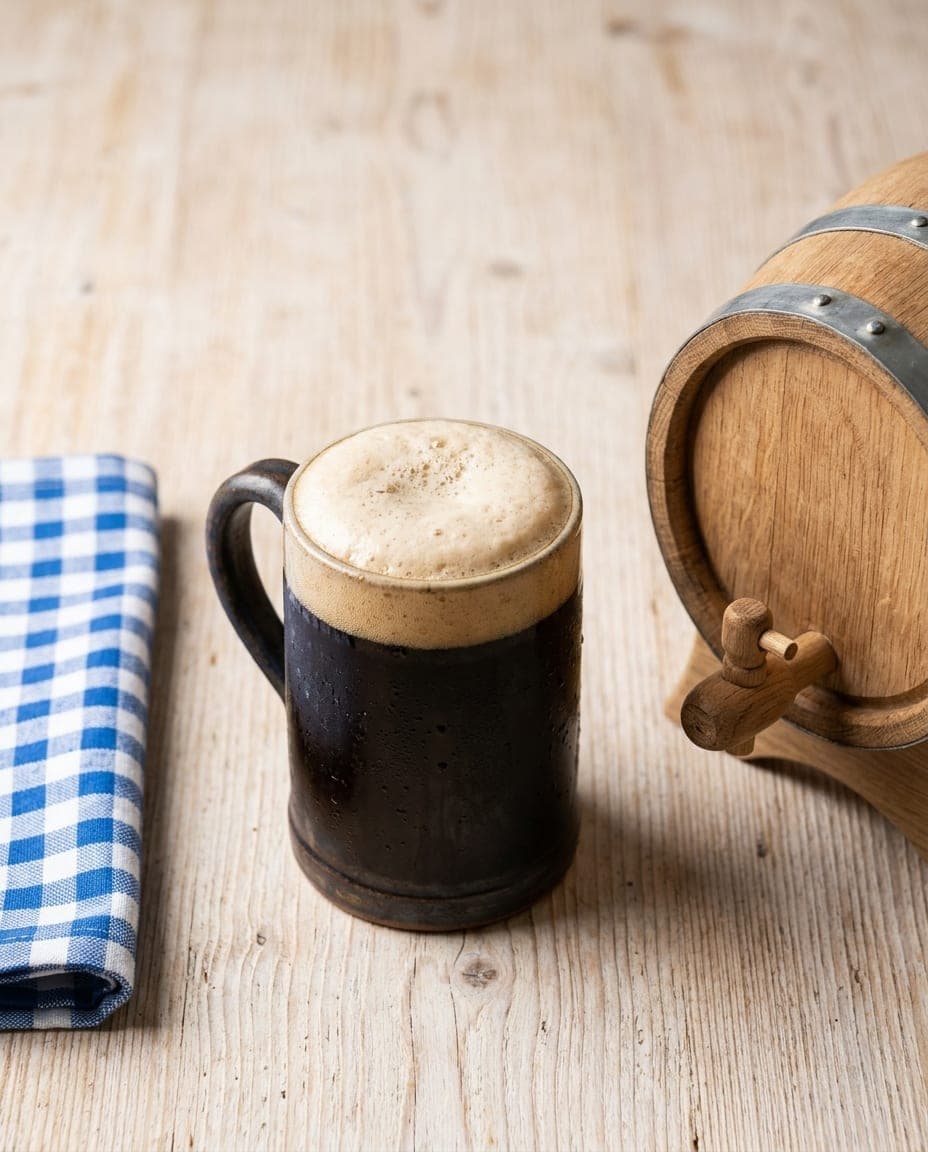
The traditional drink is a glass of Weißbier, the cloudy wheat beer, whose fruity and spicy notes suit the rich sausage. White sausage, sweet mustard, pretzel and wheat beer together form the classic Weißwurstfrühstück, a late breakfast that is both simple and deeply satisfying.
Curious facts
- The noon rule lives on. In Munich, the tradition of eating the sausage before noon is strong enough that some traditional inns stop serving it at midday.
- The skin is not eaten. The casing is traditionally removed with a knife or the sausage is sucked out, a method known as zuzeln.
- It is never smoked. Unlike many German sausages, Weißwurst is unsmoked; it is scalded by the butcher and only gently reheated in hot water, which keeps it pale.
- A regional emblem. The sausage is not a national German dish but a Bavarian speciality, with Munich as its primary home.
- The spice blend varies. Each butcher has their own balance of mace, lemon zest and herbs, making every batch slightly different.
Where to try it
The best place to eat Weißwurst is a traditional Wirtshaus in Munich, particularly in the Altstadt or near the Viktualienmarkt, the open-air market in the heart of the city, where butchers also sell fresh sausages to take home. A family-run Wirtshaus usually offers a more authentic experience than a large tourist-focused restaurant.
While Munich is the primary destination, the tradition extends to other parts of Bavaria, including towns such as Rosenheim and Augsburg. For the full experience of the midday ritual, a late-morning visit is the time to go, with a pretzel and a glass of wheat beer alongside.
Where to try it
1 destination
 Camper Van Rentals
Munich
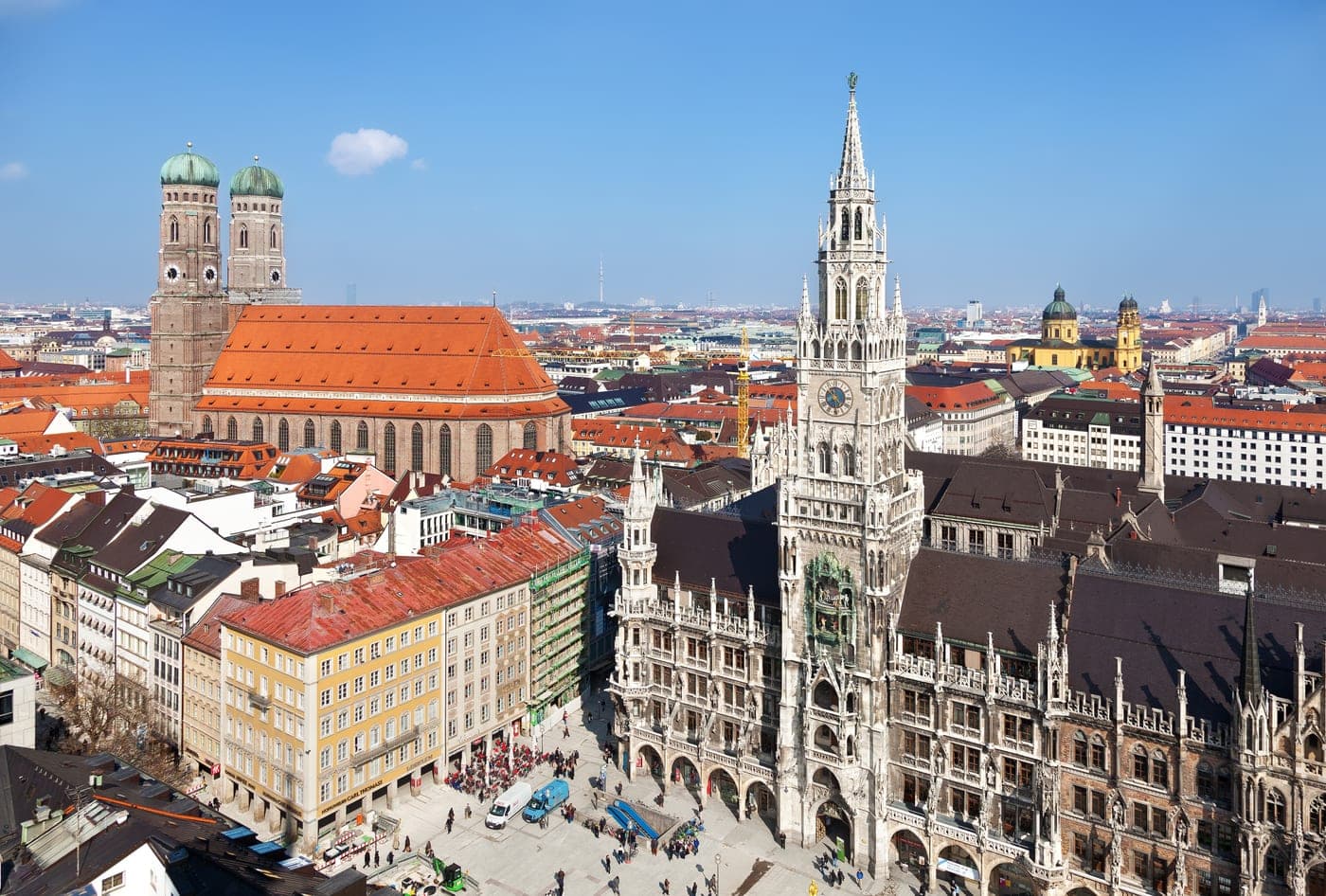
Bavaria's capital with beer gardens, baroque architecture, and Alpine access
Camper Van Rentals
1 region
 Cabins31 destinations
Bavaria
Bavaria is Germany's largest state, and one of its most varied. In the south, the land rises into the Alps, with peaks above Berchtesgaden and Garmisch-Partenkirchen, and lakes such as the Chiemsee and the Königssee nearby. Further north, the hills flatten into the Franconian wine country, where Silvaner and Müller-Thurgau vines cover slopes above the Main river. Between these two landscapes sit market towns, river cities, and castle villages that reward slow attention. Munich, the state capital, has its beer gardens, its baroque churches, and its markets selling Weißwurst in the morning. But much of Bavaria's character lives outside the capital, in places built for a quieter pace. Regensburg, on the Danube, keeps a medieval old town of narrow lanes, stone bridges, and merchant houses that once served river trade. Bamberg spreads across seven hills and several arms of the Regnitz river, and is known for its smoked Rauchbier, brewed in local taverns much as it always has been. Rothenburg ob der Tauber sits inside its own medieval walls, with half-timbered houses and a walkway along the ramparts that circles the whole old town. Franconia, in the north, is Bavaria's wine country. Vineyards climb the terraces above Würzburg and along the Main, and small wine villages sell their own vintages from cellar doors and courtyard taverns. The wine here is usually bottled in the round Bocksbeutel flask, a shape associated with the region. Cycling paths follow the river through the vines, linking one village to the next at an easy, level pace, past chapels, wine presses, and stone crosses set among the rows. In the Allgäu, close to the Austrian border, the town of Füssen sits below the castle hill of Neuschwanstein, built by King Ludwig II in the nineteenth century. The castle draws attention, but the surrounding countryside holds its own appeal: lakes, foothills, and villages where farming and dairy traditions continue much as before. Bavaria's lakes add another layer of slowness. The Chiemsee, the largest, can be crossed by boat to its island monasteries, where former royal buildings and quiet cloisters sit surrounded by water and reed beds. Smaller lakes near the Alpine foothills, such as the Staffelsee and the Ammersee, are ringed by paths used for walking and cycling rather than for speed. Food and drink run through the region's identity. Beer gardens, some centuries old, work on a simple principle: food brought from home, a beer ordered at the counter, a seat under chestnut trees for as long as the weather allows. Franconian taverns serve local wine alongside dishes built around potatoes, dumplings, and river fish. Bakeries sell pretzels still warm from the oven, and markets in towns like Nuremberg keep old traditions of spiced gingerbread and roasted sausages. A morning market in Regensburg, an afternoon among the Franconian vines, an evening in a Bamberg tavern: each has its own pace. Villages across Bavaria keep their own customs — wine festivals in Franconia, woodcarving and dairy traditions in the Alpine foothills. Mountains and vineyards, river cities and castle villages: Bavaria fits them into a single state, each within reach of the next.
CabinsCastlesHikingCamper Van Rentals