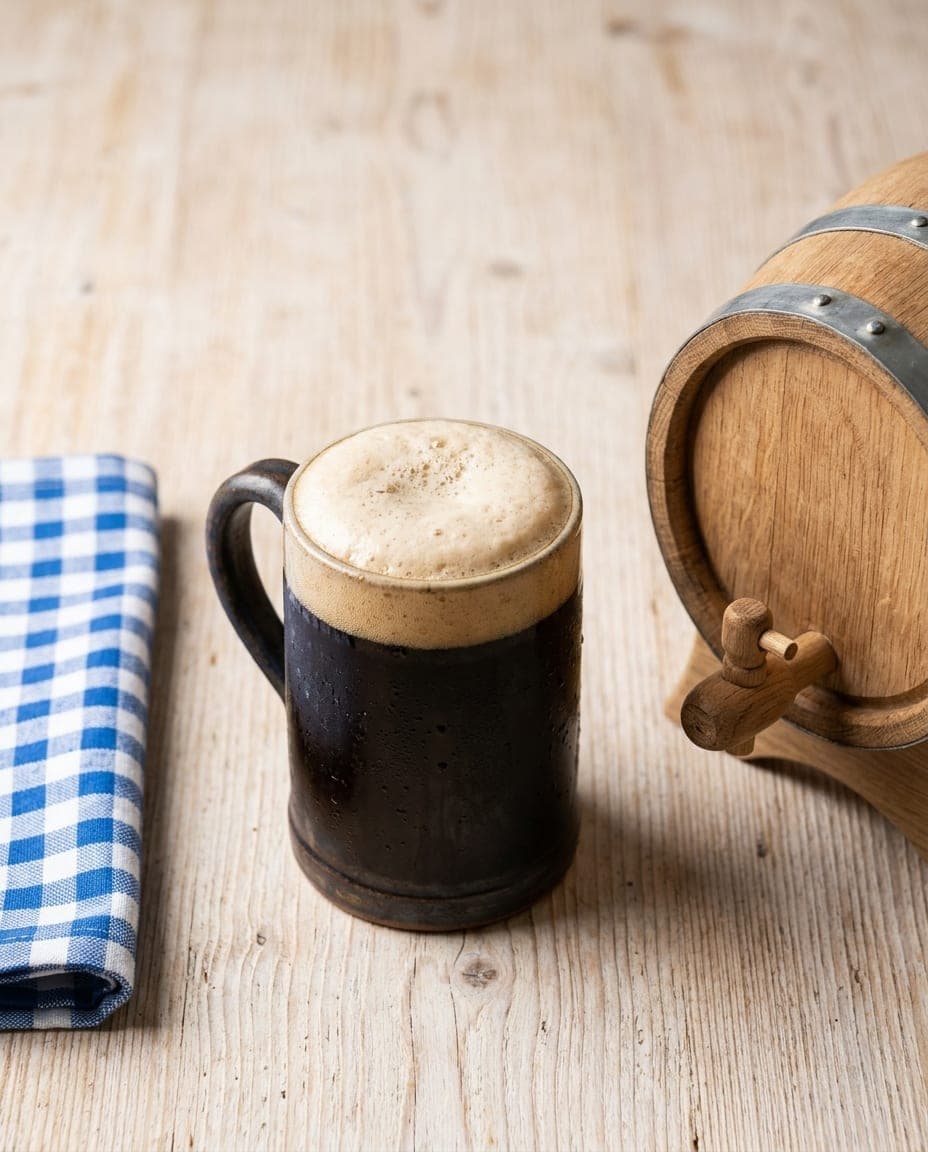
Weißbier (wheat beer)
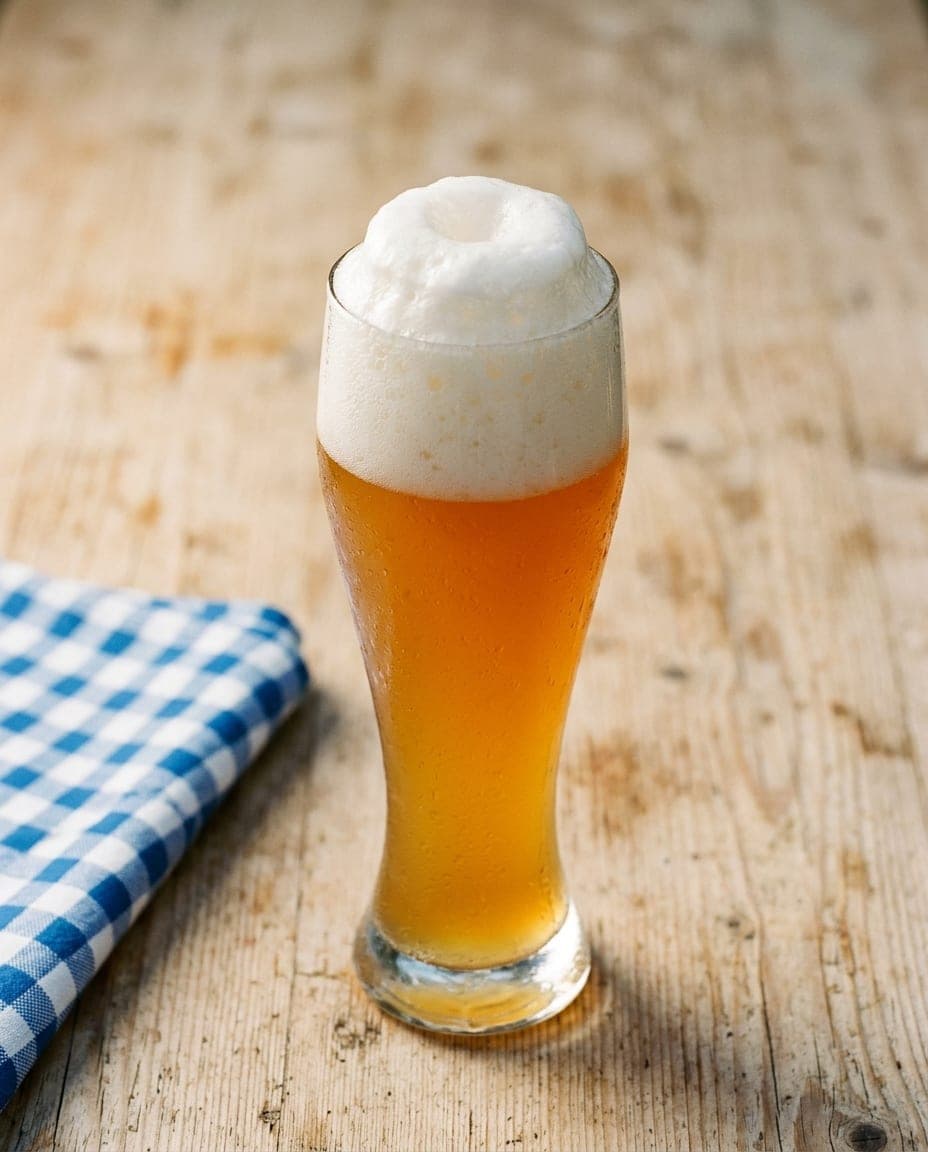
Cloudy Bavarian wheat beer with banana-clove notes, served in a tall glass
- Alcoholic
- Local name
- Weißbier
- Served
- In a tall wheat-beer glass
- Best eaten at
- A Bavarian beer garden
- Pairs with
- Weißwurst, pretzel
What it is
Weißbier, literally "white beer", is one of the most distinctive brews of Bavaria. It is a cloudy, top-fermented wheat beer where the cloudiness comes from suspended yeast rather than any fault in the brewing. The style is defined by its aroma: a natural blend of banana and clove notes produced by the specific yeast strain used during fermentation. No spices or fruit are added to achieve this character; the flavour comes from the yeast itself, which releases esters and phenols as it works.
The beer is pale to golden in colour, though a darker version exists called Dunkles Weißbier. The most common form is Hefeweizen, a term meaning "yeast wheat", where the beer is served unfiltered so the yeast remains in suspension. This gives the liquid a hazy appearance and a thick, persistent foam head that can reach several centimetres high.
The history of the white beer
For centuries, brewing wheat beer in Bavaria was a jealously guarded privilege. In the 16th century the right was held by the noble Degenberg family; when their line died out in 1602, it passed to the ruling Wittelsbach dukes, who turned wheat beer into a lucrative ducal monopoly while other brewers were largely restricted to barley. The monopoly was loosened over time, and in 1872 the Munich brewer Georg Schneider acquired the right to brew wheat beer from the crown.
The style lost ground during the 19th century as lager brewing took hold across Europe. Wheat beer production dropped sharply, and a small number of breweries kept the flame alive, preserving the methods and yeast strains that had been passed down through generations. Its revival came in the second half of the 20th century, and today it is one of Germany's best-known beer styles at home and abroad.
The name Weißbier itself is a point of some debate. Some argue the term referred to the pale colour of the beer compared to the darker brews of the time, while others link it to the white foam that crowned every glass. Regardless of the origin, it is now the standard name for the style in Bavaria, while much of the rest of Germany says Weizenbier.
How it is made
The brewing process relies heavily on the yeast, which produces the characteristic banana and clove flavours during fermentation. The beer is top-fermented, meaning the yeast works at warmer temperatures than bottom-fermented lagers, allowing these flavour compounds to develop.
The grain bill must contain at least half malted wheat, with the remainder typically being barley malt. The high proportion of wheat gives the beer a smooth, fuller mouthfeel and helps build its tall head. After fermentation, the beer is usually left unfiltered to retain the yeast in suspension, creating the cloudy appearance known as Hefeweizen. A filtered version exists called Kristallweizen, which is clear and a little crisper, with less of the yeasty character.
Where it comes from
Weißbier is Bavarian in origin and remains bound up with the local culture, with traditional breweries in Munich and in towns across Upper and Lower Bavaria. Today it is brewed and drunk throughout Germany and exported worldwide, but in Bavaria it is still a staple of everyday life, appearing on menus in beer gardens, taverns and restaurants across the region.
How it is served
Weißbier is poured into a tall, narrow glass that flares at the top to accommodate the large head of foam. The pouring process is often treated as a small ritual: the glass is rinsed with cold water before use, held at an angle, and the bottle is emptied slowly to keep the foam under control.
At the end of the pour, the last of the yeast in the bottle is swirled and poured in to deliver the full character of the beer. The result is a glass topped with a thick, creamy head that lasts for some time.
Outside Bavaria, a slice of lemon is sometimes added to the glass, though many Bavarian drinkers consider it an unnecessary addition that masks the balance of the brew. The traditional pairing is with Weißwurst, a white sausage made from veal and pork, which is typically eaten before noon as part of a late breakfast. Pretzels are another common accompaniment, offering a salty contrast to the fruity notes of the beer.
Curious facts
- The yeast does the work. The banana and clove flavours come naturally from the yeast strain used during fermentation; no spices or fruit are added to create them.
- A ducal monopoly. For around two centuries, the right to brew wheat beer in Bavaria lay with the ruling house rather than ordinary brewers.
- The glass is essential. The tall, flared glass is designed to hold the thick foam and concentrate the aroma.
- Cloudy or clear. Hefeweizen is unfiltered and cloudy, while Kristallweizen is filtered and clear.
- A near extinction. The style faded badly in the 19th century before its revival in the 20th brought it back to prominence.
- The lemon debate. A slice of lemon is a common sight outside Bavaria, though traditionalists believe it masks the balance of the brew.
Where to try it
The best place to drink Weißbier is a Bavarian beer garden, where the tradition of serving it in tall glasses and pairing it with Weißwurst is still alive. Munich is home to some of the most famous breweries, but excellent versions can be found in smaller towns across the region.
On a warm morning or afternoon, a glass alongside a plate of Weißwurst and pretzels makes for a classic Bavarian moment.
Where to try it
1 region
 Cabins31 destinations
Bavaria
Bavaria is Germany's largest state, and one of its most varied. In the south, the land rises into the Alps, with peaks above Berchtesgaden and Garmisch-Partenkirchen, and lakes such as the Chiemsee and the Königssee nearby. Further north, the hills flatten into the Franconian wine country, where Silvaner and Müller-Thurgau vines cover slopes above the Main river. Between these two landscapes sit market towns, river cities, and castle villages that reward slow attention. Munich, the state capital, has its beer gardens, its baroque churches, and its markets selling Weißwurst in the morning. But much of Bavaria's character lives outside the capital, in places built for a quieter pace. Regensburg, on the Danube, keeps a medieval old town of narrow lanes, stone bridges, and merchant houses that once served river trade. Bamberg spreads across seven hills and several arms of the Regnitz river, and is known for its smoked Rauchbier, brewed in local taverns much as it always has been. Rothenburg ob der Tauber sits inside its own medieval walls, with half-timbered houses and a walkway along the ramparts that circles the whole old town. Franconia, in the north, is Bavaria's wine country. Vineyards climb the terraces above Würzburg and along the Main, and small wine villages sell their own vintages from cellar doors and courtyard taverns. The wine here is usually bottled in the round Bocksbeutel flask, a shape associated with the region. Cycling paths follow the river through the vines, linking one village to the next at an easy, level pace, past chapels, wine presses, and stone crosses set among the rows. In the Allgäu, close to the Austrian border, the town of Füssen sits below the castle hill of Neuschwanstein, built by King Ludwig II in the nineteenth century. The castle draws attention, but the surrounding countryside holds its own appeal: lakes, foothills, and villages where farming and dairy traditions continue much as before. Bavaria's lakes add another layer of slowness. The Chiemsee, the largest, can be crossed by boat to its island monasteries, where former royal buildings and quiet cloisters sit surrounded by water and reed beds. Smaller lakes near the Alpine foothills, such as the Staffelsee and the Ammersee, are ringed by paths used for walking and cycling rather than for speed. Food and drink run through the region's identity. Beer gardens, some centuries old, work on a simple principle: food brought from home, a beer ordered at the counter, a seat under chestnut trees for as long as the weather allows. Franconian taverns serve local wine alongside dishes built around potatoes, dumplings, and river fish. Bakeries sell pretzels still warm from the oven, and markets in towns like Nuremberg keep old traditions of spiced gingerbread and roasted sausages. A morning market in Regensburg, an afternoon among the Franconian vines, an evening in a Bamberg tavern: each has its own pace. Villages across Bavaria keep their own customs — wine festivals in Franconia, woodcarving and dairy traditions in the Alpine foothills. Mountains and vineyards, river cities and castle villages: Bavaria fits them into a single state, each within reach of the next.
CabinsCastlesHikingCamper Van Rentals