Schweinsbraten mit Knödel
Roast pork with crackling, dumplings and dark beer gravy in Bavaria
- Local name
- Schweinsbraten mit Knödel
- Served with
- Dumplings, cabbage salad
- Best eaten at
- A Bavarian Wirtshaus on Sunday
- Pairs with
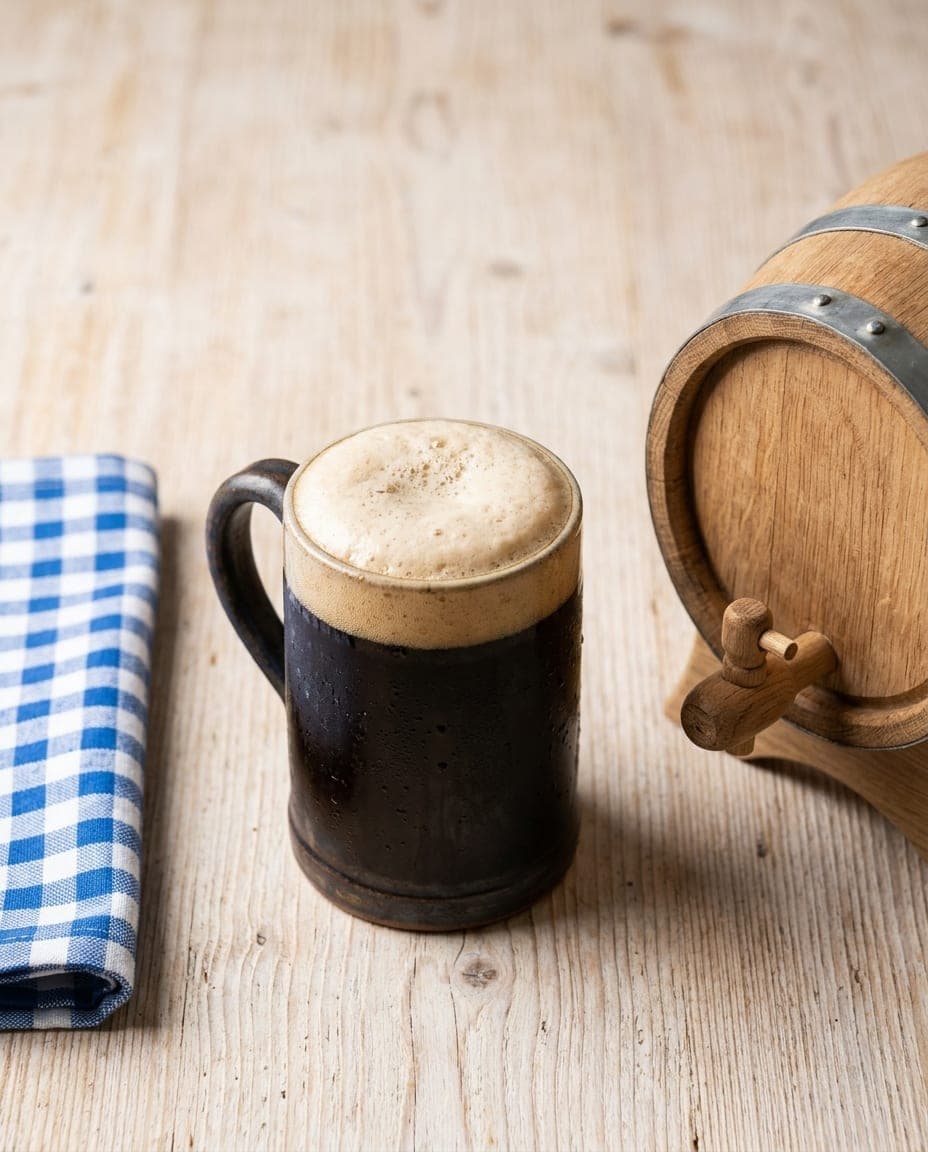
- Dunkel beer
What it is
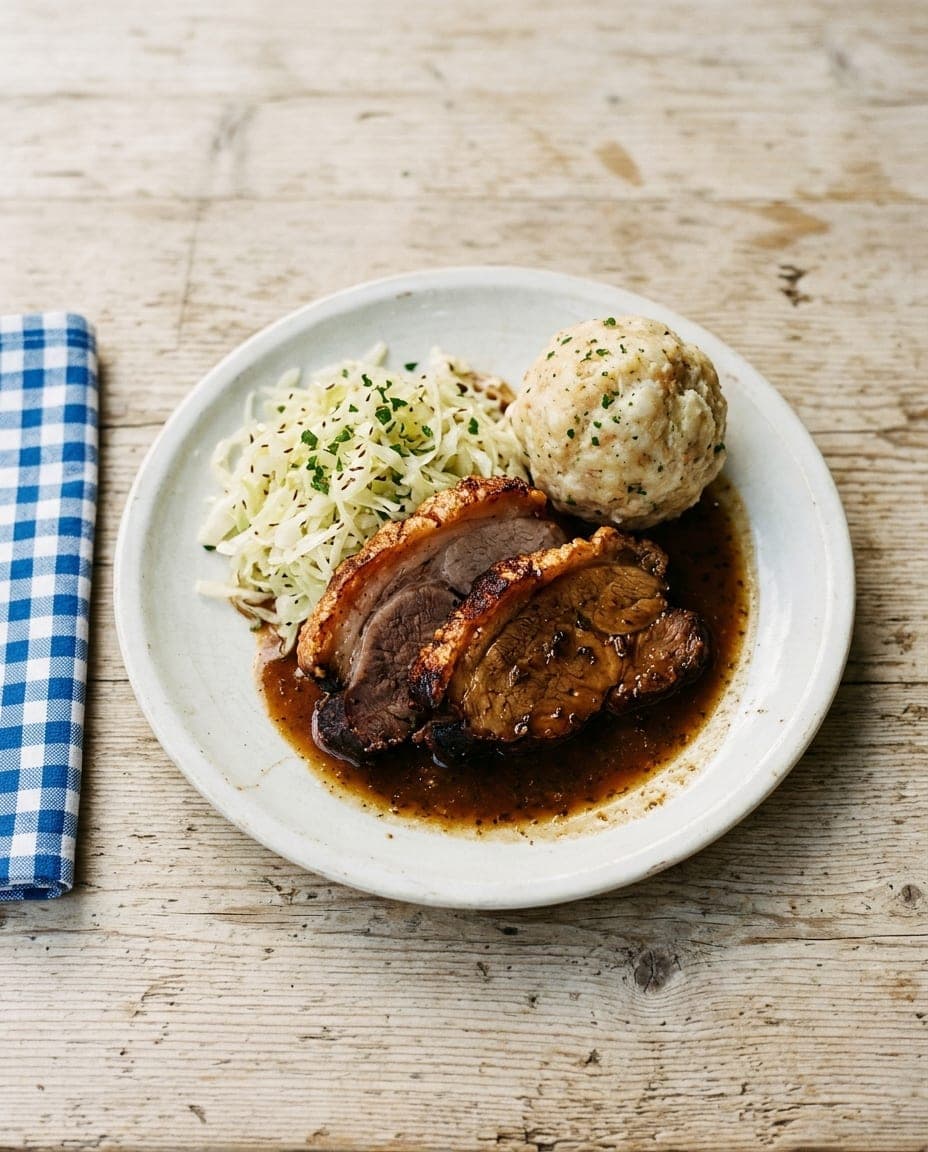
Schweinsbraten mit Knödel is the defining Sunday meal of Bavaria, a dish that sits at the centre of village life and city dining alike. It consists of a large joint of pork, usually taken from the shoulder, roasted until the skin turns into a layer of golden crackling. The meat is sliced thickly and served with two essential companions: a dark, beer-enriched gravy and a substantial dumpling, either made from stale bread rolls (Semmelknödel) or potatoes (Kartoffelknödel).
The dish is not merely food; it is part of the ritual of the Bavarian Sunday. While pork roasts are eaten across Germany, this combination of slow-roasted pork, caraway seasoning and a gravy made with beer is closely identified with Bavaria. The meal is hearty and savoury, designed to sustain a family through the afternoon after church or a long walk in the countryside. It is a dish of comfort rather than refinement, where the texture of the crackling and the ability of the dumpling to soak up the sauce are the true measures of success.
The Sunday tradition
In Bavaria, the Sonntagsbraten or Sunday roast is deeply ingrained in the social calendar. Historically, Sunday was often the one day of the week when a substantial meat dish was prepared for the whole family. The ritual lives on today, both in home kitchens and in the public Wirtshaus, where many Bavarians go on Sundays for "a Schweinsbraten".
A Bavarian village pub, or Wirtshaus, is the natural home of this dish. These are not places for quick lunches or fancy tasting menus. They have long wooden tables, filled with families, groups of friends and locals on a Sunday afternoon.
The pork arrives in thick slices, topped with crackling that shatters when cut. Beside it sits a generous portion of dark, glossy gravy and a large dumpling ready to absorb the juices. A side of cabbage salad or braised red cabbage provides a sharp contrast to the fat of the meat.
The ingredients and the method
The quality of Schweinsbraten mit Knödel relies on three core elements: the cut of pork, the seasoning, and the sauce. Shoulder is the classic choice, though neck and belly are also used; these cuts contain enough fat and connective tissue to remain moist after hours of roasting. For the crackling version, often called Krustenbraten, the rind is left intact and scored in a diamond pattern before it goes into the oven, so that it turns into a crisp, bubbling crust rather than a tough hide.
The seasoning is what gives this roast its character. Alongside salt, caraway seeds are the essential spice, rubbed generously onto the meat before roasting; garlic, juniper or marjoram are sometimes added. The earthy, anise-like taste of caraway cuts through the fat. Onions, carrots and sometimes celeriac are placed under the meat, adding sweetness to the juices that collect at the bottom of the tin.
The gravy is made from these dark, concentrated juices. Beer is added to the pan, usually a dark lager or Dunkel, and the mixture is reduced. The result is a sauce that is both bitter and sweet, with a deep colour that matches the roast. It is served in generous quantities, intended to be eaten with the dumpling.
What goes onto the plate
- Pork shoulder: For crackling, the rind is left on and scored before roasting.
- Caraway seeds: These provide the signature aroma and flavour.
- Bread dumplings (Semmelknödel): Made from stale bread rolls, milk, eggs and herbs, light yet dense enough to hold their shape.
- Potato dumplings (Kartoffelknödel): A common alternative, made from raw and/or cooked potatoes.
- Dark beer gravy: Created from the roasting juices and dark beer.
- Cabbage: Either a cold Krautsalat of white cabbage with caraway, vinegar and often bacon, or Blaukraut, red cabbage braised with apples.
The choice between bread and potato dumplings often depends on personal preference or local habit within Bavaria, and neither is considered superior. The cabbage matters too; without its acidity, the meal would feel too heavy.
How it is eaten
The diner cuts into the pork, making sure each piece has some crackling: crisp on the outside and tender within. This is not a dish where one eats the components separately; the appeal lies in the combination of dumpling, meat juices and beer sauce. The dumpling absorbs the gravy until it becomes soft and flavourful, while the crackling provides a satisfying crunch against the tender meat.
The cabbage is eaten alongside, a forkful after a mouthful of pork to refresh the palate. A glass of beer, often a Dunkel or a Helles, is the traditional accompaniment, and a Schnaps or coffee may follow. In a busy Wirtshaus, the meal is eaten slowly, with time allowed for conversation.
Where it is served
Schweinsbraten mit Knödel is found throughout Bavaria, but it holds a special status in the rural areas and small towns where tradition remains strong. In places like Kirchanschöring, Passau and Perasdorf, it is a staple of the local Wirtshaus, where the menu might be short, with this roast as the central offering.
In towns like Passau, long-established inns have served it to locals for decades. A good sign is a Wirtshaus where the air smells of roasting pork and caraway.
The quality of the crackling is often the first sign of a good kitchen, as achieving the perfect texture requires skill and patience. If the skin is chewy or the meat dry, the roast has not been treated with the respect it deserves.
Curious facts
- The caraway signature: Caraway is the spice most closely associated with the Bavarian pork roast.
- Two dumpling worlds: Bread dumplings and potato dumplings are both standard in Bavaria, and neither is considered superior.
- A Sunday dish: In many households and village pubs, Schweinsbraten is above all the Sunday lunch, though Wirtshäuser serve it on other days too.
- The beer connection: The gravy is often made with dark beer, linking the dish to the local brewing tradition.
- Crust or no crust: A roast with crackling is often called Krustenbraten; without the rind it is simply Schweinsbraten.
Where to try it
3 destinations
 Cabins
Kirchanschöring
Charming village known for its traditional Bavarian architecture and local festivals.
Cabins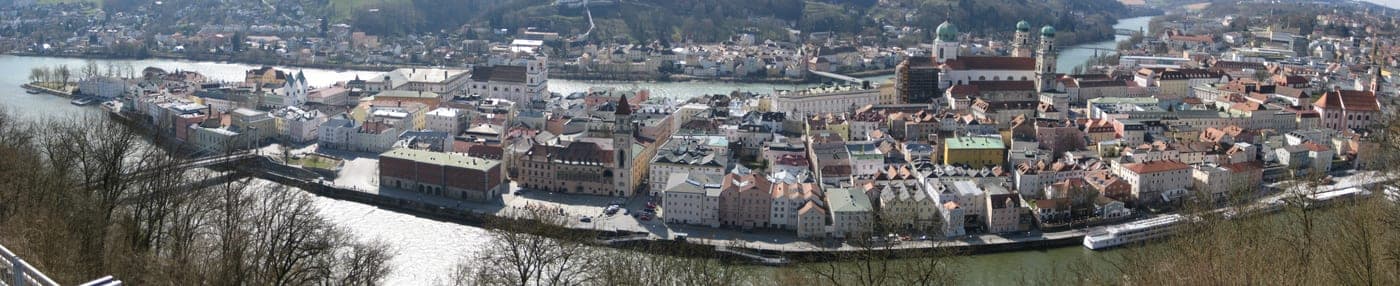

1 region
 Cabins31 destinations
Bavaria
Bavaria is Germany's largest state, and one of its most varied. In the south, the land rises into the Alps, with peaks above Berchtesgaden and Garmisch-Partenkirchen, and lakes such as the Chiemsee and the Königssee nearby. Further north, the hills flatten into the Franconian wine country, where Silvaner and Müller-Thurgau vines cover slopes above the Main river. Between these two landscapes sit market towns, river cities, and castle villages that reward slow attention. Munich, the state capital, has its beer gardens, its baroque churches, and its markets selling Weißwurst in the morning. But much of Bavaria's character lives outside the capital, in places built for a quieter pace. Regensburg, on the Danube, keeps a medieval old town of narrow lanes, stone bridges, and merchant houses that once served river trade. Bamberg spreads across seven hills and several arms of the Regnitz river, and is known for its smoked Rauchbier, brewed in local taverns much as it always has been. Rothenburg ob der Tauber sits inside its own medieval walls, with half-timbered houses and a walkway along the ramparts that circles the whole old town. Franconia, in the north, is Bavaria's wine country. Vineyards climb the terraces above Würzburg and along the Main, and small wine villages sell their own vintages from cellar doors and courtyard taverns. The wine here is usually bottled in the round Bocksbeutel flask, a shape associated with the region. Cycling paths follow the river through the vines, linking one village to the next at an easy, level pace, past chapels, wine presses, and stone crosses set among the rows. In the Allgäu, close to the Austrian border, the town of Füssen sits below the castle hill of Neuschwanstein, built by King Ludwig II in the nineteenth century. The castle draws attention, but the surrounding countryside holds its own appeal: lakes, foothills, and villages where farming and dairy traditions continue much as before. Bavaria's lakes add another layer of slowness. The Chiemsee, the largest, can be crossed by boat to its island monasteries, where former royal buildings and quiet cloisters sit surrounded by water and reed beds. Smaller lakes near the Alpine foothills, such as the Staffelsee and the Ammersee, are ringed by paths used for walking and cycling rather than for speed. Food and drink run through the region's identity. Beer gardens, some centuries old, work on a simple principle: food brought from home, a beer ordered at the counter, a seat under chestnut trees for as long as the weather allows. Franconian taverns serve local wine alongside dishes built around potatoes, dumplings, and river fish. Bakeries sell pretzels still warm from the oven, and markets in towns like Nuremberg keep old traditions of spiced gingerbread and roasted sausages. A morning market in Regensburg, an afternoon among the Franconian vines, an evening in a Bamberg tavern: each has its own pace. Villages across Bavaria keep their own customs — wine festivals in Franconia, woodcarving and dairy traditions in the Alpine foothills. Mountains and vineyards, river cities and castle villages: Bavaria fits them into a single state, each within reach of the next.
CabinsCastlesHikingCamper Van Rentals