Salzwedeler Baumkuchen
The spit-baked tree cake from Salzwedel with protected status
- Vegetarian
- Local name
- Salzwedeler Baumkuchen
- Best eaten at
- A Salzwedel Baumkuchen café
- Pairs with
- Coffee
What it is
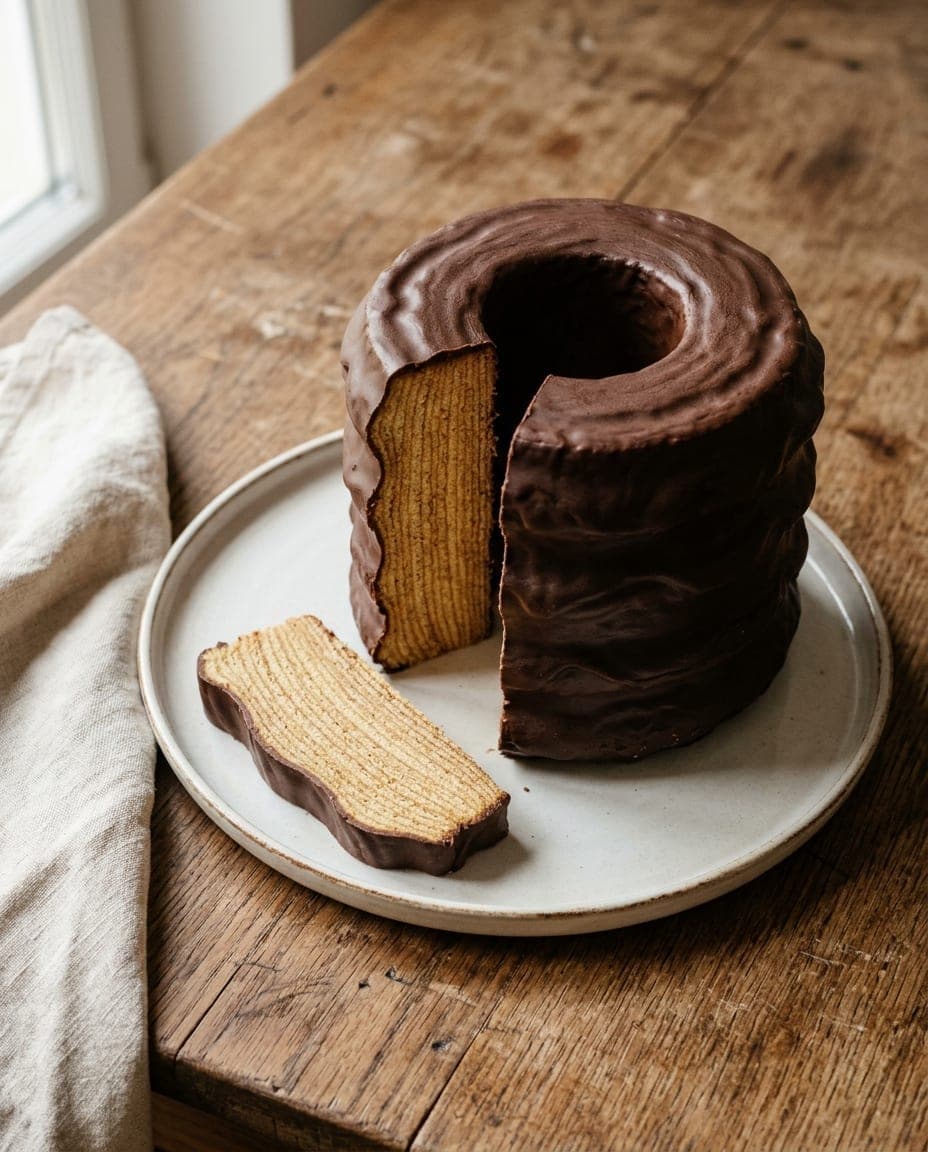
Salzwedeler Baumkuchen is a cylindrical cake defined by its concentric rings, which resemble the growth rings of a felled tree. The name translates literally as "tree cake", though the local form carries a specific geographical weight. It comes from the town of Salzwedel in the Altmark region of Saxony-Anhalt, where its recipe tradition is traced back to 1807. Unlike most cakes that rise in a tin, this one is baked on a rotating spit in front of an open fire.
The texture is distinct: dense yet moist, with alternating bands of light sponge and darker, caramelised crust formed by the direct heat. The process requires constant attention, as each layer must be poured onto the turning roller and browned before the next one is added. This method creates a cake that is difficult to replicate without specialised equipment. It is not merely a confection but a regional emblem, protected since 2010 by an EU protected geographical indication (PGI) that restricts the name to cakes baked within the town of Salzwedel.
The spit and the flame
The defining feature of this cake is how it comes into being. A roller turns on a spit in front of an open fire inside a brick oven, heated by wood or gas. The baker pours or ladles a thin layer of batter over the roller as it turns, allowing that layer to brown before adding the next. This cycle repeats many times, typically somewhere between ten and twenty, depending on the desired size of the cake.
An ordinary baking oven cannot reproduce this result, because the heat must strike the moving surface directly while the batter sets in thin sheets. Because the batter is applied by hand, it runs and drips slightly as the roller turns, giving Salzwedel cakes their irregular, "wild" rings. The process is labour-intensive and requires a skilled hand, so the cake commands a higher price than standard baked goods.
A history of layers
The origins of Baumkuchen are tied to the broader history of German pastry making, and no single inventor is recorded. In Salzwedel, the story usually begins with a recipe written down in 1807 by a journeyman confectioner, Johann Andreas Schernikow, on which local production is still based. The name Salzwedeler Baumkuchen is first documented in 1843.
From the late 19th century, Salzwedel's bakers produced the cake in large quantities and shipped most of it to customers far beyond the town, turning a local craft into a well-known mail-order speciality. Production continued after the Second World War, through the years of the GDR, when shortages sometimes forced bakers to replace butter with margarine.
The protected geographical indication formalised a tradition that had existed for two centuries. It prevents bakers outside the designated area from using the name Salzwedeler Baumkuchen and requires every stage of production to take place in Salzwedel. It sits alongside a small group of other protected German baked goods and sweets, such as Aachener Printen and Nürnberger Lebkuchen.
What goes into it
The ingredients are simple but require high quality to achieve the correct balance between the light sponge and the caramelised layers. Each bakery has its own variation, but the core components remain consistent:
- A rich batter: Butter, egg yolks, sugar and flour, with whisked egg whites folded in and a little flavouring.
- The layers: Each coat is applied thinly so the cake cooks through without burning, resulting in the characteristic rings when sliced.
- The coating: The finished cake is usually covered in white sugar fondant or chocolate.
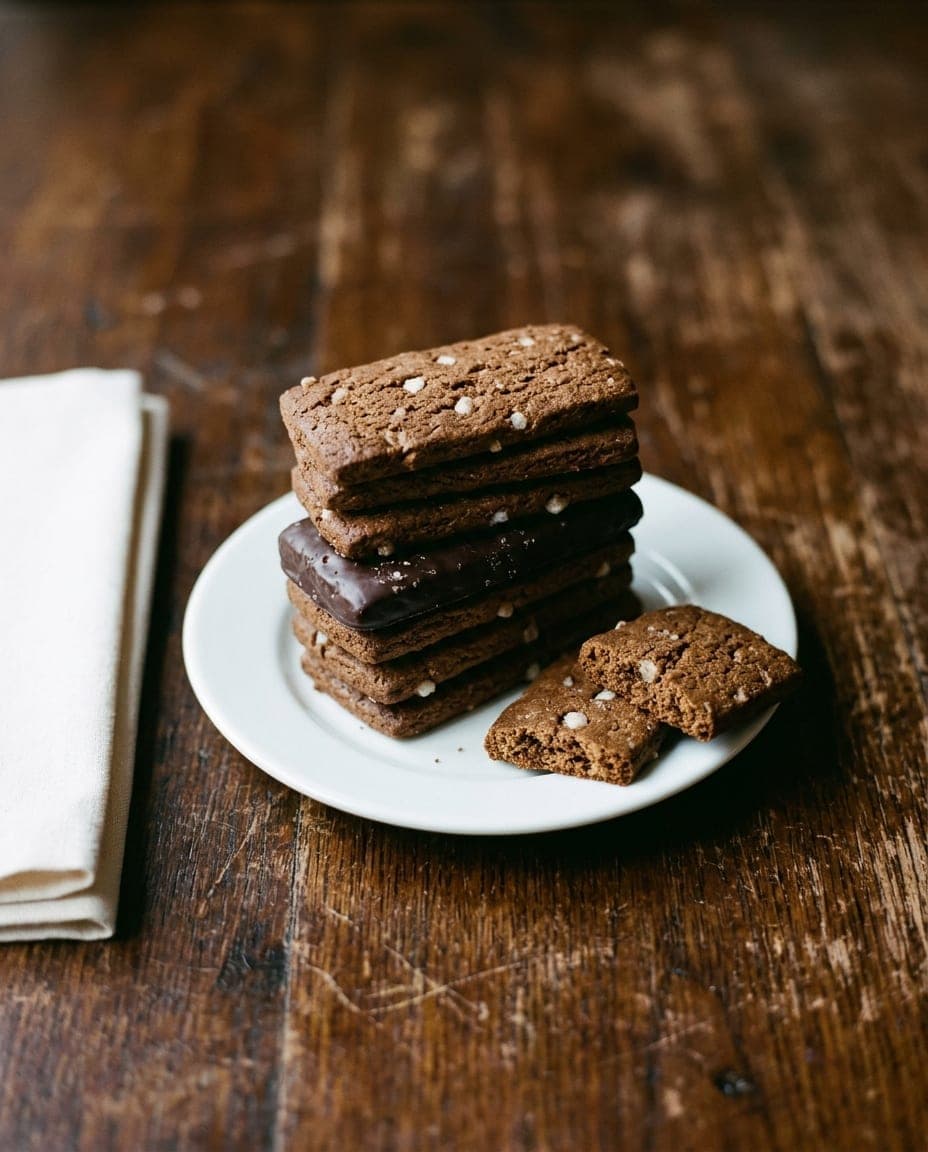
- Tips and bars: Offcuts and smaller pieces are sold as chocolate-coated Baumkuchenspitzen (tips) and bars.
The cake contains no preservatives and is sold fresh. The exterior offers a thin, sweet shell over the soft, buttery interior, and the texture can vary slightly from one baker to another, but the visual signature of the rings remains constant.
How it is eaten and when
Salzwedeler Baumkuchen is traditionally served as a treat with afternoon coffee. The cake is sold as whole rings or in pieces, and it is usually cut into thin slices that show off the layers clearly.
A café in Salzwedel is the natural place to try it, with a hot coffee as the standard accompaniment to balance the sweetness of the coating. During the winter months, particularly around Christmas, the cake becomes a popular gift, often wrapped in decorative packaging and sent to friends and family.
Curious facts
- A protected name. Only cakes baked in Salzwedel according to the registered specification can legally be called Salzwedeler Baumkuchen.
- Fire, not tin. The open fire and rotating spit are essential; a conventional oven cannot replicate the caramelisation of the layers.
- Hand-poured batter. Each layer is applied by a baker as the roller turns, giving the cake its irregular rings.
- Shipped far and wide. By the late 19th century, most of the town's Baumkuchen was sent to customers outside Salzwedel.
- A winter favourite. It is especially popular as a Christmas gift.
- Visual rings only. The name comes from the tree-ring appearance of the cross-section, not from any use of wood or fruit in the batter.
Where to try it
The most authentic experience is in Salzwedel itself, where several cafés in the old town specialise in this cake. Some bakeries bake on site, allowing visitors to watch the rotating spit in action. Outside Salzwedel, similar Baumkuchen are made across Germany, but only those baked in the town may carry its name.
Where to try it
1 region
 Boat Rentals1 destination
Saxony-Anhalt
Saxony-Anhalt is a historically rich region known for its diverse landscapes and cultural heritage. It is home to the Harz Mountains, offering scenic hiking trails and charming towns like Wernigerode and Quedlinburg, a UNESCO World Heritage site with well-preserved medieval architecture. The region's largest city, Magdeburg, features the stunning Cathedral of St. Maurice and St. Catherine. Notably, Saxony-Anhalt is recognized for its wine production along the Saale-Unstrut wine route. The region is also famous for the Bauhaus movement's roots in Dessau, where the iconic Bauhaus School was founded. Festivals celebrating local traditions abound throughout the year, providing unique insights into regional culture.
Boat RentalsHiking