Obatzda
A Bavarian beer-garden spread of mashed camembert, butter and paprika
- Vegetarian
- Local name
- Obazda
- Served with
- Pretzel, radish
- Best eaten at
- A Bavarian beer garden
- Pairs with
- Weißbier or Helles
What it is
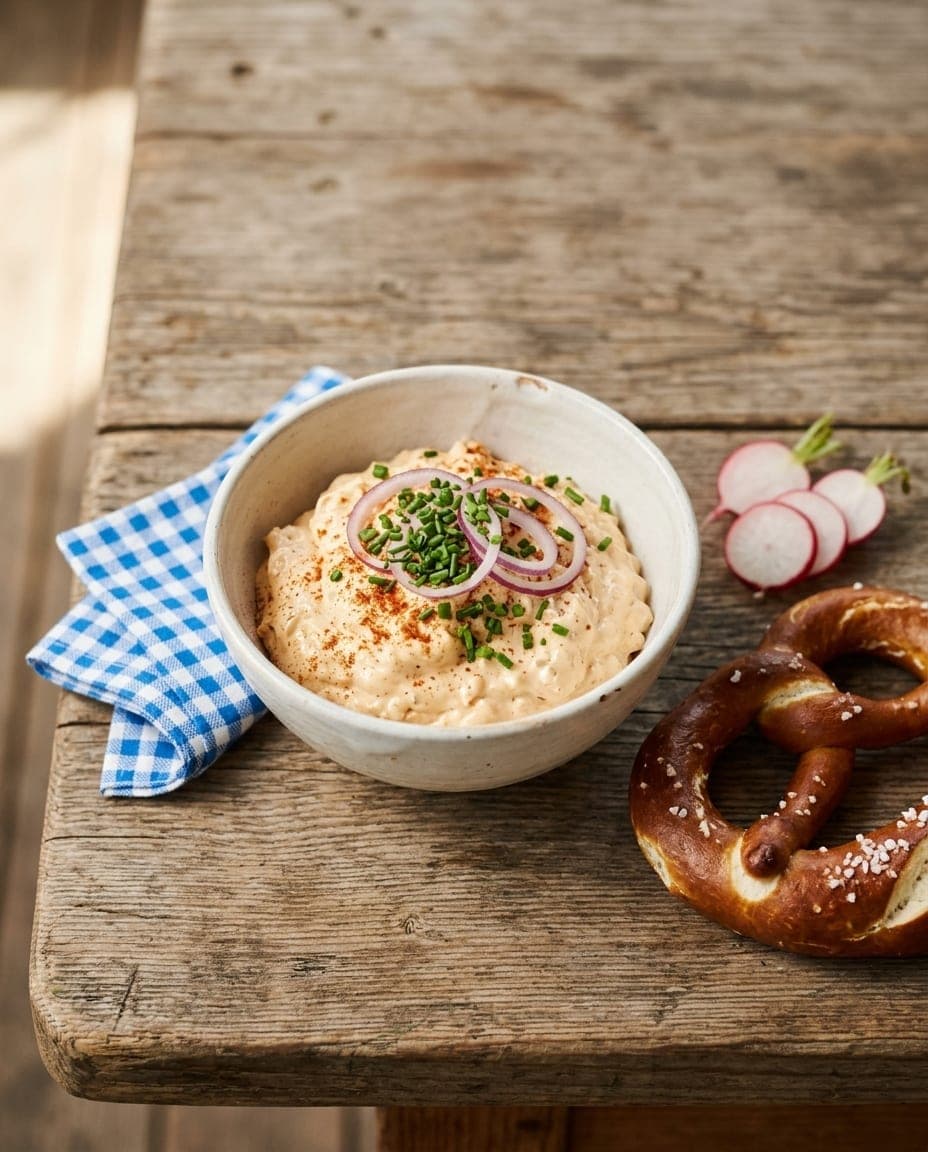
Obatzda, often spelled Obazda in its local dialect form, is a soft, savoury cheese spread that defines the atmosphere of a Bavarian beer garden. It is not a delicate appetiser or a refined garnish for a fine dining table. Instead, it is a hearty, rustic mixture eaten at long wooden tables or on benches under chestnut trees. The texture is coarse and creamy rather than smooth, with a bright orange-pink colour that comes from the addition of paprika.
The dish is a staple of Bavarian summer evenings and year-round gatherings, often shared from a bowl in the centre of the table. Its origins lie in practicality rather than high cuisine: it is generally explained as a way to use up over-ripe Camembert that was too soft to sell. By mashing the cheese with butter and spices, a cook could turn a potential waste product into a popular and flavourful spread.
A Bavarian origin story
The most widely repeated account places its creation in Freising, a town north of Munich, during the 1920s. The story credits Katharina Eisenreich, landlady of the Bräustüberl Weihenstephan from 1920 to 1958, with serving her guests a mixture of cheese, butter and spices from the early 1920s onwards.
The attribution rests largely on local tradition, and similar ways of mashing leftover cheese were probably made in many households before it. What is clear is that the dish spread from Freising to beer gardens across Bavaria, becoming so associated with the region that "Obazda" (also "Obatzter") has been a protected geographical indication (PGI) in the EU since 2015.
The name itself offers a clue to its nature. Obazda is a Bavarian dialect word usually translated as "mashed up" or "mixed together". This reflects the method: taking soft ingredients and working them together until they form a unified, spreadable mass. It is a dish that values texture and flavour over presentation, often served in a simple bowl or on a wooden board.
What goes into it
There is no single recipe, and every beer garden has its own version. The base is always soft, ripe cheese, typically Camembert, sometimes with Brie or Romadur, that has been allowed to ripen fully until the interior is creamy. A common rule of thumb is two parts cheese to one part butter. The cheese is mashed until the lumps are broken down but the mixture remains coarse rather than silky smooth.
The other components are mixed in to bind the cheese and add depth:
- Butter, which provides a rich base that softens the sharpness of the ripe cheese.
- Paprika, usually sweet, responsible for the dish's distinctive orange-pink hue and mild, earthy flavour.
- Finely chopped onion, added raw to provide a sharp, pungent contrast to the creamy base.
- Caraway, used sparingly, whole or ground, to add a warm, slightly bitter note that complements the cheese.
- A splash of beer, often a local Weißbier or Helles, which loosens the mixture slightly and adds a malty depth.
Some variations include a little cream cheese or cream to adjust the texture, while others add garlic or horseradish for extra bite. The result is a spread that is salty, creamy and gently spiced, thick enough to hold its shape when scooped but soft enough to melt on the tongue. Because Camembert is often made with animal rennet, it is not reliably vegetarian.
How to eat it
Obatzda is eaten cold, never heated. It usually comes in a bowl or on a plate alongside large pretzels known as Brezn or slices of dark bread. The pretzel is commonly torn by hand into rough pieces for spreading or scooping.
The dish is often accompanied by radishes, either the small red kind or the long white Radi sliced into thin spirals and salted. Served raw, they provide a crisp, peppery contrast to the soft, rich spread. The combination creates a balance: the cool, creamy cheese and butter against the sharp bite of the onion and radish, all held together by the earthy paprika.
The best setting for eating Obatzda is a Bavarian beer garden, where it is made for sharing rather than solitary dining. Diners sit on long benches, often sharing a table with strangers. A glass of Weißbier or Helles is the usual companion, as the carbonation and gentle bitterness of the beer cut through the fat of the cheese and butter.
Curious facts
- A dialect name. The word Obazda comes from Bavarian dialect and is usually translated as "mashed up", describing the method rather than the ingredients.
- The colour comes from paprika. The bright orange-pink shade is not natural to the cheese but comes from paprika, which also adds a mild warmth.
- A protected speciality. "Obazda" and "Obatzter" are registered in the EU as a protected geographical indication for Bavaria since 2015.
- The onion remains raw. Unlike many cooked spreads, the chopped onion in Obatzda is added raw to retain its sharp, pungent bite against the soft cheese.
Where to try it
The most traditional setting for Obatzda is a Bavarian beer garden. These are found throughout the region, from Munich to the countryside around Freising and beyond. The dish is rarely the focus of high-end restaurants; it belongs to beer gardens and rustic taverns where long wooden tables stand under chestnut trees.
It is also a standard item on the Brotzeit (snack) menus of Bavarian inns and is sold ready-made at butchers' and cheese counters across the region. While the dish is available year-round, it is particularly popular during the warmer months when outdoor seating is open.
Where to try it
1 region
 Cabins31 destinations
Bavaria
Bavaria is Germany's largest state, and one of its most varied. In the south, the land rises into the Alps, with peaks above Berchtesgaden and Garmisch-Partenkirchen, and lakes such as the Chiemsee and the Königssee nearby. Further north, the hills flatten into the Franconian wine country, where Silvaner and Müller-Thurgau vines cover slopes above the Main river. Between these two landscapes sit market towns, river cities, and castle villages that reward slow attention. Munich, the state capital, has its beer gardens, its baroque churches, and its markets selling Weißwurst in the morning. But much of Bavaria's character lives outside the capital, in places built for a quieter pace. Regensburg, on the Danube, keeps a medieval old town of narrow lanes, stone bridges, and merchant houses that once served river trade. Bamberg spreads across seven hills and several arms of the Regnitz river, and is known for its smoked Rauchbier, brewed in local taverns much as it always has been. Rothenburg ob der Tauber sits inside its own medieval walls, with half-timbered houses and a walkway along the ramparts that circles the whole old town. Franconia, in the north, is Bavaria's wine country. Vineyards climb the terraces above Würzburg and along the Main, and small wine villages sell their own vintages from cellar doors and courtyard taverns. The wine here is usually bottled in the round Bocksbeutel flask, a shape associated with the region. Cycling paths follow the river through the vines, linking one village to the next at an easy, level pace, past chapels, wine presses, and stone crosses set among the rows. In the Allgäu, close to the Austrian border, the town of Füssen sits below the castle hill of Neuschwanstein, built by King Ludwig II in the nineteenth century. The castle draws attention, but the surrounding countryside holds its own appeal: lakes, foothills, and villages where farming and dairy traditions continue much as before. Bavaria's lakes add another layer of slowness. The Chiemsee, the largest, can be crossed by boat to its island monasteries, where former royal buildings and quiet cloisters sit surrounded by water and reed beds. Smaller lakes near the Alpine foothills, such as the Staffelsee and the Ammersee, are ringed by paths used for walking and cycling rather than for speed. Food and drink run through the region's identity. Beer gardens, some centuries old, work on a simple principle: food brought from home, a beer ordered at the counter, a seat under chestnut trees for as long as the weather allows. Franconian taverns serve local wine alongside dishes built around potatoes, dumplings, and river fish. Bakeries sell pretzels still warm from the oven, and markets in towns like Nuremberg keep old traditions of spiced gingerbread and roasted sausages. A morning market in Regensburg, an afternoon among the Franconian vines, an evening in a Bamberg tavern: each has its own pace. Villages across Bavaria keep their own customs — wine festivals in Franconia, woodcarving and dairy traditions in the Alpine foothills. Mountains and vineyards, river cities and castle villages: Bavaria fits them into a single state, each within reach of the next.
CabinsCastlesHikingCamper Van Rentals