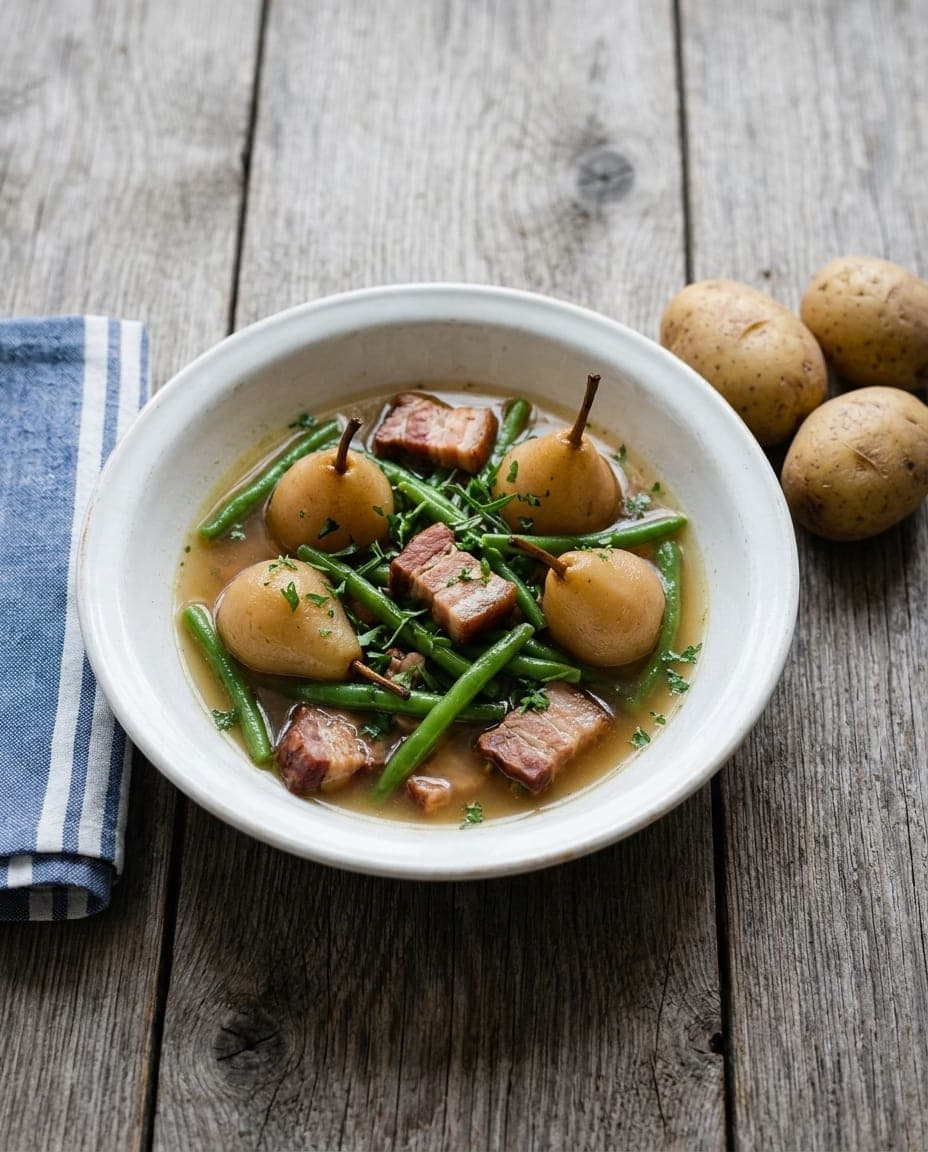
Mecklenburger Rippenbraten
A Mecklenburg pork rib roast stuffed with apples and prunes, a festive winter dish
- Local name
- Mecklenburger Rippenbraten
- Served with
- Red cabbage, potatoes
- Best eaten at
- A Mecklenburg family table in winter
- Pairs with
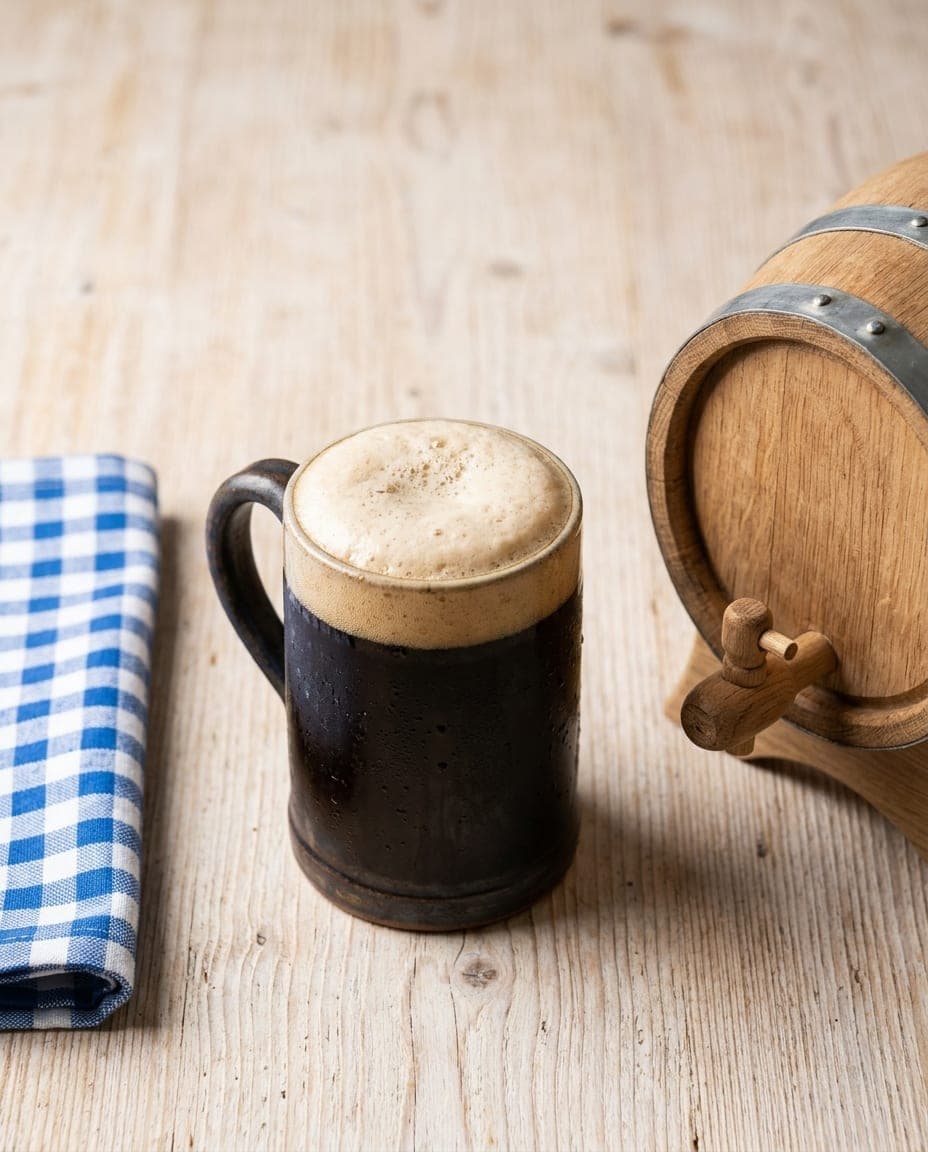
- German dark lager
What it is
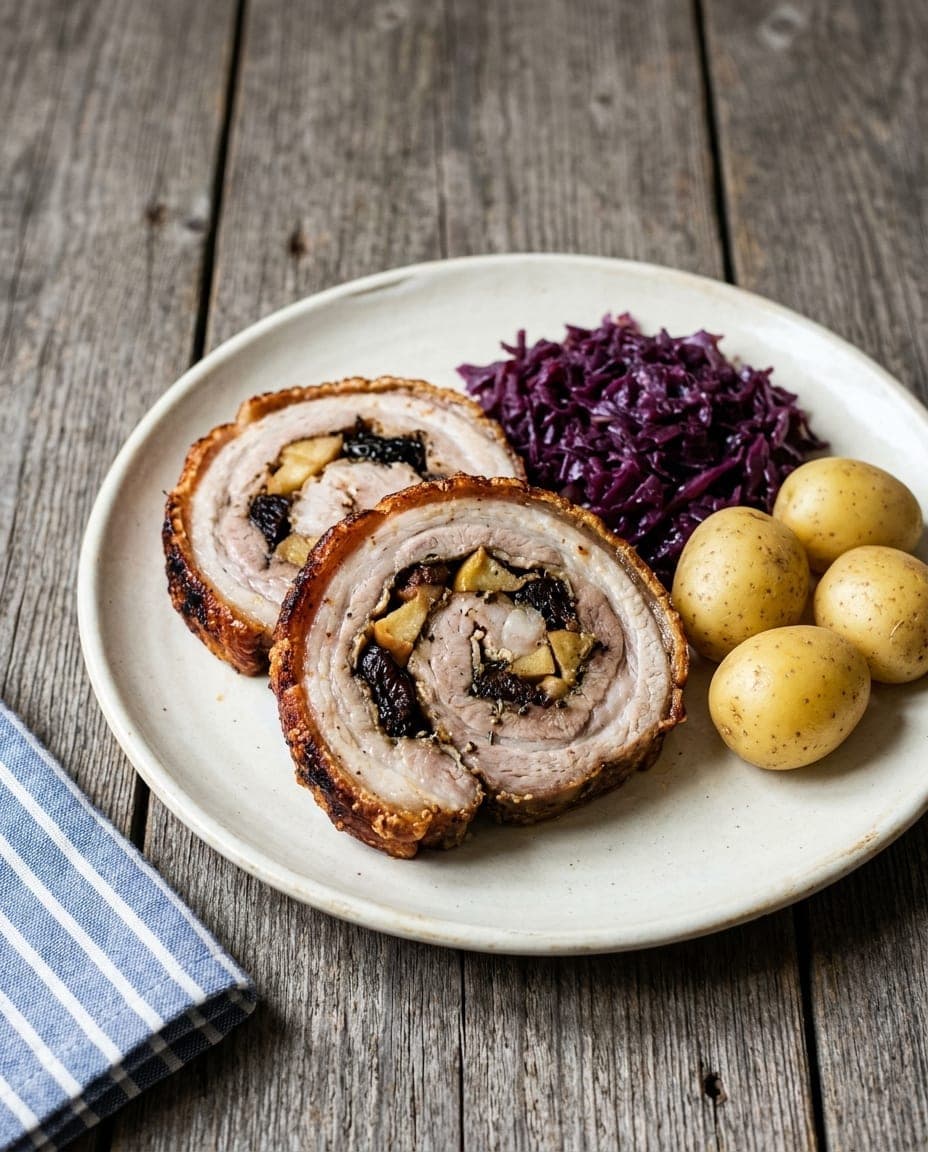
Mecklenburger Rippenbraten is a substantial roast of pork ribs with their meat and fat, originating from the north German state of Mecklenburg-Vorpommern. It is not a dish found on menus across Germany, but a regional speciality associated with the festive tables of Mecklenburg. The rib piece is cut between the bones without chopping through, folded or rolled around a filling of apple chunks and plump prunes, often bound with a little grated rye bread, then tied and roasted until the fat renders and the surface crisps.
The defining characteristic of this roast is the filling. As the meat cooks, the fruit inside softens and releases a sweet, fruity juice that mixes with the pork juices to create a distinctively aromatic gravy. This method distinguishes it from many southern German pork roasts, which often rely on beer or caraway seeds for their taste. The result is a savoury dish where the sweetness of the fruit balances the saltiness of the pork and the warmth of the seasoning.
Where it comes from
The dish belongs to the agricultural traditions of Mecklenburg, a region shaped by its farmland and its proximity to the Baltic Sea. The cooler, wetter climate favours hardy fruit trees like apples, and Mecklenburg cooking has long been fond of combining dried fruit with meat; the writer Carl Julius Weber noted that the people lived largely off potatoes, dried fruit, cabbage, turnips and beans. Prunes could be stored for months, providing a sweet contrast to the heavy winter meats when fresh fruit was unavailable.
In the south of Germany, pork is often cooked with beer and caraway, reflecting different culinary histories. In Mecklenburg, the pairing of meat with fruit became a regional signature, seen also in dishes such as Tüffel un Plum, potato soup with plums and bacon. The Rippenbraten is listed among the classic local specialities in towns such as Schwerin, and it is typically a roast for family gatherings and the winter holidays rather than an everyday meal.
How it is eaten
The roast is typically served as the centrepiece of a midday or evening meal, especially in the colder months. It arrives at the table cut into thick slices between the ribs, revealing the soft fruit filling within the layers of meat and fat. The usual accompaniments are red cabbage, cooked slowly with apples and spices, and either boiled potatoes or caramelised ones glazed in sugar and butter until golden.
The gravy is usually made from the pan juices and the fruit juices, creating a glossy sauce that coats the meat and vegetables. While the dish is rich, the acidity of the red cabbage cuts through the fat, balancing the palate. A glass of German dark lager suits it well, as the maltiness complements the roasted pork and the sweetness of the prunes without overpowering them.
What goes into it
The preparation relies on a few key ingredients that define the regional flavour:
- Pork rib piece: A joint with a good layer of fat to keep the meat moist during long roasting; some butchers sell it lightly cured.
- Apples and prunes: Fresh apple pieces and dried prunes provide the sweet fruit core inside the roast.
- Rye bread or rusk crumbs: Often added to bind the filling.
- Salt, pepper and spices: A pinch of cinnamon is common, though recipes vary.
- Red cabbage: Often cooked with vinegar or apple to add tartness.
- Potatoes: Boiled or caramelised to soak up the savoury juices.
Curious facts
- A northern signature. Unlike southern German pork dishes that use beer or caraway, this roast relies on fruit, reflecting the long-standing Mecklenburg taste for sweet-and-savoury combinations.
- A festive roast. The dish is most at home at winter family gatherings in Mecklenburg-Vorpommern.
- Fruit inside the meat. The apples and prunes are not a side dish but are placed directly inside the joint to infuse the pork with sweetness as it cooks.
- Ribs cut, not chopped. The bones are cut into so the rib piece can be folded into a pocket for the filling, but not chopped through.
- Gravy creation. The sauce is enriched by the fruit juices that escape from the meat during roasting, adding a distinctive depth to the dish.
Where to try it
The best place to experience Mecklenburger Rippenbraten is at a traditional family gathering or in a regional restaurant in Rostock, Schwerin or the smaller towns of Mecklenburg, particularly during the winter months. Many local inns and Gasthäuser in the region offer it as a speciality, often accompanied by the classic red cabbage and potato sides.
Where to try it
2 destinations
 Boat Rentals
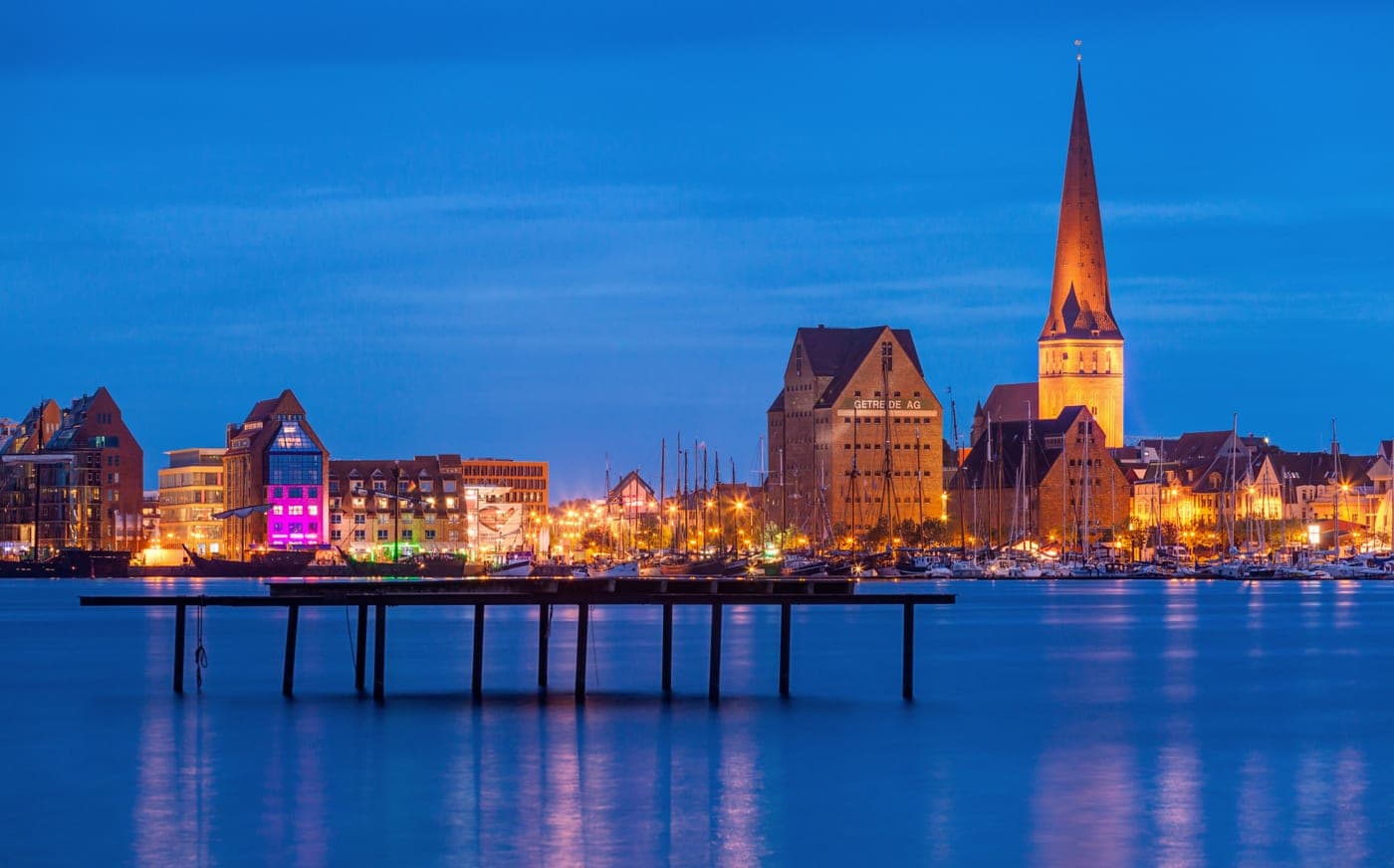
Rostock
Hanseatic Baltic port city with medieval gates and seaside suburb.
Boat RentalsHiking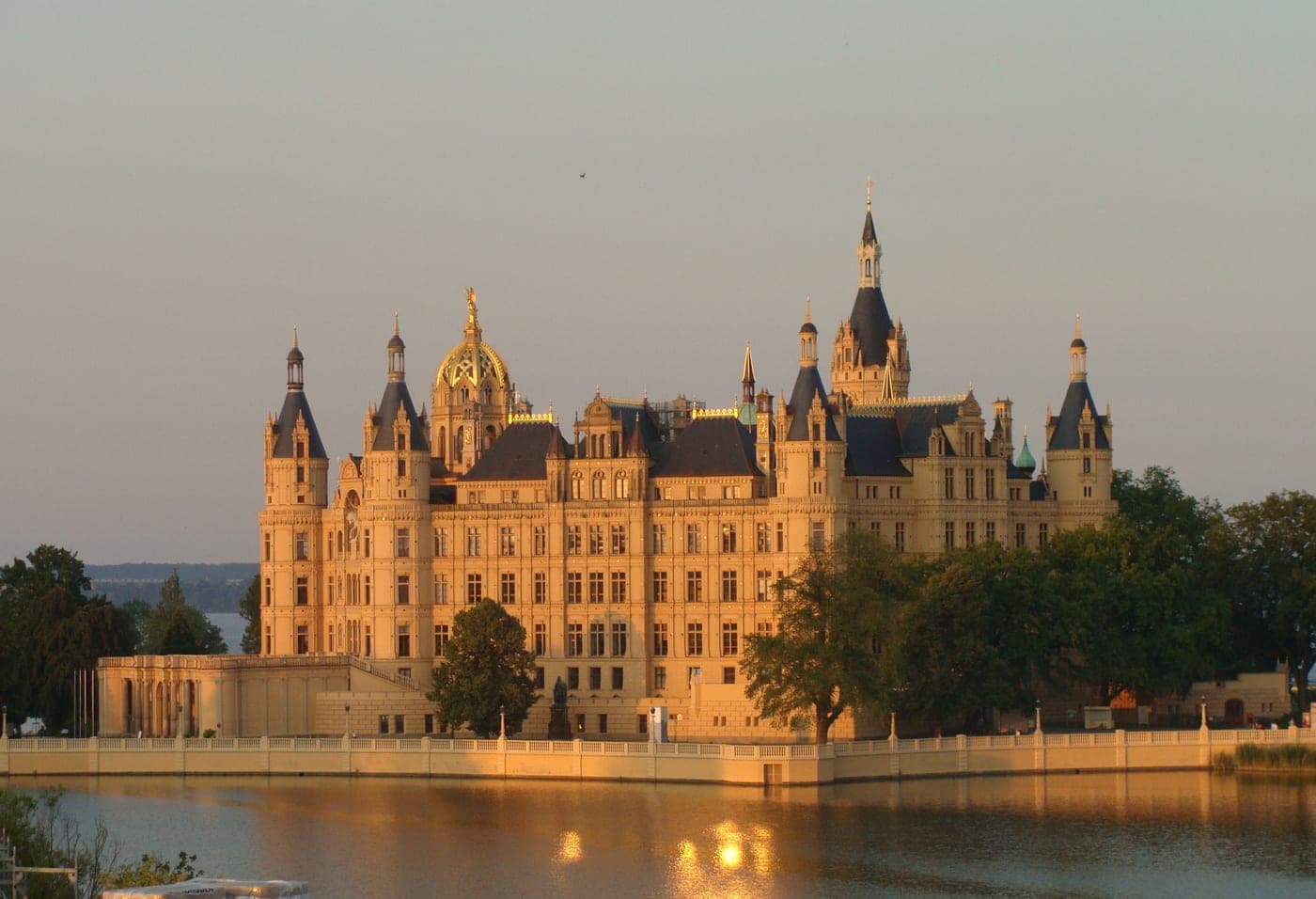 Boat Rentals
Schwerin
Charming lakeside town featuring a stunning castle and lush parks.
Boat RentalsHiking
1 region
 Boat Rentals11 destinations
Mecklenburg-Vorpommern
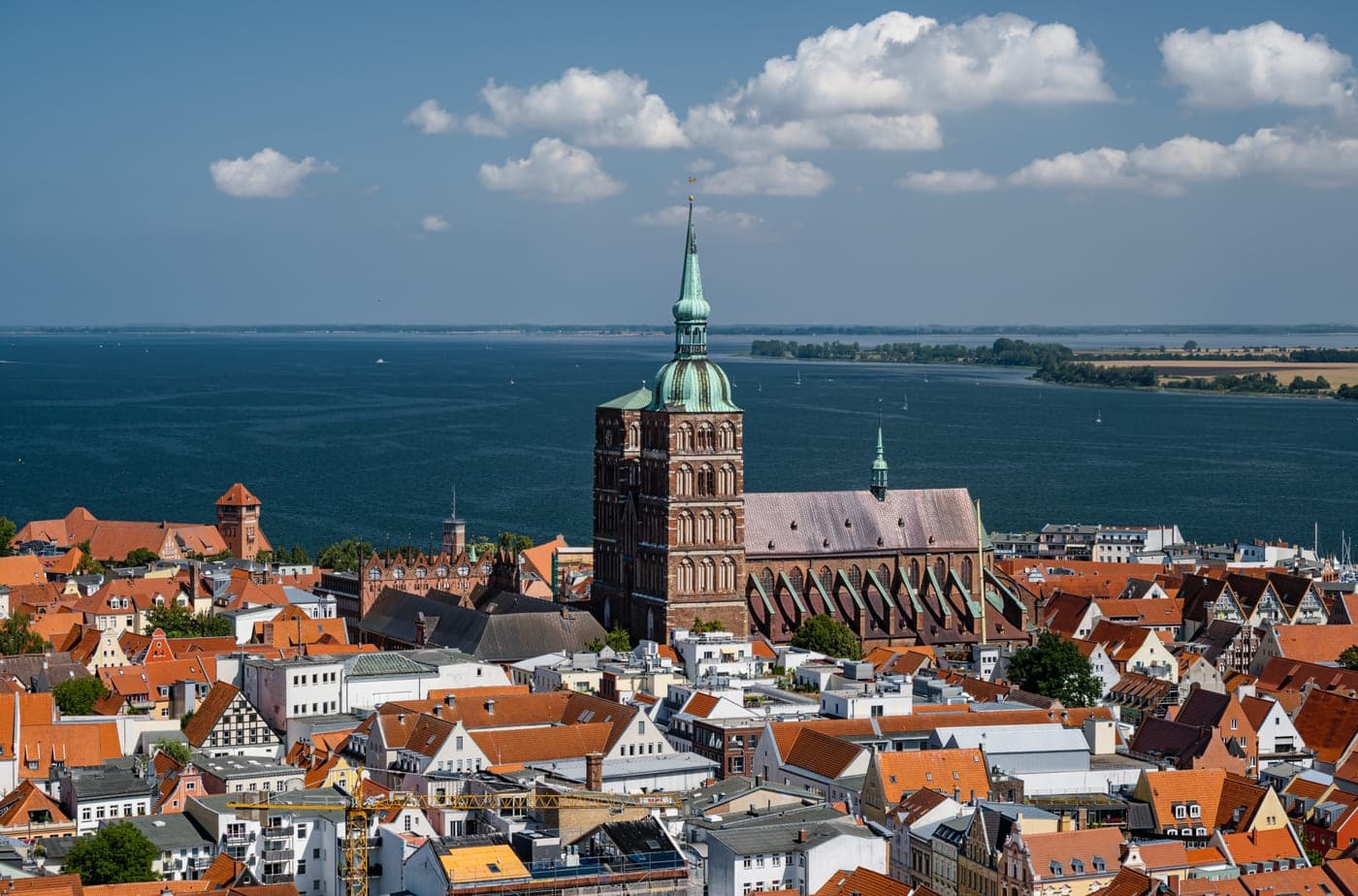
Mecklenburg-Vorpommern is the largest of Germany's federal states by area, reaching from the Baltic Sea inland across a landscape scattered with lakes. The name joins two historic regions: Mecklenburg in the west, long ruled from Schwerin, and Vorpommern, Western Pomerania, in the east, the German share of the old Baltic region of Pomerania that today continues into Poland. This eastern half is flat farmland and river estuaries, with the port towns of Stralsund and Greifswald. Rostock, the state's largest city, keeps a brick Gothic skyline around St. Mary's Church, with a harbour at Warnemünde where ferries, fishing boats, and sailing yachts share the same stretch of water. Stralsund and Wismar preserve step-gabled merchant houses and market squares built on the wealth of Baltic trade. Greifswald, a university town further east, shows the same red-brick churches rising above low rooflines. Inland, Schwerin's old town circles a castle built on an island in the middle of its own lake, now the seat of the state parliament. Behind the coast lies the Mecklenburg Lake District, where glacial lakes are strung together by narrow channels and canals. Müritz anchors a national park of reed beds, wet woodland, and open water. Small towns such as Waren, Röbel, and Plau am See sit at the water's edge, their harbours used by canoes and sailing boats moving between lakes. The Baltic coast itself turns rougher and more open. Rügen, Germany's largest island, rises into chalk cliffs at Jasmund National Park, where beech forest reaches the sea above the white rock face at Königsstuhl. The island's seaside resorts, Binz, Sellin, and Göhren among them, keep rows of nineteenth-century villas with wooden verandas, a style known locally as Bäderarchitektur. Usedom, shared with Poland at its eastern end, has a similar line of resort towns, Heringsdorf, Ahlbeck, and Bansin, strung along one long sand beach joined by a wooden pier. Between the two larger islands, Hiddensee stays low and quiet. Away from the resorts, the Fischland-Darß-Zingst peninsula keeps fishing villages shaped by the shallow Bodden lagoons that separate the peninsula from the mainland. Ahrenshoop grew into an artists' colony in the late nineteenth century and still keeps galleries in old captains' houses. The region's kitchens draw on both sea and lake: herring and sprat from the Baltic, pike and zander from inland waters, rye bread and potatoes as everyday staples, and a tradition of fish smoking in the coastal villages. Mecklenburger Rippenbraten, a slow-roasted pork dish, and beer from small regional breweries round out menus built for a cooler, maritime climate. Mecklenburg-Vorpommern holds together two different rhythms: the still water and reed beds of its lake district, and the open sand and chalk of its Baltic shore.
Boat RentalsHiking