Laugenbrezel (pretzel)
A lye-dipped knot from southern Germany with crisp skin and a soft heart
- Vegetarian
- Local name
- Laugenbrezel
- Served with
- Butter
- Best eaten at
- A Bavarian beer garden
- Pairs with
- Weißbier
What it is
The Laugenbrezel is a specific type of bread knot that defines the bakeries of Bavaria and Baden-Württemberg. It is recognised instantly by its dark mahogany skin and the coarse salt that clings to the surface. The name describes the process: Lauge means lye, a strong alkaline solution in which the dough is dipped before it enters the oven, while Brezel is the German word for the pretzel shape, usually traced back to the Latin brachium, "arm".
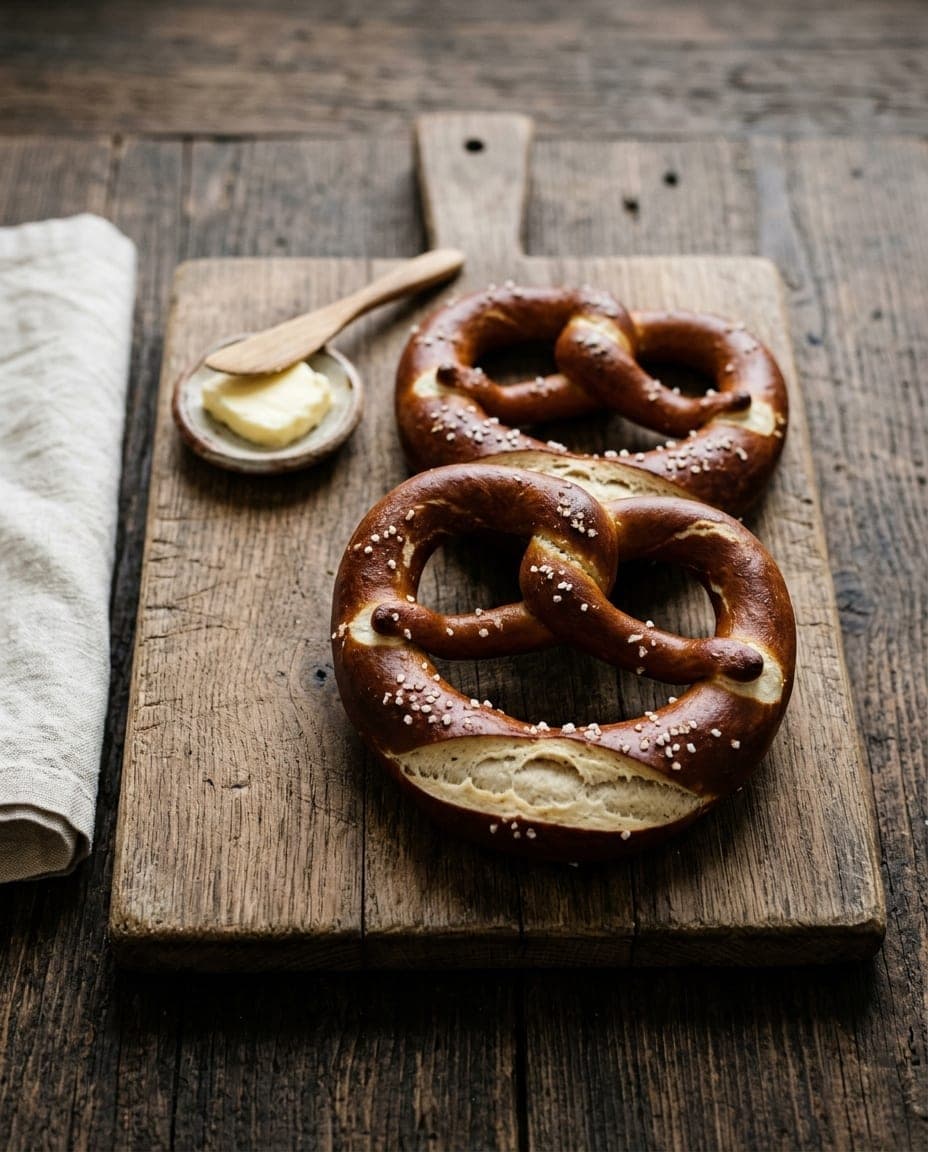
Unlike ordinary breads, the Laugenbrezel owes its deep brown hue and glossy sheen to the lye, which speeds up browning on the surface during baking. The exterior becomes thin, crisp and slightly chewy, while the interior remains soft and airy. The shape is a loop with two arms crossed over each other and pressed onto a thick "belly", the arms thinning towards the ends.
The Laugenbrezel is a staple of daily life in southern Germany, appearing in bakery windows from Munich to Stuttgart. It is sold fresh through the day and eaten at breakfast, as a snack or alongside a meal. While similar knots exist elsewhere in Europe, the southern German versions stand apart for their lye-dipped crust and their regional variations in shape and salting.
The history of the knot
The origin of the pretzel shape is often linked to monasteries. A popular legend says that monks shaped dough to resemble arms crossed in prayer, offering the breads as rewards. The story is widely told but remains folklore rather than documented fact. What is certain is that pretzels have been baked in German-speaking lands for many centuries, and the knot has long served as the emblem of bakers in southern Germany.
How and when bakers began dipping pretzels in lye is less clear. Both Munich and Swabia tell stories of an accidental discovery, but none can be confirmed. Today bakers use a dilute solution of food-grade sodium hydroxide.
The association between the pretzel and Bavaria's beer culture is strong. The salty, savoury Breze, as it is called there, is an obvious companion to Munich's beers, and the rise of the beer garden helped make it the ubiquitous symbol it is today. Since 2014 the Bayerische Breze has been an EU protected geographical indication, meaning pretzels sold under that name must be made in Bavaria.
How it is made
The defining step is the brief dip in a cold lye solution before baking. The lye promotes the browning reactions that create the dark crust and gives a subtle alkaline tang. The dough itself is simple, typically consisting of flour, water, yeast, salt, a little fat and sometimes a touch of malt.
Once the dough has been rolled out and twisted into the classic knot, it is dipped in the lye solution for a few seconds. This must be done with care, as the solution is caustic. The pretzels are then sprinkled with coarse salt, or sometimes with seeds, and placed in a hot oven, where the crust sets quickly while the interior expands.
In Swabia, a clean slash is made across the thick belly before baking, so that it opens neatly as it rises. The result is a bread with a distinct contrast: a shiny exterior that gives way to a soft, pale crumb.
Where it comes from
The Laugenbrezel is bound up with Bavaria and Baden-Württemberg, where it is considered a regional speciality as much as an everyday bread. The shape varies between the two: the Swabian Brezel has thin, crisp arms set high on a fat, neatly cut belly, while the Bavarian Breze has thicker arms and a belly that cracks open more rustically during baking.
In Munich and the surrounding countryside, pretzels are sold in every bakery, from small family-run shops to large bakery chains. They are also a fixture in beer gardens, where they are served alongside local beers and cheese spreads, and many visitors associate their taste with southern Germany itself.
How to eat it
The Laugenbrezel is best eaten fresh, ideally on the day it is baked. In Swabia it is often sliced lengthwise and spread with butter to make a Butterbrezel, a classic breakfast or mid-morning snack in which the salty crust and creamy butter balance each other.
In Bavaria it is a common accompaniment to Obatzda, a soft cheese spread made from Camembert, butter, onions and paprika, which is popular in beer gardens. It is also the traditional partner of Weißwurst, the white veal sausage customarily eaten before noon, though the pretzel is versatile enough to accompany many savoury dishes.
Curious facts
- The lye is transformed. During baking, the lye on the surface reacts and is converted into harmless compounds, so the finished pretzel is safe to eat.
- Two textures in one. The thin arms bake crisp, while the thick belly remains soft and airy inside.
- A regional rivalry. Swabians and Bavarians each defend their own shape, distinguished mainly by the thickness of the arms and the cut on the belly.
- Salt on top. Coarse salt is applied after dipping but before baking, creating a crunchy, savoury surface.
- Beer garden staple. The Breze is inseparable from Bavarian beer gardens, where it partners a cold Weißbier or other local brews.
Where to try it
The most authentic experience of the Laugenbrezel is found in a Bavarian beer garden or a traditional bakery in Munich, Augsburg or Stuttgart. These are everyday places where locals stop for breakfast, lunch or an evening drink, and the pretzels are often sold still warm from the oven.
A simple warm Laugenbrezel with butter offers a taste of southern German tradition that is both accessible and bound up with local culture.
Where to try it
2 regions
 Camper Van Rentals12 destinations
Baden-Württemberg
Baden-Württemberg fills Germany's southwest corner, from the Rhine plain in the west to the limestone plateau of the Swabian Jura in the east. The land moves in slow shifts here: vineyard slopes give way to dense forest, forest opens onto grassland and cave country, and everything eventually settles toward the wide, calm water of Lake Constance in the south. It is a region built for a wandering pace, town by town, valley by valley. Wine gives much of the region its rhythm. On the Upper Rhine, the volcanic hill of the Kaiserstuhl holds terraced vineyards that catch unusually strong sun for Germany, and small growers here work Spätburgunder and Grauburgunder grapes into wines poured in village Weinstuben. South of it, the Markgräflerland carries its own soft vineyard hills toward the Swiss border, linked by paths that wind through the vines from one wine village to the next. Near Stuttgart, the Neckar valley holds the Württemberg wine region, where Trollinger and Lemberger vines grow on steep terraces braced by dry stone walls that vintners still mend by hand. East of the Rhine, the Black Forest rises into ridges of spruce and fir, its valleys dotted with timber farmhouses under heavy, sloping roofs. Clockmaking has never quite left these villages, and workshops still turn out cuckoo clocks in the old way. Freiburg im Breisgau sits at the forest's western edge, its old town threaded by small open channels called Bächle that run past the cathedral square and into the surrounding lanes. Further into the hills, half-timbered towns such as Gengenbach keep market squares lined with houses that lean gently with age, and Fasnet carnival traditions bring out carved wooden masks each winter. Castles mark the region's high points. Heidelberg's red sandstone ruin looks down over the Neckar and the baroque rooftops of the old town below, its terraces a well-known spot for watching the river. Further south, Hohenzollern Castle sits on a steep, isolated hill at the edge of the Swabian Jura, its towers visible above the surrounding farmland long before the castle comes fully into view. Smaller fortress towns between the two hold quieter versions of the same story, with gatehouses and keeps built into hillsides above vineyards or forest. Tübingen keeps its own slow tradition on the Neckar, where flat-bottomed Stocherkahn boats are punted along the river below a row of tall, colourful houses. Students and residents share the same narrow lanes that have shaped the town for generations. South and east of Tübingen, the Swabian Jura opens into limestone grassland, sheep pasture, and juniper heath, cut through by dry valleys and cave systems that draw walkers onto marked trails. At the region's southern edge, Lake Constance spreads into a broad expanse of water shared with Switzerland and Austria. Orchards, vineyards, and small harbour towns line its shore, where fishing boats still go out early. Reed beds and level paths follow much of the water's edge, giving long, flat stretches for walking or cycling between towns without losing sight of the lake. Festivals mark the region's calendar as much as its landscape does. Wine villages hold harvest festivals in autumn, serving new wine alongside onion tart in courtyards strung with lights. Winter brings Fasnet, with its carved masks and processions through Black Forest towns. Spring and summer bring open-air concerts in castle courtyards and vineyard walks led by local growers. Bicycles and walking boots suit this region well. Marked cycling routes follow the Rhine plain past vineyards and orchards, climb gradually into Black Forest valleys beside running streams, and trace the Lake Constance shore through reed beds and harbour towns. Hiking paths cover the same ground more slowly, crossing vineyard terraces, forest ridges, and Jura grassland, and often link one small town to the next without a long detour. Each part of Baden-Württemberg keeps its own version of this slow character: a wine village square in the Kaiserstuhl, a castle terrace above the Neckar, a quiet stretch of Bodensee shore, a forest clearing where the only sound is water moving somewhere close by.
Camper Van RentalsBoat RentalsHikingCabins Cabins31 destinations
Bavaria
Bavaria is Germany's largest state, and one of its most varied. In the south, the land rises into the Alps, with peaks above Berchtesgaden and Garmisch-Partenkirchen, and lakes such as the Chiemsee and the Königssee nearby. Further north, the hills flatten into the Franconian wine country, where Silvaner and Müller-Thurgau vines cover slopes above the Main river. Between these two landscapes sit market towns, river cities, and castle villages that reward slow attention. Munich, the state capital, has its beer gardens, its baroque churches, and its markets selling Weißwurst in the morning. But much of Bavaria's character lives outside the capital, in places built for a quieter pace. Regensburg, on the Danube, keeps a medieval old town of narrow lanes, stone bridges, and merchant houses that once served river trade. Bamberg spreads across seven hills and several arms of the Regnitz river, and is known for its smoked Rauchbier, brewed in local taverns much as it always has been. Rothenburg ob der Tauber sits inside its own medieval walls, with half-timbered houses and a walkway along the ramparts that circles the whole old town. Franconia, in the north, is Bavaria's wine country. Vineyards climb the terraces above Würzburg and along the Main, and small wine villages sell their own vintages from cellar doors and courtyard taverns. The wine here is usually bottled in the round Bocksbeutel flask, a shape associated with the region. Cycling paths follow the river through the vines, linking one village to the next at an easy, level pace, past chapels, wine presses, and stone crosses set among the rows. In the Allgäu, close to the Austrian border, the town of Füssen sits below the castle hill of Neuschwanstein, built by King Ludwig II in the nineteenth century. The castle draws attention, but the surrounding countryside holds its own appeal: lakes, foothills, and villages where farming and dairy traditions continue much as before. Bavaria's lakes add another layer of slowness. The Chiemsee, the largest, can be crossed by boat to its island monasteries, where former royal buildings and quiet cloisters sit surrounded by water and reed beds. Smaller lakes near the Alpine foothills, such as the Staffelsee and the Ammersee, are ringed by paths used for walking and cycling rather than for speed. Food and drink run through the region's identity. Beer gardens, some centuries old, work on a simple principle: food brought from home, a beer ordered at the counter, a seat under chestnut trees for as long as the weather allows. Franconian taverns serve local wine alongside dishes built around potatoes, dumplings, and river fish. Bakeries sell pretzels still warm from the oven, and markets in towns like Nuremberg keep old traditions of spiced gingerbread and roasted sausages. A morning market in Regensburg, an afternoon among the Franconian vines, an evening in a Bamberg tavern: each has its own pace. Villages across Bavaria keep their own customs — wine festivals in Franconia, woodcarving and dairy traditions in the Alpine foothills. Mountains and vineyards, river cities and castle villages: Bavaria fits them into a single state, each within reach of the next.
CabinsCastlesHikingCamper Van Rentals