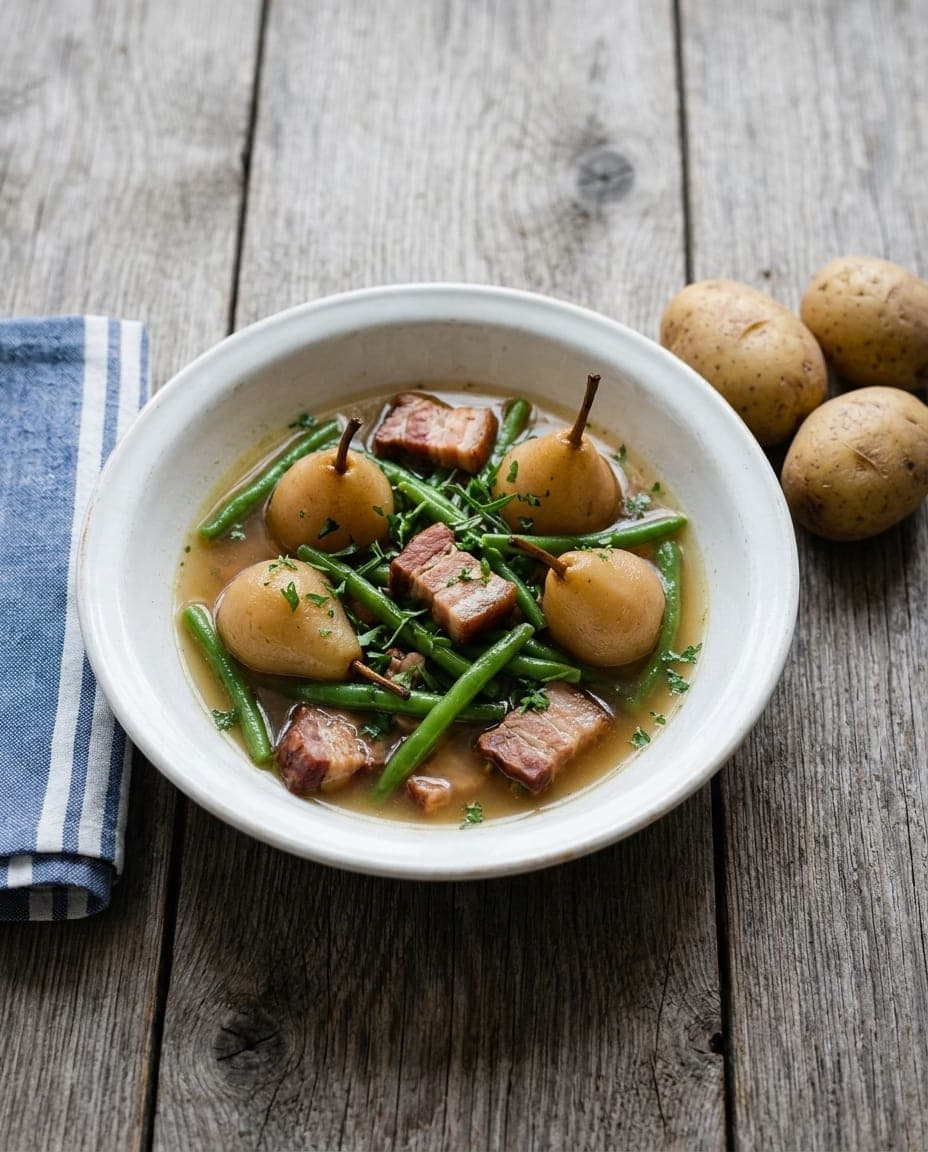
Holsteiner Katenschinken
Cold-smoked ham from Schleswig-Holstein's farmhouse smokehouses
- Local name
- Holsteiner Katenschinken
- Served with
- Dark bread, butter
- Pairs with
- Pils or Korn
What it is
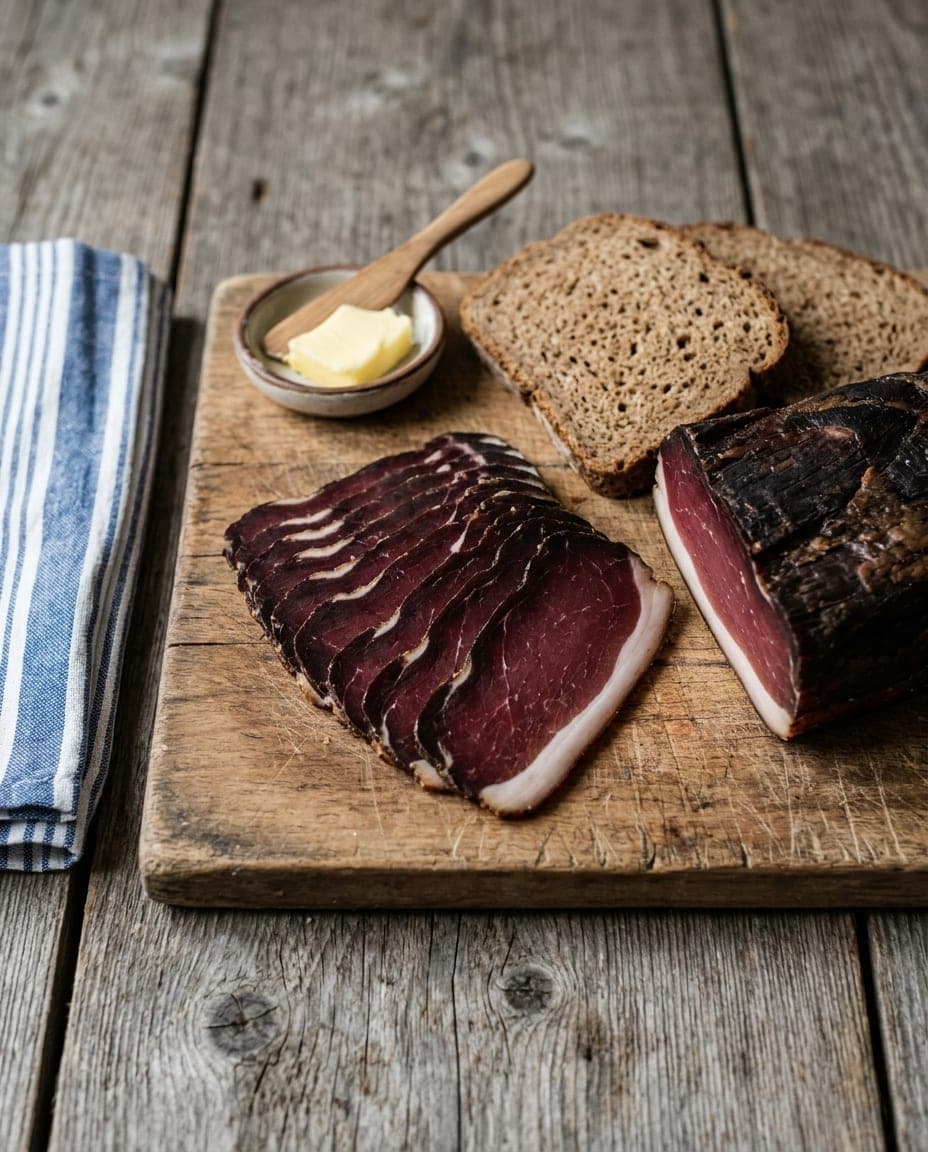
Holsteiner Katenschinken is a cured ham from the northern German state of Schleswig-Holstein. The name translates roughly as "cottage ham", pointing directly to its origin: the Kate, a traditional rural house in which hams were smoked. Unlike many regional hams that rely on heat or speed, this product is defined by patience. It is dry-salted by hand and then hung in cool beechwood smoke for weeks or even months.
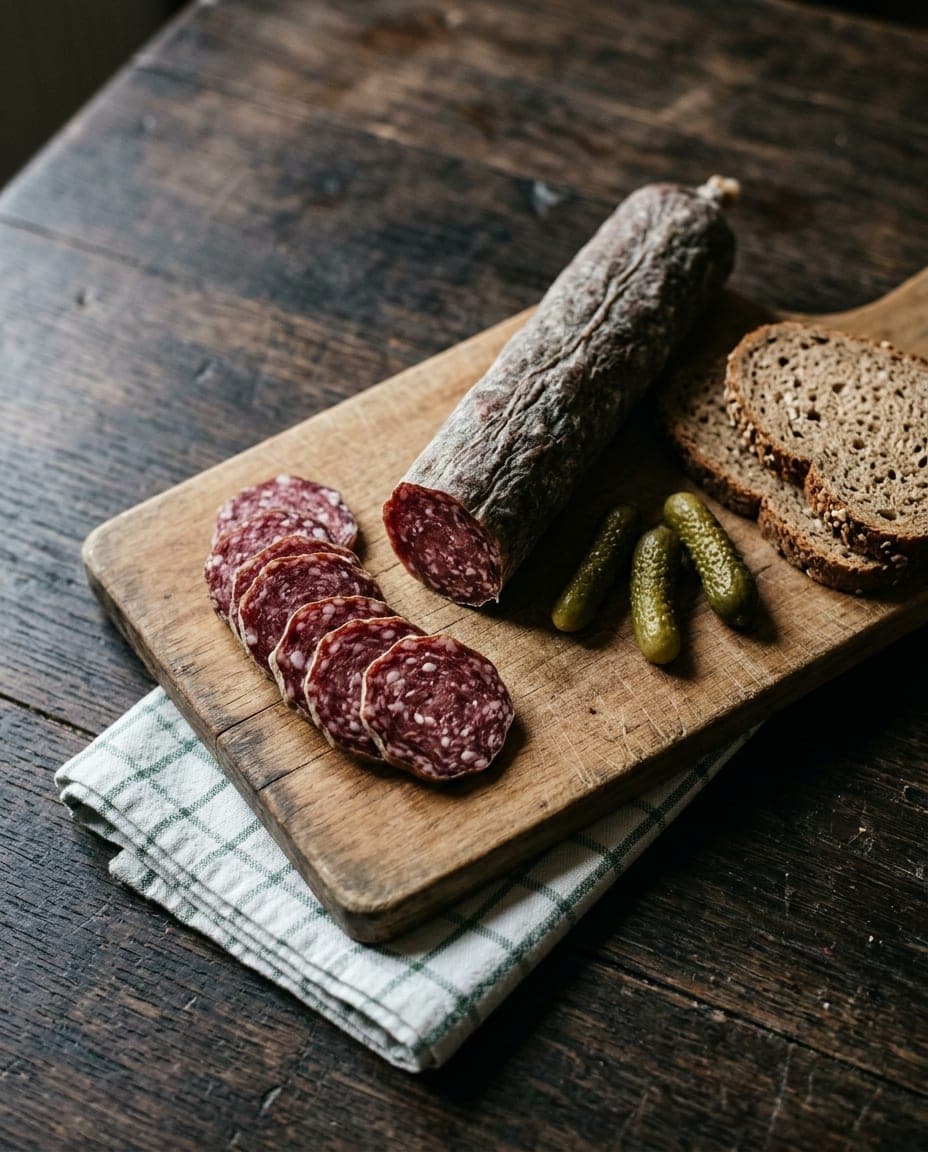
The result is a ham with a dark rind and meat that is deep red, lightly marbled, firm and distinctly smoky. The texture is dense rather than soft, and it is best sliced thinly. It remains a regional speciality tied to the smoking traditions of Schleswig-Holstein, and since 2012 the name has been protected in the EU as a geographical indication.
The smoke of the Kate
The defining feature of this ham is the Kate. In rural Schleswig-Holstein, the traditional farmhouse was a hall house without a chimney: smoke from the open hearth drifted up through the building and out under the roof, curing the hams hung in it. Later, dedicated smokehouses known as Räucherkaten were built on the same principle, and the slow, cold smoking gave the meat its characteristic flavour without cooking it.
The hams are rubbed with a salt mixture and rest in a cool curing room for several weeks, then they are exposed to smoke from mainly beechwood at temperatures that must not exceed 25 °C. Depending on the season, smoking can last up to six months, and the whole process takes at least four months. The low temperatures ensure that the fat does not melt away, preserving the texture while allowing the smoky aroma to penetrate deep into the muscle. Under the protected name, salting, smoking and maturing must all take place in Schleswig-Holstein.
How it is eaten
Holsteiner Katenschinken is almost always served cold. It is a fixture of the northern German cold table. The ham is sliced thinly and placed on dark bread, often rye or a dense mixed-grain loaf, with a generous layer of butter.
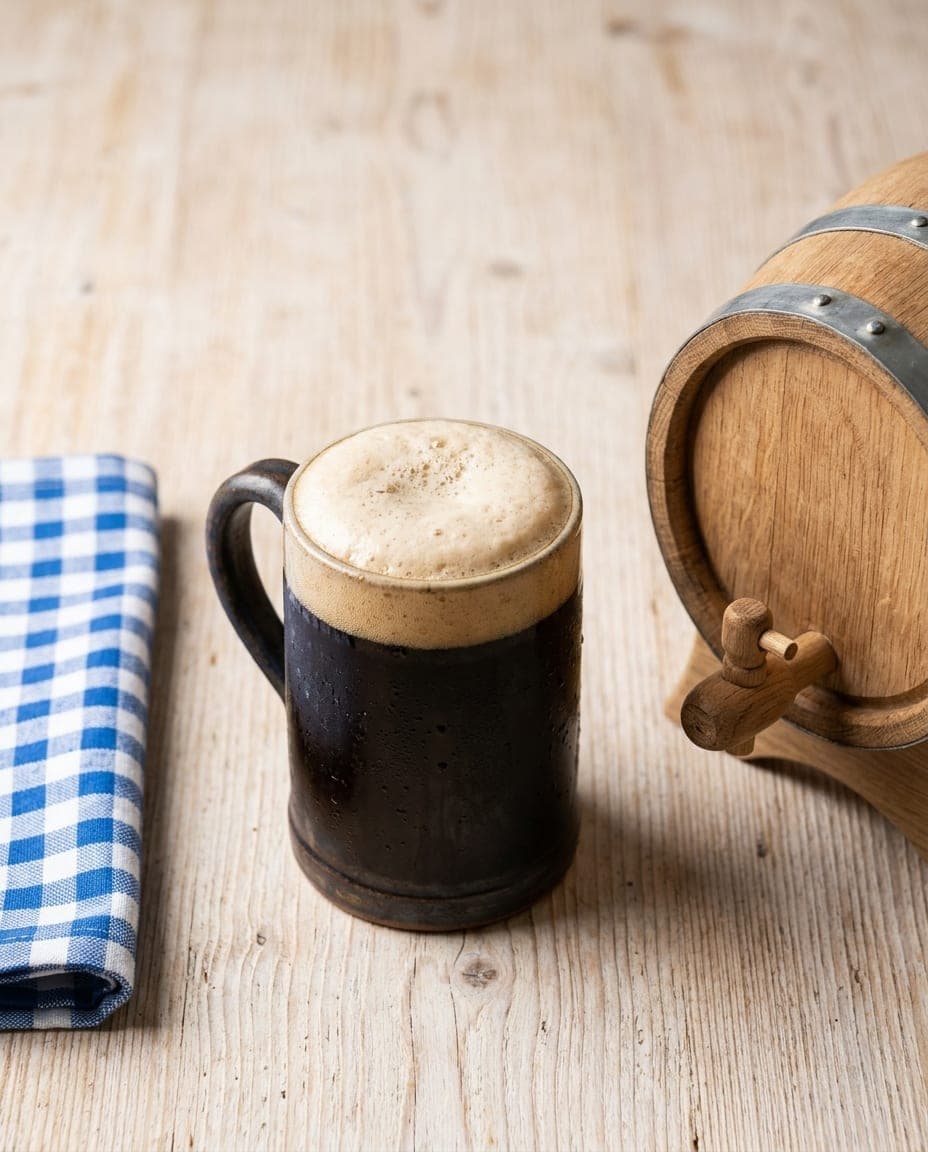
The combination is simple but substantial. The saltiness and smoke of the meat are balanced by the creaminess of the butter and the earthy texture of the dark bread. It is not typically eaten as part of a hot meal. Instead, it appears on the table alongside other cold cuts, cheeses and pickles. A glass of Pils or Korn is a traditional companion, helping to cut the fat of the cured meat.
Where to find it
The best place to seek out Holsteiner Katenschinken is in Schleswig-Holstein itself, particularly in the Holstein countryside, where several traditional smokehouses still work in the old way and sell directly to visitors. It is also found in farm shops, local delicatessens and at markets across the state.
The ham is often sold in whole pieces or thick slabs that are sliced to order. It is a product that rewards slow travel; the effort to find it in its place of origin adds to the experience of tasting it.
Curious facts
- The name comes from the house. The word Kate refers to the small rural house or smokehouse in which the hams were cured in smoke.
- An old export. The earliest written record dates from 1608, when ham from the region was sent to the Danish king Christian IV.
- Cool smoke only. The smoking room must stay below 25 °C, so the ham is flavoured by smoke without being cooked.
- Protected status. The name Holsteiner Katenschinken has been a protected geographical indication since 2012, so only hams salted, smoked and matured in Schleswig-Holstein can use it.
- A cold table staple. It is rarely served hot; its role is firmly as part of the cold buffet.
Where to try it
1 destination
1 region
 Boat Rentals6 destinations
Schleswig-Holstein
Schleswig-Holstein sits between two seas, and that fact shapes everything about its pace. On the west side, the Wadden Sea pulls back twice a day, leaving wide flats of mud and sand where oystercatchers and seals gather. On the east, the Baltic keeps a calmer shoreline, cut by narrow fjords called Förden that reach inland past reed beds and small fishing harbors. Between the two coasts lies a quieter inland belt of moraine hills, beech woods and lakes known as Holsteinische Schweiz, where the land rolls gently toward small lakes rather than open sea. Lübeck is the region's best-known town, its old core built by Hanseatic merchants and still arranged around brick gabled houses, a river harbor and the twin towers of the Holstentor gate. Marzipan making has been a local craft here for generations, and the smell of almond paste still drifts from shopfronts near the market square. A short distance north, Flensburg carries a different character: its harbor front and old rum warehouses point to centuries of trade with Norway and Denmark, and Danish is still spoken by a minority in town. Schleswig, at the head of the Schlei fjord, keeps an old layer of the region's history, with Gottorf Castle, now home to the state museums, facing the cathedral across the water. Villages in Schleswig-Holstein tend to sit low against the horizon, red brick and thatched roofs blending into flat fields or dike grass. Along the North Sea coast, dikes double as footpaths and cycling routes, running for long stretches with the sea on one side and grazing sheep on the other. The flatness of the land makes cycling an easy way to move between villages, small harbors and the ferry piers that link the mainland to the islands. Sylt, Föhr and Amrum lie offshore within the Wadden Sea National Park, each with its own character: Sylt is known for its dune landscape and thatched Frisian houses, Föhr keeps a quiet, agricultural feel around village greens and old churches, and Amrum holds an extensive dune area. Inland, the lake district around Plön and Eutin offers a different kind of water travel. Small passenger boats cross the lakes between beech forests, and Plön sits below its own castle, overlooking the water from a wooded hill. Eutin keeps a baroque palace and gardens open for slow walking. Further west, the town of Husum sits by its own tidal harbor, and each spring the palace garden there fills with crocus blooms. Kiel, the state capital, faces the Baltic directly and turns into a sailing city every summer during Kieler Woche. Things to do in Schleswig-Holstein tend to build from the coastline itself: watching the tide uncover the Wadden Sea flats, following a dike path between two fishing harbors, crossing an inland lake by small boat, or walking a fjord town's quay while gulls work the fish stalls. Herring and eel appear often on menus near the coast, and Labskaus, a hearty dish of corned beef, potato and beetroot, remains a Baltic port staple. The region rewards attention to weather and tide as much as to any single sight — mudflats change completely between low and high water, and light on the Baltic coast shifts quickly with the wind. Markets, harbor cafés and small guesthouses set the rhythm here more than any schedule does. Whether the starting point is Lübeck's brick lanes, Flensburg's Danish-flavored harbor, or a quiet island church on Föhr, Schleswig-Holstein holds together as one landscape of tide, wind and water, best taken in a village or a shoreline at a time.
Boat RentalsHikingCamper Van RentalsLocal Cuisine