Frankfurter Grüne Soße
Cold sauce of seven herbs served with eggs and potatoes in Frankfurt
- Vegetarian
- Local name
- Frankfurter Grie Soß
- Served with
- Boiled eggs, potatoes
- Best eaten at
- A Sachsenhausen apple-wine tavern
- Pairs with
- Apfelwein (Ebbelwoi)
What it is
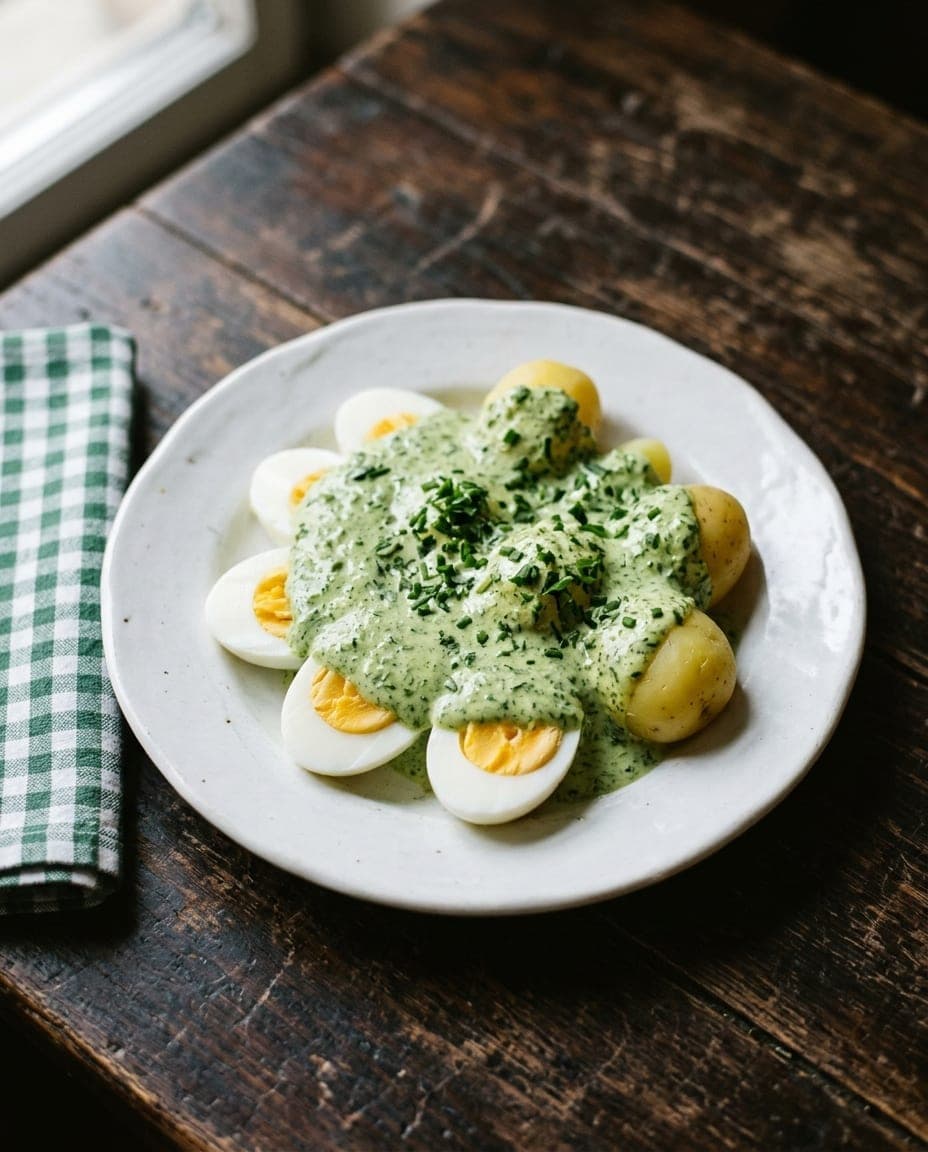
Frankfurter Grüne Soße, known locally as Frankfurter Grie Soß, is a cold green sauce that defines the culinary identity of Frankfurt am Main and the surrounding part of Hesse. It is not a dressing for salad, nor a garnish in the way a mustard or horseradish might be. It is a substantial, creamy sauce made from seven fresh herbs, chopped finely and folded into a base of soured dairy and egg. The result is a cool, herbaceous sauce that sits alongside boiled potatoes and hard-boiled eggs as a traditional spring meal.
The dish belongs to the season rather than the calendar year. Fresh herbs reach Frankfurt markets in March and remain available until autumn, but the traditional day to eat it is Maundy Thursday (Gründonnerstag), widely regarded as the start of the green sauce season. Since 2016, the herb mixture sold as Frankfurter Grüne Soße has been protected in the EU as a Protected Geographical Indication (PGI).
The seven herbs
The identity of the dish rests on its ingredients. The classic bundle contains seven varieties: borage, chervil, garden cress, parsley, salad burnet (Pimpinelle), sorrel and chives. In Frankfurt markets, these are sold together, wrapped in white paper. Under the PGI rules for the herb mix, all seven must be present and no single herb may make up more than 30 per cent of the weight.
Each herb contributes a distinct note to the final flavour. Borage adds a cucumber-like freshness, while sorrel provides a sharp, lemony acidity that cuts the richness of the dairy base. Chervil brings a hint of aniseed, chives a mild onion note, cress a peppery bite, parsley an earthy freshness and salad burnet a gentle, nutty depth. The combination is fresh yet savoury, unlike other green sauces found in Germany or beyond.
The herbs are chopped as finely as possible, almost into a paste, before being mixed into the base. This typically consists of sour cream, Schmand, yoghurt or quark, often with oil, vinegar, salt and sometimes a touch of mustard. Many traditional versions also add chopped hard-boiled eggs, or mash the yolks into the sauce, which gives it body. The entire preparation happens cold; no heat is ever applied to the herbs or the finished sauce.
How it is eaten
Frankfurter Grüne Soße is rarely served as a starter. It is the centrepiece of a spring lunch, traditionally paired with boiled potatoes and hard-boiled eggs that are halved and placed in the dish. The sauce surrounds the eggs and coats the potatoes, so the cool herbs meet the warm, starchy elements. It also accompanies boiled beef, schnitzel or fish, though the egg and potato combination remains the best-known presentation.
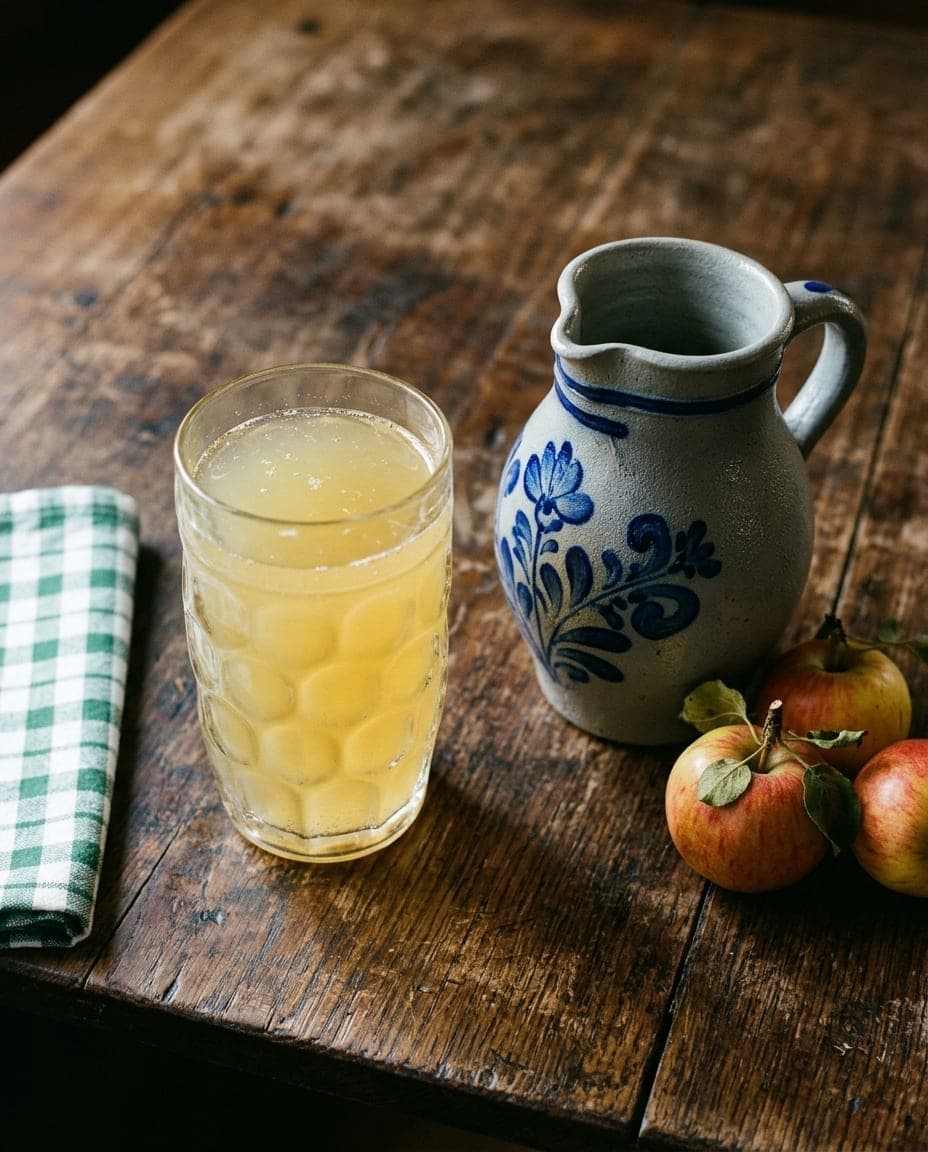
The meal is often enjoyed at an apple-wine tavern (Äppelwoi-Wirtschaft), above all in the Sachsenhausen district of Frankfurt. These are unpretentious neighbourhood taverns where apple wine is poured from the grey-and-blue stoneware jug known as a Bembel. The tart apple wine and the sharp, herby sauce are natural companions on the menu.
The custom of eating green sauce on Maundy Thursday is often linked to the old practice of eating green food on that day at the end of Lent, possibly influenced by the German name of the day. While the religious observance has faded for many, the culinary habit remains strong.
Where it comes from
The roots of Frankfurter Grüne Soße lie in the market gardens surrounding Frankfurt am Main, particularly in the district of Oberrad, which is closely associated with growing the seven herbs. The PGI covers the herb mixture rather than the finished sauce: at least 70 per cent of the herbs must be grown in Frankfurt or in the towns directly bordering the city.
The city has embraced the sauce as its own. Local markets display the paper-wrapped herbs prominently during the season, and the sight of them is a sign that spring has arrived. Goethe, Frankfurt's most famous son, is frequently cited in local lore as having loved the dish, though there is no evidence that he even knew it.
Curious facts
- Seven herbs, strict rules. The protected herb mix must contain borage, chervil, cress, parsley, salad burnet, sorrel and chives, with no single herb exceeding 30 per cent.
- A cold preparation. The herbs are never cooked. They are chopped raw and mixed into a cold base to preserve their fresh flavour.
- The Maundy Thursday link. The dish is traditionally eaten on Gründonnerstag, the informal start of the green sauce season.
- Sachsenhausen connection. The apple-wine taverns of Sachsenhausen are among the classic places to eat the sauce.
- A protected name. Since 2016 the Frankfurt herb mix has been an EU Protected Geographical Indication.
- Goethe's preference. Local tradition holds that Johann Wolfgang von Goethe was a fan of the sauce, though there is no evidence for it.
Where to try it
To eat Frankfurter Grüne Soße in its truest form, Frankfurt am Main is the place, specifically the Sachsenhausen district. Here, apple-wine taverns serve the sauce with boiled potatoes and eggs alongside their apple wine. These are not fancy restaurants but simple neighbourhood spots where locals gather for lunch.
The best time to visit is in spring, when the markets are full of the seven-herb bundles and the taverns are busy with people celebrating the start of the season. A meal here is a simple affair: a bowl of the sauce, boiled potatoes, halved hard-boiled eggs and a glass of local apple wine.
Where to try it
1 destination
 Camper Van Rentals
Frankfurt am Main
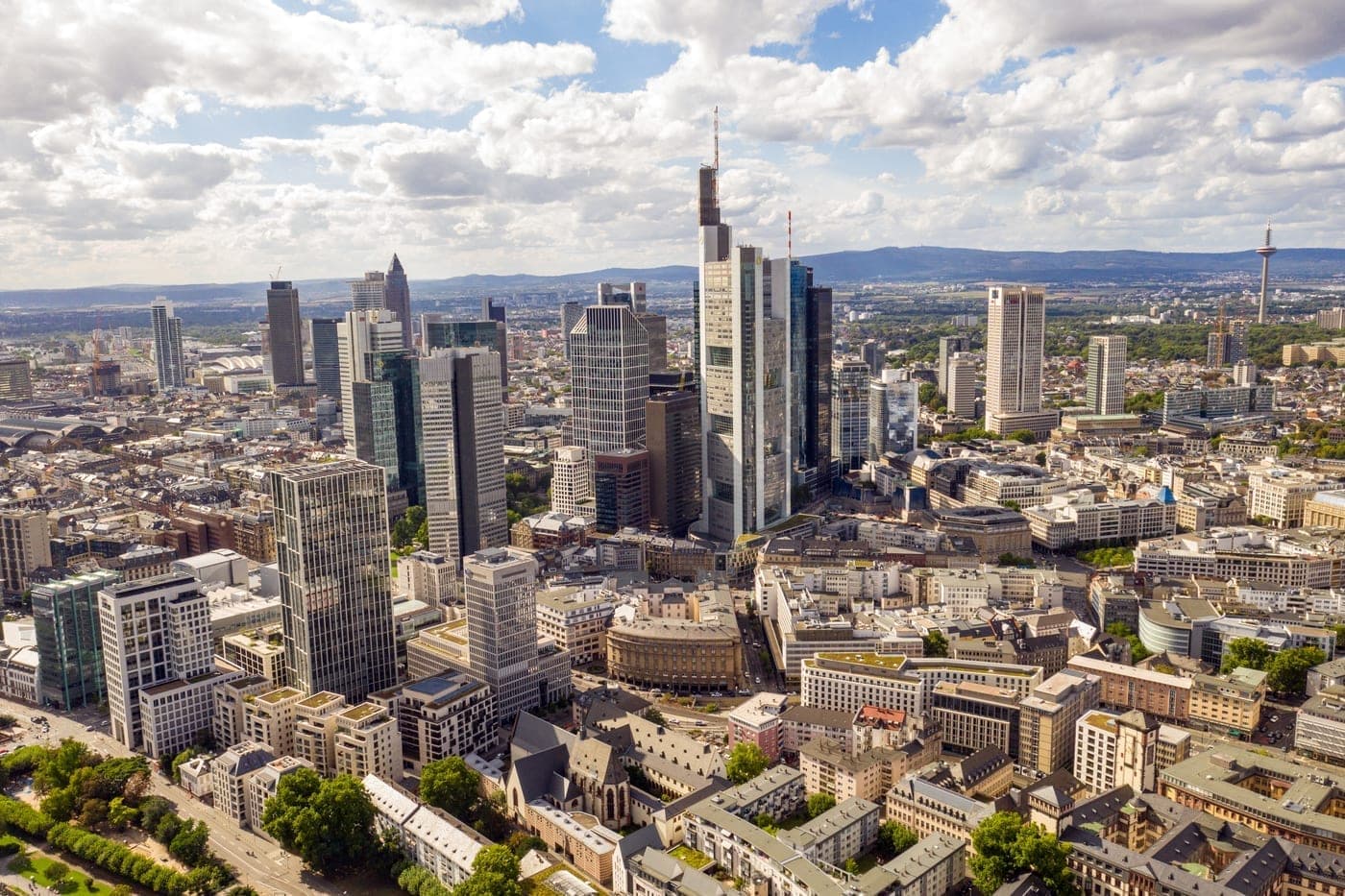
Financial hub with reconstructed old town, museums, and apple wine taverns
Camper Van RentalsHiking
1 region
 Castles5 destinations
Hesse
Hesse sits at the middle of Germany, and its landscape shows that in-between position clearly: river valleys lined with vineyards, forested hills that rise into proper mountain trails, and old market towns that never grew into cities. The pace here is set by the land itself. Along the Rhine, in the district known as the Rheingau, steep slopes have carried vines for centuries. Riesling is the grape that defines the area, grown on terraces above towns such as Rüdesheim, Eltville, and Geisenheim, where the river bends and the hills catch the afternoon sun. Marked cycling paths follow the water through the vine rows, past wine presses and small cellar doors that open onto the lane in season. Wiesbaden, the state capital, grew up around its hot springs. The Romans built baths here, and the town's spa culture never really stopped afterward — the same warm mineral water still rises through the ground and feeds the fountains and bathhouses that give the old streets their elegant, slightly formal air. Wide boulevards, stucco façades, and a domed casino all belong to that same spa-town character. Darmstadt, not far south, took a different path. At the start of the twentieth century, a group of artists and architects built the Mathildenhöhe colony there, a hillside cluster of houses, studios, and a wedding tower designed as a single artistic statement. The result is unlike anything else nearby: Jugendstil curves, mosaic tiles, and gardens laid out to match the buildings around them. To the north, the Taunus range folds into wooded ridges and open summits, with the Feldberg as its high point. Paths climb through beech forest and break out onto grassy tops with views back down toward the Rhine and Main valleys. At the foot of the range, Bad Homburg keeps its own spa tradition, with a park landscaped around mineral springs and a Kurhaus at its centre. Marburg lies along the Lahn river, its old town built up a steep hillside beneath a castle that has watched over the crossing for centuries. Narrow lanes climb between half-timbered houses toward the Elisabethkirche, one of the earliest Gothic churches built in Germany, and the university that has shaped the town since the sixteenth century sits woven right through the streets rather than set apart from them. Hesse also carries a strong thread of fairy tale history. The Brothers Grimm worked in Kassel for much of their lives, gathering and editing the folk tales that later spread around the world, and the town where they grew up, Steinau an der Straße, still keeps their family home. Kassel itself holds the Bergpark Wilhelmshöhe, a hillside park built around water cascades and crowned by a huge statue of Hercules, with fountains set running on fixed days through the warmer months. Further east, Bad Hersfeld grew around a Benedictine abbey whose church was left roofless after a fire centuries ago. The ruined nave now hosts an open-air theatre festival each summer, with the half-timbered old town filling up around performance nights. Fulda, close by, keeps its baroque cathedral quarter and a web of quiet lanes built for walking rather than traffic. Wine, water, and woodland repeat across Hesse in different combinations. The Rhine and Lahn valleys both carry cycling routes built along old towpaths, with easy gradients that pass through vineyard villages and under castle ruins. Autumn brings the grape harvest to the Rheingau, with presses running and new wine, still cloudy and sweet, sold by the glass in village squares. Spring and early summer suit the Taunus trails, when the beech woods are freshly green and the ridge paths stay cool. Spa towns like Wiesbaden and Bad Homburg keep their bathhouses open through the year, giving the region a rhythm that does not depend on any single season. What holds Hesse together is this mix of built and grown landscape: castle hills standing over vine terraces, spa parks laid out beside forest ridges, and small towns where the half-timbered centre and the surrounding countryside read as one continuous place rather than a destination and its outskirts.
CastlesCamper Van RentalsHiking