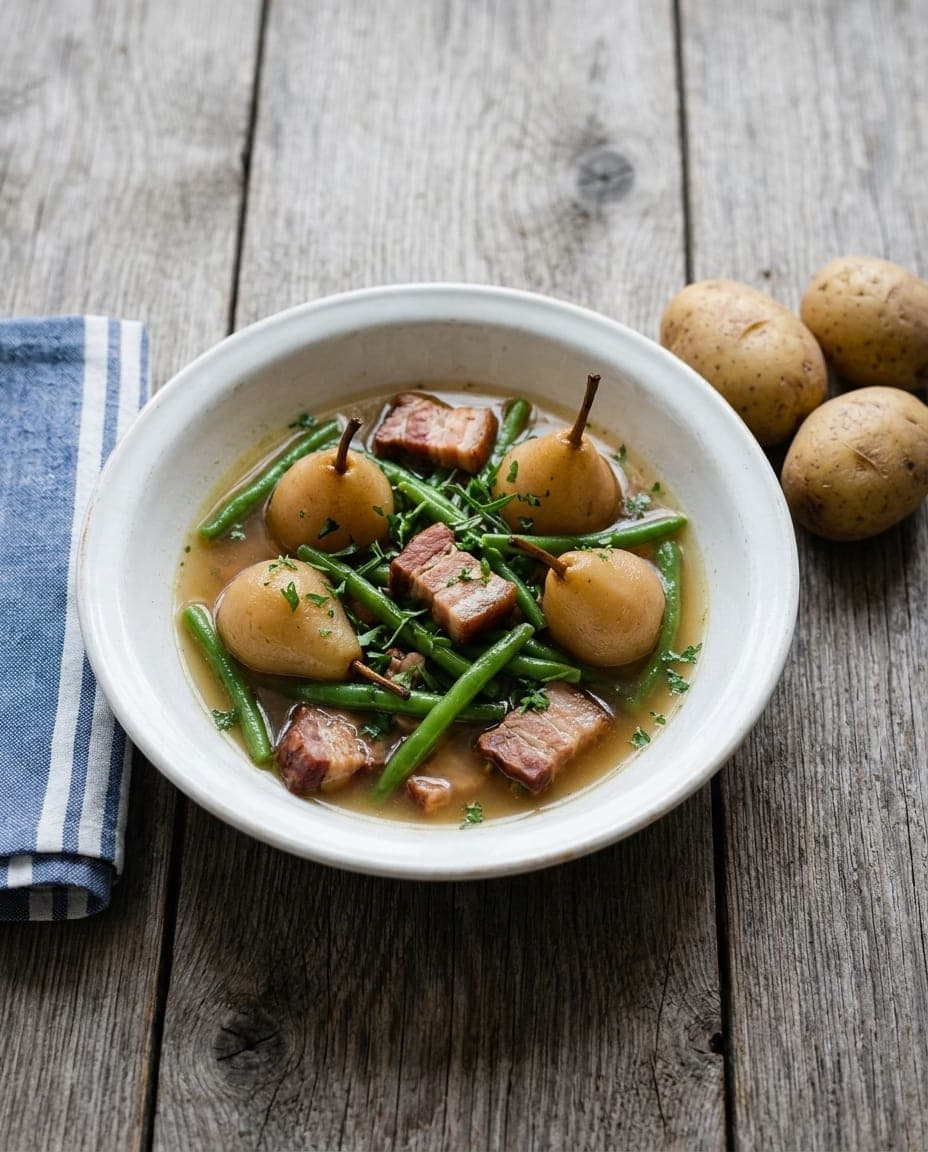
Flammkuchen
Thin crisp flatbread from Baden's wood ovens, topped with crème fraîche, onions and bacon
- Local name
- Flammkuchen
- Best eaten at
- A Baden Straußwirtschaft
- Pairs with
- Grauburgunder or new wine
What it is
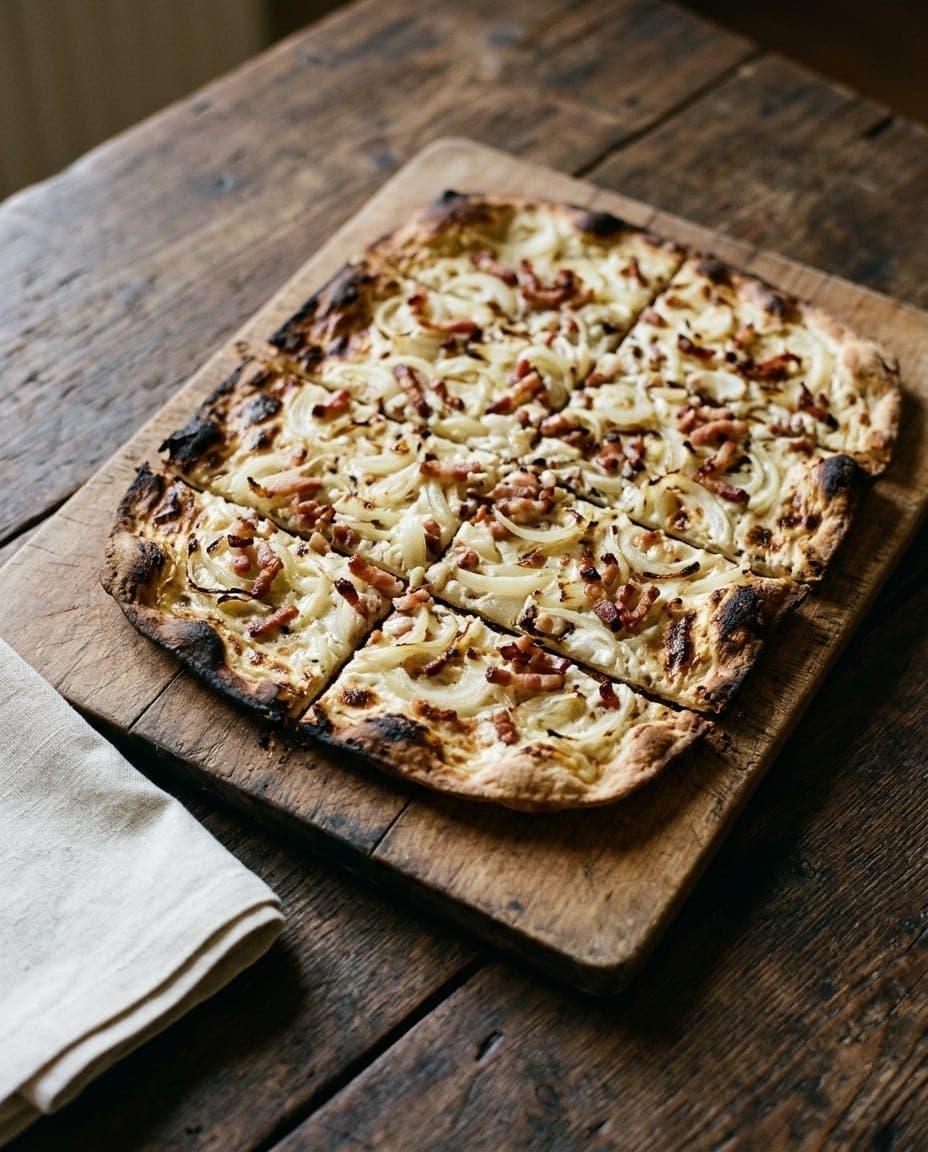
Flammkuchen, a term that translates literally to "flame cake", is a thin, crisp flatbread native to the Upper Rhine. On the German side it belongs above all to Baden, as well as the Palatinate and Saarland, and it shares its identity with its neighbour across the river in Alsace, where it is known as tarte flambée. The dish consists of a round or oblong base of dough rolled so thin that it becomes almost translucent before baking. It is spread with a layer of crème fraîche, sour cream or fromage blanc, scattered with raw onion rings and strips of smoked bacon (Speck), then baked for just a few minutes in a very hot oven until the edges are dark and charred.
The result is a dish that balances textural contrasts: a brittle, crackling crust against the soft, cooling dairy and the salty, smoky meat. It is not a heavy meal in the traditional sense, but it is substantial enough to be eaten as a main course.
The oven test and the communal bake
The story behind Flammkuchen begins with the wood-burning ovens that once stood in many villages and farmyards. These masonry ovens were essential for baking bread, which required sustained heat. Before the loaves went in, a thin piece of bread dough, topped with whatever was to hand, often onions and bacon, could be slid into the oven while the flames had not yet fully died down.
The thin bake served a double purpose. It made use of the fierce initial heat, and it helped the baker judge the temperature: if it blackened too quickly, the oven needed to cool a little before the bread could follow. The quick bake became a snack for the family while they waited. Over generations, the practice turned into a recognised local speciality, and the charred edges became a desired feature rather than a sign of failure.
The dish was never meant to be elaborate or expensive. It relied on cheap, readily available ingredients: flour, dairy, onions and cured pork. Its enduring appeal lies in this simplicity and its connection to the communal act of baking bread together.
Where it comes from
Flammkuchen is a regional speciality of the Upper Rhine, an area that straddles the border between France and Germany. In Alsace, the dish carries the French name tarte flambée and the Alsatian name Flammekueche, while on the German side it is generally known as Flammkuchen. It remains a staple on menus across Baden, from Karlsruhe to the Ortenau and the Kaiserstuhl.
The Upper Rhine has a long history of shared culture between Alsace and Baden. While the names differ, the preparation remains remarkably consistent on both sides of the border. The dough, a simple bread dough, is rolled out until it is almost paper-thin, and the toppings are applied generously but without crowding, allowing the heat to penetrate the thin base and create the characteristic char.
What goes into it
The ingredients of Flammkuchen are few, but each plays a specific role. The base is a simple dough of flour, water, salt and sometimes a little oil or yeast, rolled out until it shatters when bitten into.
The topping begins with a layer of crème fraîche, sour cream or fromage blanc, which provides a cool, creamy contrast to the hot, crispy crust. The onions are used raw in thin rings or slices; they soften slightly in the oven but retain their bite. The bacon is usually smoked (Speck), cut into small strips that crisp up alongside the dough, adding a salty, smoky depth.
While onion and bacon remain the standard, variations exist. Some versions add mushrooms, while a gratinée version is topped with grated cheese. A sweet variant is made with sliced apples and cinnamon, though this is less common in traditional settings.
How it is eaten
Flammkuchen is usually a dish for sharing, brought to the table on a wooden board, cut into pieces and eaten with the hands. Groups often order several, one after another, and share them as the evening progresses.
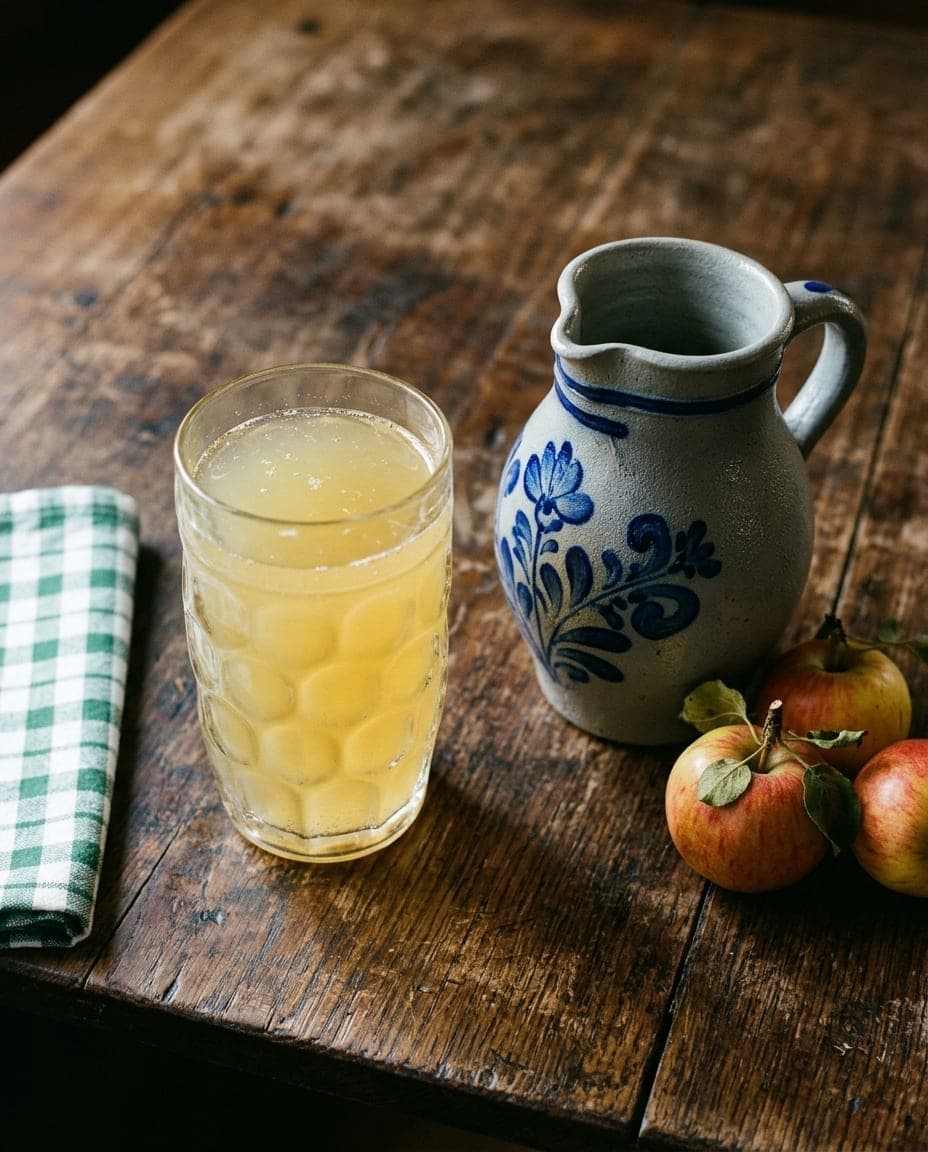
In Baden, one of the most characteristic places to eat it is a Straußwirtschaft, a seasonal wine tavern where local grape growers sell their own wine directly to the public for a few months of the year. Here, Flammkuchen is served alongside a glass of local wine, such as a Grauburgunder (Pinot Gris), or in autumn a glass of new wine from the current harvest.
The pairing is traditional and practical. The acidity of the wine cuts the fat of the cream and the saltiness of the bacon, while the crisp flatbread provides a satisfying textural counterpoint.
Curious facts
- The name describes the cooking method. The term Flammkuchen refers to the dish being baked while the flames in the oven had not yet died down.
- It is not a pizza. Despite the visual similarity, Flammkuchen differs from pizza in its paper-thin dough and the absence of tomato sauce in the classic version.
- A thin creamy layer. In traditional preparations, the cream is spread so thinly that it almost disappears under the onions, leaving only a subtle creaminess to balance the smoke.
- A regional boundary marker. The dish exists on both sides of the Rhine but carries different names, reflecting the cultural exchange between Alsace and Baden over centuries.
- Seasonal taverns. A Straußwirtschaft opens only for a limited period each year, often in spring and in autumn after the harvest, which ties the Flammkuchen-and-wine ritual to the wine calendar.
Where to try it
A characteristic place to find Flammkuchen is a Straußwirtschaft in the wine villages of Baden along the Upper Rhine. These taverns are marked by a Strauß, a bunch of twigs or a broom hung outside, indicating that the wine is ready for sale. Inside, the atmosphere is casual, with tables often set up outdoors under vines or trees.
In Karlsruhe, Freiburg and other towns of the region, many traditional restaurants serve the dish too, though the experience differs from the rural taverns. For the fullest experience, a tavern among the vineyards, where the wine is the grower's own and the flatbread comes straight from a hot oven, captures the spirit of the region best.
Where to try it
1 destination
 Camper Van Rentals
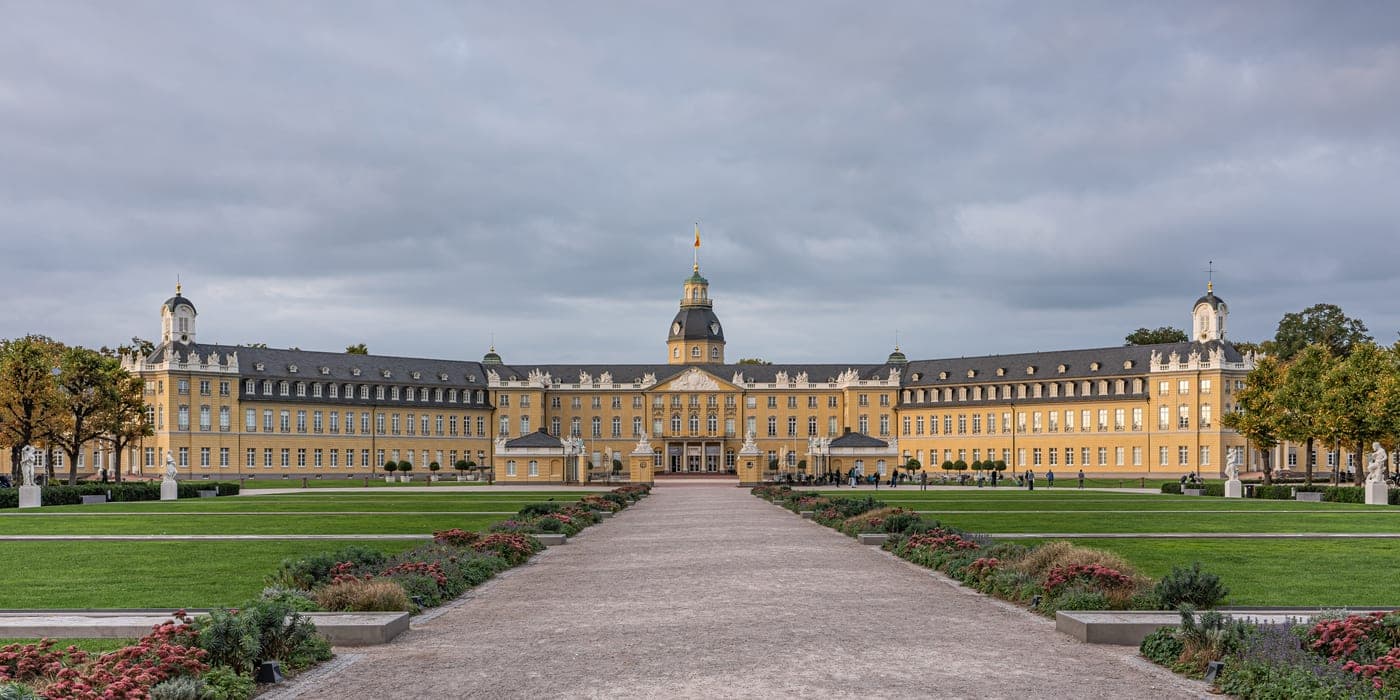
Karlsruhe
Planned city with fan-shaped layout radiating from baroque palace.
Camper Van RentalsHiking
1 region
 Camper Van Rentals12 destinations
Baden-Württemberg
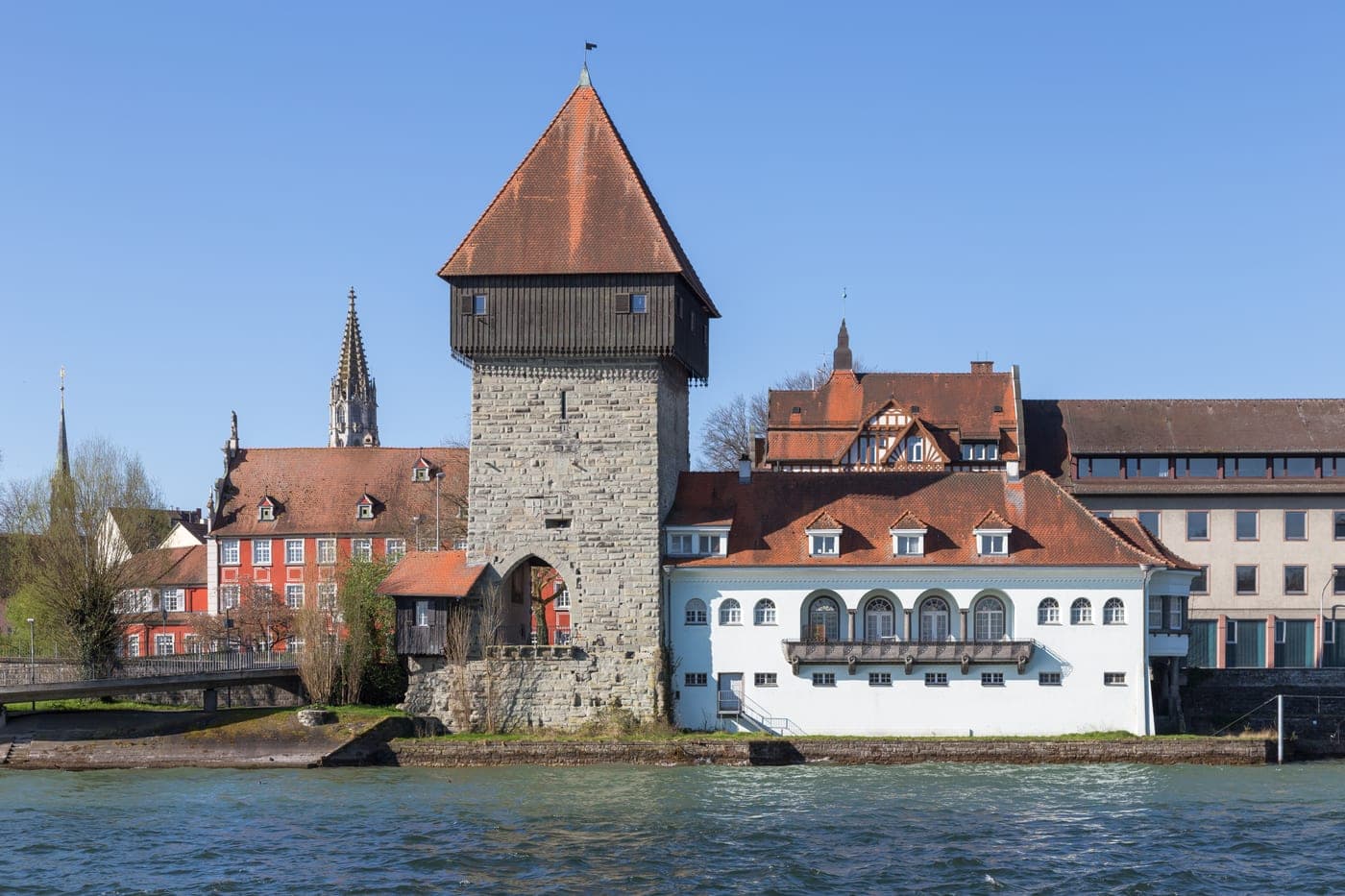
Baden-Württemberg fills Germany's southwest corner, from the Rhine plain in the west to the limestone plateau of the Swabian Jura in the east. The land moves in slow shifts here: vineyard slopes give way to dense forest, forest opens onto grassland and cave country, and everything eventually settles toward the wide, calm water of Lake Constance in the south. It is a region built for a wandering pace, town by town, valley by valley. Wine gives much of the region its rhythm. On the Upper Rhine, the volcanic hill of the Kaiserstuhl holds terraced vineyards that catch unusually strong sun for Germany, and small growers here work Spätburgunder and Grauburgunder grapes into wines poured in village Weinstuben. South of it, the Markgräflerland carries its own soft vineyard hills toward the Swiss border, linked by paths that wind through the vines from one wine village to the next. Near Stuttgart, the Neckar valley holds the Württemberg wine region, where Trollinger and Lemberger vines grow on steep terraces braced by dry stone walls that vintners still mend by hand. East of the Rhine, the Black Forest rises into ridges of spruce and fir, its valleys dotted with timber farmhouses under heavy, sloping roofs. Clockmaking has never quite left these villages, and workshops still turn out cuckoo clocks in the old way. Freiburg im Breisgau sits at the forest's western edge, its old town threaded by small open channels called Bächle that run past the cathedral square and into the surrounding lanes. Further into the hills, half-timbered towns such as Gengenbach keep market squares lined with houses that lean gently with age, and Fasnet carnival traditions bring out carved wooden masks each winter. Castles mark the region's high points. Heidelberg's red sandstone ruin looks down over the Neckar and the baroque rooftops of the old town below, its terraces a well-known spot for watching the river. Further south, Hohenzollern Castle sits on a steep, isolated hill at the edge of the Swabian Jura, its towers visible above the surrounding farmland long before the castle comes fully into view. Smaller fortress towns between the two hold quieter versions of the same story, with gatehouses and keeps built into hillsides above vineyards or forest. Tübingen keeps its own slow tradition on the Neckar, where flat-bottomed Stocherkahn boats are punted along the river below a row of tall, colourful houses. Students and residents share the same narrow lanes that have shaped the town for generations. South and east of Tübingen, the Swabian Jura opens into limestone grassland, sheep pasture, and juniper heath, cut through by dry valleys and cave systems that draw walkers onto marked trails. At the region's southern edge, Lake Constance spreads into a broad expanse of water shared with Switzerland and Austria. Orchards, vineyards, and small harbour towns line its shore, where fishing boats still go out early. Reed beds and level paths follow much of the water's edge, giving long, flat stretches for walking or cycling between towns without losing sight of the lake. Festivals mark the region's calendar as much as its landscape does. Wine villages hold harvest festivals in autumn, serving new wine alongside onion tart in courtyards strung with lights. Winter brings Fasnet, with its carved masks and processions through Black Forest towns. Spring and summer bring open-air concerts in castle courtyards and vineyard walks led by local growers. Bicycles and walking boots suit this region well. Marked cycling routes follow the Rhine plain past vineyards and orchards, climb gradually into Black Forest valleys beside running streams, and trace the Lake Constance shore through reed beds and harbour towns. Hiking paths cover the same ground more slowly, crossing vineyard terraces, forest ridges, and Jura grassland, and often link one small town to the next without a long detour. Each part of Baden-Württemberg keeps its own version of this slow character: a wine village square in the Kaiserstuhl, a castle terrace above the Neckar, a quiet stretch of Bodensee shore, a forest clearing where the only sound is water moving somewhere close by.
Camper Van RentalsBoat RentalsHikingCabins