Paris-Brest
A ring of choux pastry celebrating the Paris–Brest–Paris cycle race
- Vegetarian
- Local name
- Paris-Brest
- Best eaten at
- A Parisian pâtisserie
- Pairs with
- Coffee
What it is
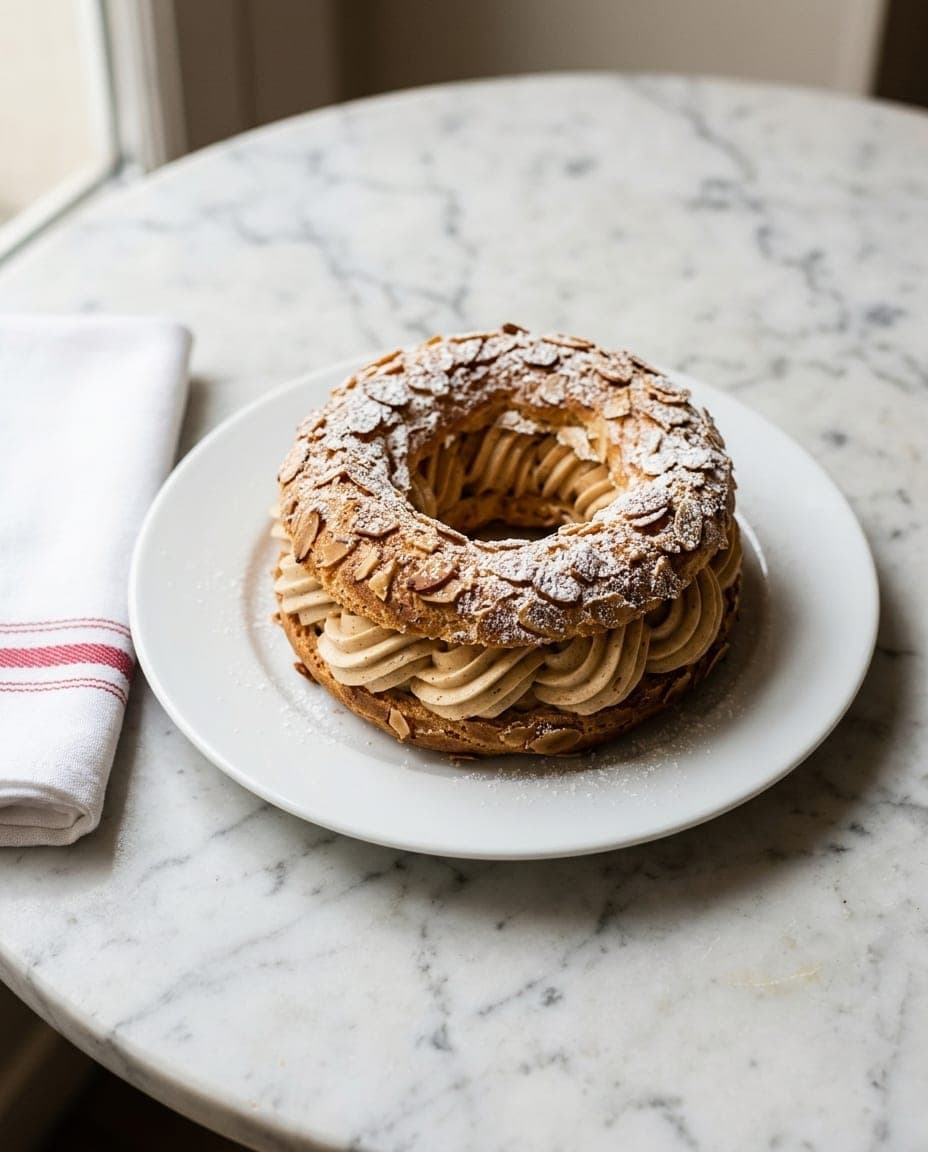
The Paris-Brest is a circular pastry made from choux dough, split horizontally and generously filled with a light cream flavoured with praline. It is finished with a dusting of icing sugar and scattered with flaked almonds. The shape mimics the wheel of a bicycle, serving as an edible tribute to the Paris–Brest–Paris cycle race.
The pastry is tied to the Île-de-France region, specifically to the capital and the nearby town of Maisons-Laffitte, where it was created. While choux pastry appears in many forms across France, from éclairs to profiteroles, the Paris-Brest stands apart due to its distinct ring shape and the praline cream that fills it. It is a substantial item, sold as a whole wheel to share or in smaller individual portions, and is usually eaten with a fork rather than held in the hand.
The texture offers a contrast between the crisp, airy exterior of the baked pastry and the soft, creamy interior. The filling is not merely sweet; it carries the deep, nutty notes of caramelised hazelnuts and almonds ground into a paste. This combination has made the pastry a staple in Parisian pâtisseries for over a century.
The origin of the ring
The story behind the pastry is rooted in sport rather than culinary tradition. The Paris–Brest–Paris race was founded in 1891 by the journalist Pierre Giffard as a test of the endurance of riders and their machines over a distance of roughly 1,200 kilometres. The route ran from Paris to the Breton port of Brest and back again.
In 1910, Giffard asked Louis Durand, a pastry cook in Maisons-Laffitte, west of Paris, to create a pastry honouring the event. The result was a choux ring designed to look like a bicycle wheel. The name Paris-Brest reflects the two ends of the race, while the shape represents the wheel that carried the riders through the night and across the countryside.
Over time, the pastry moved from a single pâtisserie into the permanent repertoire of French bakeries, where it has remained a classic ever since.
The praline filling
The heart of the Paris-Brest lies in its filling, which distinguishes it from other choux pastries filled with plain cream or custard. The base is usually a crème pâtissière, a thick custard made with milk, eggs, sugar and flour. This custard is then beaten with softened butter to create a richer, airier cream known as crème mousseline.
To this creamy base, praline paste is added. Praline in this context refers to caramelised nuts, typically hazelnuts or almonds, which have been cooked until the sugar turns golden brown and then ground into a smooth paste. The result is a filling that is both rich and aromatic, with a deep nuttiness that balances the sweetness of the pastry. The process requires skill to ensure the cream remains light enough to pipe into the choux ring while holding its shape firmly once filled.
The praline element is what gives the Paris-Brest its characteristic taste and makes it a speciality rather than a generic choux pastry.
How to eat it
The Paris-Brest is typically served as a dessert or with an afternoon coffee in a café or pâtisserie setting. Because of its size and the richness of the filling, it is almost always eaten with a fork. The pastry alone is substantial enough to stand as a complete dessert.
A whole Paris-Brest is usually sliced into wedges before being served, making it easier to manage with cutlery. The flaked almonds on top add a slight crunch that contrasts with the soft interior, and the icing sugar provides a final light layer of sweetness.
It pairs naturally with coffee, which cuts the richness of the praline cream. A strong black coffee or a café au lait complements the nutty flavours without overpowering them.
Where it belongs on the menu
The Paris-Brest is a fixture in traditional French pâtisseries throughout the country, and particularly in Paris. It appears in establishments ranging from small neighbourhood shops to larger, historic pâtisseries in central Paris, as well as on restaurant dessert menus.
In a typical pâtisserie, the Paris-Brest is displayed alongside other choux pastries such as the éclair or the religieuse, though its ring shape makes it instantly recognisable. It requires the skills of a pastry chef to prepare the praline cream and pipe the choux dough correctly.
The Paris-Brest is available year-round, with no particular season limiting its presence. Like many French pastries, it is often bought as a whole ring for family gatherings or special occasions.
Curious facts
- A wheel made of dough. The shape represents a bicycle wheel, a nod to the riders of the Paris–Brest–Paris race.
- The praline secret. The filling relies on caramelised hazelnuts or almonds ground into a paste, which transforms a simple cream into a deep, aromatic filling.
- A 1910 creation. The pastry was created in 1910 by Louis Durand, a pâtissier in Maisons-Laffitte, at the request of the race's founder, Pierre Giffard.
- An older race. The race itself is older than the pastry: it was first run in 1891.
- Eaten with cutlery. Unlike many French pastries that are held in the hand, the Paris-Brest is substantial and rich enough to call for a fork.
Where to try it
The most authentic experience of the Paris-Brest is found in a Parisian pâtisserie, where the tradition is maintained by chefs who understand its history and technique. Pâtisseries in Maisons-Laffitte, the town where it was created, also take pride in it. The whole ring is usually available to take away and share at the table.
The quality of the praline filling varies between establishments, and a well-regarded pâtisserie usually offers the most balanced version of the classic.
The Paris-Brest is a treat that rewards a willingness to slow down. It is not a quick snack but a moment to savour, best enjoyed with a cup of coffee in a quiet corner of a traditional café. The history embedded in its shape makes it a fitting tribute to the endurance of the cyclists who once rode the Paris–Brest–Paris route.
Where to try it
1 region
 Camper Van Rentals1 destination
Île-de-France
Île-de-France is the smallest region in France, yet it is the most populous, primarily known for Paris, its capital. Beyond the iconic landmarks of the city, this region offers hidden gems such as the medieval town of Provins, a UNESCO World Heritage site, where well-preserved fortifications tell tales of its rich history. The Vexin Français Regional Natural Park showcases picturesque landscapes and charming villages like La Roche-Guyon. Unique culinary experiences abound, with local specialties like Brie cheese and wines from the Île-de-France vineyards. The region also hosts lesser-known châteaux, such as Château de Malmaison, once home to Joséphine Bonaparte. Travelers can explore art in places like Giverny, where Monet's gardens inspire creativity. Each corner of Île-de-France presents an opportunity to dive into local culture and history, making it a region worth exploring at a leisurely pace.
Camper Van Rentals