Baguette
France's long, crisp daily loaf, with UNESCO-listed craft
- Vegetarian
- Local name
- Baguette
- Served with
- Butter, cheese, charcuterie
- Best eaten at
- The neighbourhood boulangerie
What it is
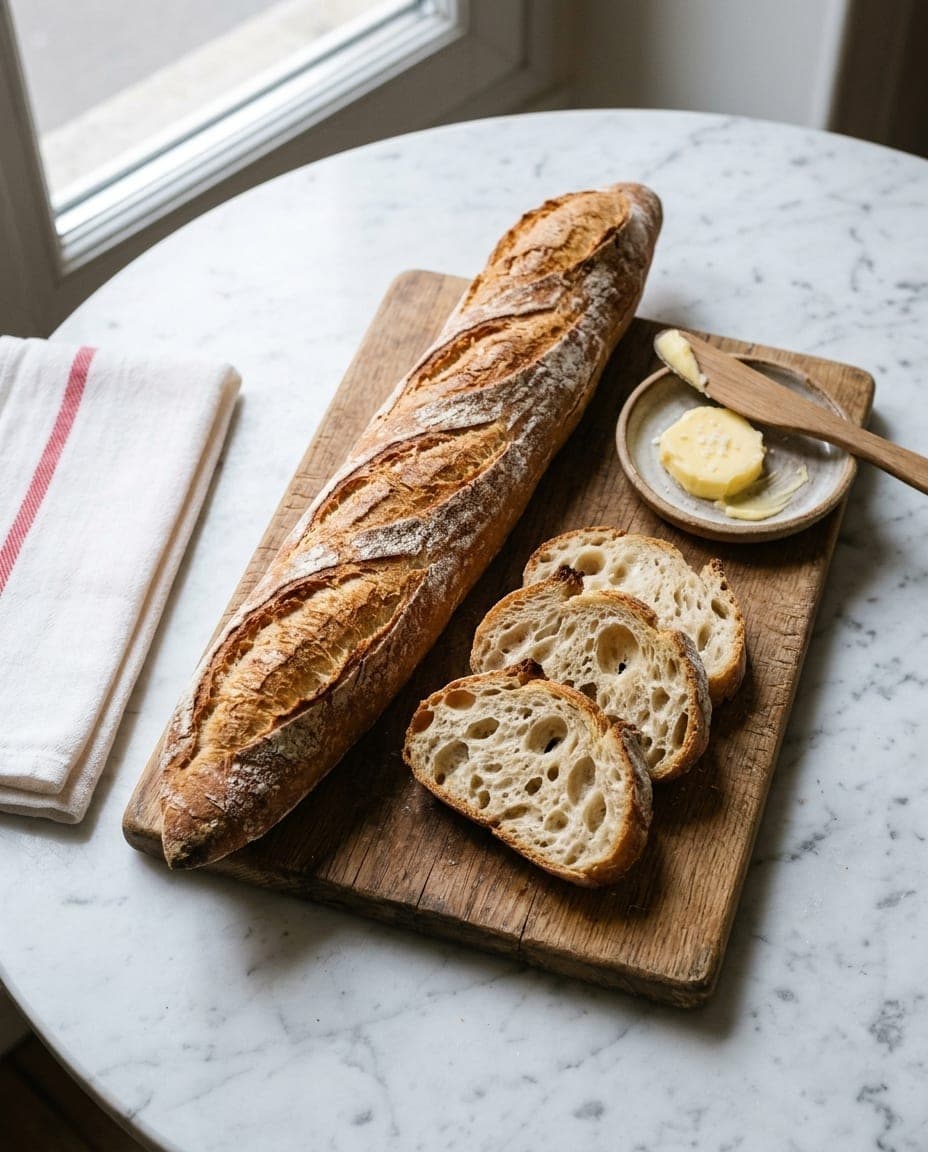
The baguette is the most recognisable bread in France, a long, thin loaf of wheat flour, water, salt and yeast or leaven that defines the daily rhythm of the country. It is not merely a side dish but a central element of French life: according to the bakers' confederation, more than six billion baguettes are produced in France each year. The texture is distinct: a thin, crackling crust that shatters when broken, revealing an open, irregular crumb that is cream-coloured rather than stark white.
The name simply means "stick" or "wand". While similar long loaves exist elsewhere, the baguette as known today is tied to French baking traditions and regulations. It is often served with butter, cheese or charcuterie, and fresh from the oven it is good enough to eat on its own. The bread is eaten across the whole country, though Paris, where the style took shape, still likes to think it sets the standard.
The history of the long loaf
The origin of the baguette is a subject of debate among historians, with no single inventor or date accepted as fact. Some accounts link its shape to the late 19th century, when French bakers began using steam ovens that allowed for longer loaves to bake more evenly. Others suggest it evolved from the pain viennois, a style of bread popularised in Paris by Viennese bakers from the mid-1800s. The name baguette for the loaf seems to have entered common usage only in the early 20th century, though earlier references describe similar long loaves under different names.
By the early 20th century, the long thin loaf had become a staple of Parisian life. The shape was practical for people who needed bread they could carry easily, tucked under the arm.
The modern form of the baguette was established in the interwar years, as Parisians came to favour a bread that was crisp outside and soft inside. The shape became so well-known that by the mid-20th century, it was impossible to imagine French baking without it.
The decree that defines it
In 1993, the French government issued a decree (no. 93-1074 of 13 September) that defined pain de tradition française, the basis of the baguette sold as a tradition. This regulation was designed to protect traditional baking methods from industrial shortcuts. Bread sold under that name must be made from wheat flour, water, salt and yeast and/or leaven, with only tiny permitted amounts of bean, soya or malted wheat flour. No additives are allowed, and the dough must never be frozen at any stage.
This decree created a clear divide in French bakeries. The baguette de tradition follows these rules, resulting in a loaf with a more complex flavour and a texture that changes as it cools. The ordinary baguette, by contrast, may contain additives, and supermarket versions are often baked from frozen or pre-made dough. While both are legal, the tradition version is the one sought by those who value the craft of baking.
A separate clause of the same decree reserves the term pain maison for bread kneaded, shaped and baked entirely where it is sold. Together these rules have helped preserve the art of French baking, ensuring that the baguette de tradition remains a daily staple in many neighbourhoods.
How it is made and what goes into it
The making of a baguette relies on four simple ingredients: flour, water, salt and yeast or leaven. The magic lies not in the recipe but in the technique. A traditional baker will mix the dough to a specific consistency, allowing it to rise slowly to develop flavour. The dough is then shaped into long, thin loaves, which are scored with diagonal slashes known as grignes before baking.
These cuts open in the oven, creating the characteristic ridges on the crust. The scoring also allows the bread to expand properly, resulting in an open crumb structure. The baking process itself is critical: the loaf must be baked at a high temperature with steam to achieve a thin, crackling crust and a soft interior.
The result is a bread that is best eaten on the day it is baked. A baguette left overnight becomes hard and loses its flavour, which is why many households buy bread daily.
How to eat it
The baguette is eaten in many ways, but its most traditional form is simply with butter, cheese or charcuterie. A slice of fresh baguette spread with salted butter is a classic breakfast or snack, often accompanied by coffee; at meals it mops up sauces and stews.
Neighbourhood bakeries are often family-run and serve as community hubs; around 12 million people in France visit one every day. The bread is carried under the arm, and the crusty end, le quignon, is often nibbled on the way home.
In Paris, the baguette is also served in cafes and bistros, often as part of a meal. It is paired with cheese from different regions, such as comté or brie, or with cured meats like jambon de Bayonne. Stale baguette is rarely served at table, though it lives on in dishes such as pain perdu.
Curious facts
- The UNESCO listing. On 30 November 2022, the "artisanal know-how and culture of baguette bread" was inscribed on UNESCO's Representative List of the Intangible Cultural Heritage of Humanity.
- The Paris competition. The City of Paris holds an annual Grand Prix for the best baguette de tradition. The winning bakery receives prize money and becomes one of the Élysée Palace's bread suppliers for a year.
- The daily ritual. Many French households buy fresh bread every day. It is common to see people carrying baguettes under their arms in Paris streets.
Where to try it
The best place to eat a baguette is the neighbourhood boulangerie, where the bread is made fresh daily. In Paris, these bakeries are found on almost every street corner, from the busy boulevards to quiet residential avenues.
The surest sign of quality is a bakery that makes its bread on site and sells a baguette de tradition alongside the ordinary one.
Where to try it
1 region
 Camper Van Rentals1 destination
Île-de-France
Île-de-France is the smallest region in France, yet it is the most populous, primarily known for Paris, its capital. Beyond the iconic landmarks of the city, this region offers hidden gems such as the medieval town of Provins, a UNESCO World Heritage site, where well-preserved fortifications tell tales of its rich history. The Vexin Français Regional Natural Park showcases picturesque landscapes and charming villages like La Roche-Guyon. Unique culinary experiences abound, with local specialties like Brie cheese and wines from the Île-de-France vineyards. The region also hosts lesser-known châteaux, such as Château de Malmaison, once home to Joséphine Bonaparte. Travelers can explore art in places like Giverny, where Monet's gardens inspire creativity. Each corner of Île-de-France presents an opportunity to dive into local culture and history, making it a region worth exploring at a leisurely pace.
Camper Van Rentals