Macaron parisien
Almond meringue shells sandwiching ganache in Paris
- Vegetarian
- Local name
- Macaron parisien, macaron Gerbet
- Best eaten at
- A Parisian pâtisserie
- Pairs with
- Tea or Champagne
What it is
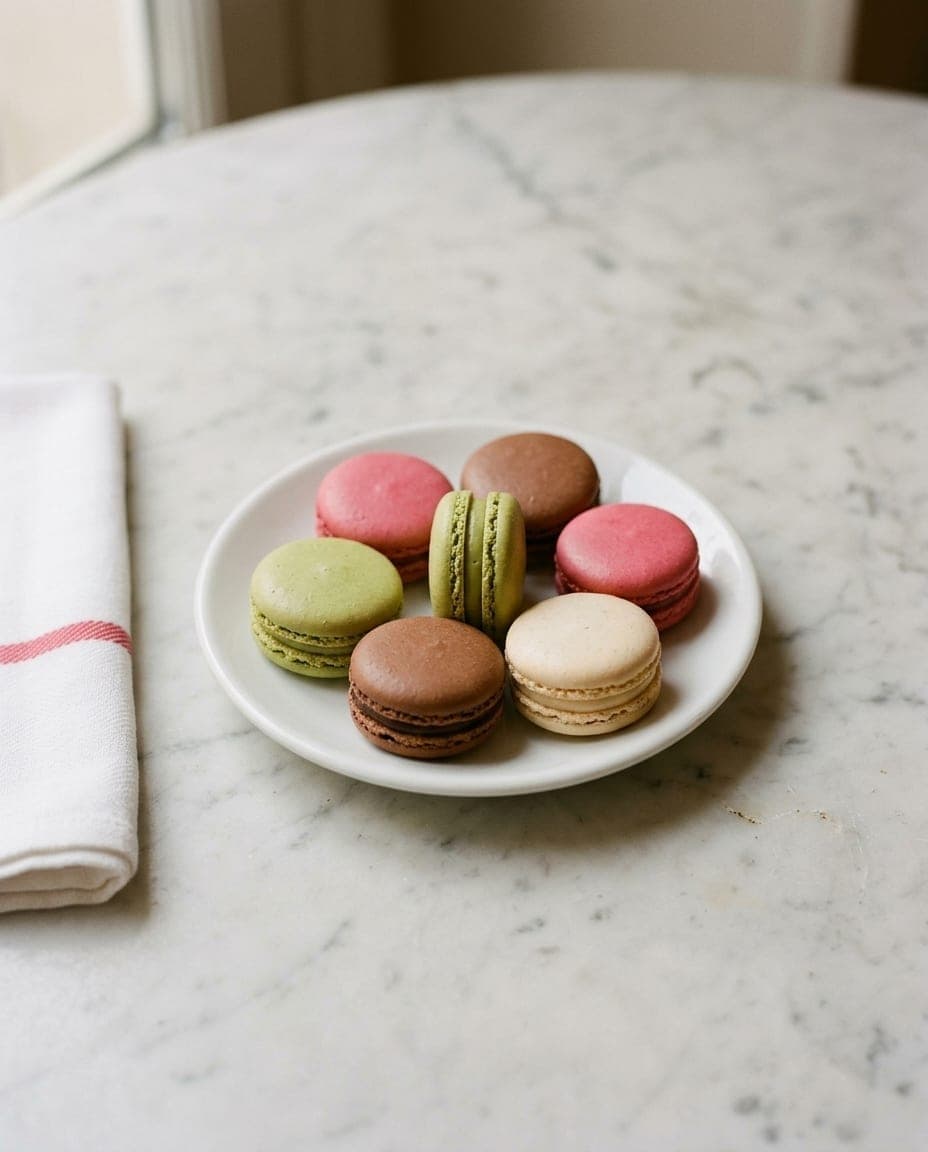
The macaron parisien is a small, round confection made from two smooth-topped almond meringue shells sandwiching a layer of ganache, buttercream or jam. It belongs to the family of sweet pastries known as macarons, but this specific form is distinct from the older single almond biscuits found in other French towns. The Parisian version is defined by its double-decker structure: two delicate, crisp shells joined by a soft filling.
The shells are smooth and uniform, often coloured in bright or pastel shades to match their flavour. They have an uncracked top and a frilled base known as the pied ("foot") or collerette, which forms as the batter rises in the oven. Inside, the filling ranges from dark chocolate ganache to raspberry jam. The texture is precise: the shell offers a slight resistance before yielding to a soft centre, while the filling binds the two halves into a single bite.
This pastry is not a coconut macaroon, the biscuit common in British and American baking. The confusion between the two names often surprises visitors. The macaron parisien is almond-based, with no coconut involved. It is a product of Parisian pâtisserie culture, specifically associated with the capital.
The origin of the double-decker
Almond macarons have a long history in France, though their exact origins are disputed. A popular story credits Italian cooks in the entourage of Catherine de' Medici with bringing them to France in the 16th century, but there is no record to support it. Single almond biscuits have long been associated with towns such as Nancy, Amiens and Saint-Émilion, where they remain popular as simple, chewy biscuits. The version known today as the macaron parisien is a much later invention.
The credit for creating the sandwich form is most often given to Pierre Desfontaines of the Paris pâtisserie Ladurée in the early 20th century, who is said to have had the idea of joining two shells with a filling. The claim is not undisputed: the pastry cook Claude Gerbet is also credited with the idea, and the sandwich style was originally known as the "Gerbet" or "Paris" macaron. By the 1930s, macarons were being served in pairs with jams, liqueurs and spices.
Whatever its exact birth, the pastry became a symbol of Parisian elegance and spread through the city's cafés and pâtisseries. Today it is sold all over France, but it remains most strongly identified with Paris.
How it is made
The process begins with the shells, which require ground almonds and icing sugar sifted to a fine powder. This mixture is combined with whipped egg whites, either as a French meringue or, in many professional kitchens, an Italian meringue made with hot sugar syrup. The batter must be folded carefully until it reaches a precise flowing consistency. This step is known as macaronnage: the mixture is folded until it falls from the spatula in a ribbon that slowly disappears into the bowl.
The batter is piped onto baking sheets and often left to rest. During this rest, a thin skin forms on the surface of each piped mound, which helps the shells keep a smooth top in the oven. The heat pushes the batter upward to form the characteristic frilled foot. The baking must be precise to ensure the top remains smooth while the interior stays soft and slightly chewy.
Once baked and cooled, the shells are filled with a chocolate ganache, a flavoured buttercream or sometimes a fruit jam. The two halves are pressed together gently so that the filling spreads evenly to the edges. The result is a pastry that looks perfectly symmetrical, with a clean line where the shells meet.
How it is eaten
The macaron parisien is bought by the piece at a Parisian pâtisserie, usually displayed in glass cases. It is often arranged in small boxes for gifts or personal consumption. Many pâtissiers let filled macarons rest in the refrigerator for a day before selling them, so that moisture from the filling softens the inside of the shell slightly, and they are best eaten within a few days.
At its peak, the shell offers a gentle crunch before giving way to the soft interior. A macaron eaten straight after baking can feel dry and overly crisp; the short maturing time is what creates the balance of textures.
It is often paired with tea or Champagne. The sweetness of the pastry stands up to the bitterness of black tea or complements the acidity of sparkling wine. It is not meant to be a full dessert course but rather a pause in the day, a sweet interlude during a walk through the city or a break at a café table.
Curious facts
- The colour codes. Many pâtisseries use colours to signal flavours, such as pink for raspberry or green for pistachio. The association is not universal, however, and some houses use different shades for the same taste.
- Macaron or macaroon. Both words come from the same French macaron. In English, "macaron" is now generally used for the Parisian sandwich and "macaroon" for the coconut or almond biscuit; in the UK, the Parisian kind is also called a "French macaroon".
- The skin matters. Resting the piped batter before baking helps prevent cracked tops, which is why the step is part of many classic recipes.
- Not a single biscuit. Unlike the older macarons of Nancy or Saint-Émilion, the macaron parisien relies on the interplay between two shells and a filling.
- A gift tradition. Boxes of macarons are a popular gift in Paris, often packed in the pâtisserie's own distinctive box or bag.
Where to try it
The best place to eat a macaron parisien is at a Parisian pâtisserie, particularly those with a long history in the city. While many shops produce excellent versions, the pastry is most closely associated with the houses that helped define its modern form.
Not every pâtisserie offers the same quality. The skill required to achieve the smooth top and the even foot varies from kitchen to kitchen. A skilled pâtissier will produce a shell with no cracks and a filling that is neither too runny nor too stiff.
The pastry is available year-round, with seasonal variations in flavour. In spring, there may be strawberry or elderflower versions, while autumn brings chestnut. The base recipe stays constant while the fillings follow the seasons.
Where to try it
1 destination
 Camper Van Rentals
Paris
Roadsurfer camper van rental station at Paris Orly & CDG airports.
Camper Van Rentals
1 region
- Camper Van Rentals1 destination
Île-de-France
Île-de-France is the smallest region in France, yet it is the most populous, primarily known for Paris, its capital. Beyond the iconic landmarks of the city, this region offers hidden gems such as the medieval town of Provins, a UNESCO World Heritage site, where well-preserved fortifications tell tales of its rich history. The Vexin Français Regional Natural Park showcases picturesque landscapes and charming villages like La Roche-Guyon. Unique culinary experiences abound, with local specialties like Brie cheese and wines from the Île-de-France vineyards. The region also hosts lesser-known châteaux, such as Château de Malmaison, once home to Joséphine Bonaparte. Travelers can explore art in places like Giverny, where Monet's gardens inspire creativity. Each corner of Île-de-France presents an opportunity to dive into local culture and history, making it a region worth exploring at a leisurely pace.
Camper Van Rentals