Lentilles vertes du Puy
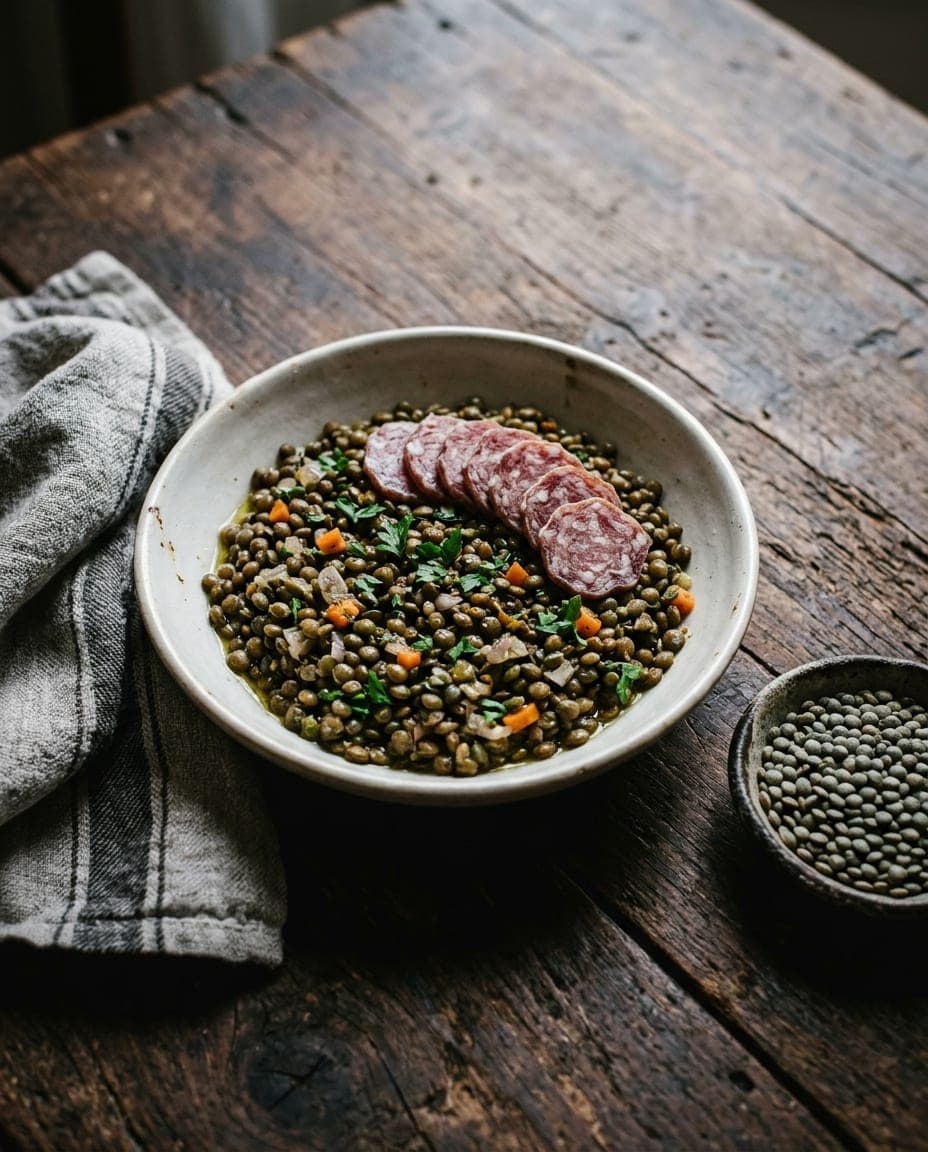
AOP green lentils from Le Puy-en-Velay, served warm with sausage
- Vegetarian
- Local name
- Lentille verte du Puy
- Served with
- Saucisse, petit salé
- Best eaten at
- A Le Puy bistro
- Pairs with
- Côtes d'Auvergne red
What it is
Lentilles vertes du Puy are small green lentils, pale green marbled with dark blue-green, grown around the town of Le Puy-en-Velay in the Haute-Loire department of central France. They belong to the Auvergne-Rhône-Alpes region and are a regional speciality rather than a dish found everywhere in the country. In 1996 the Lentille verte du Puy became the first vegetable in France to receive an appellation d'origine contrôlée, today protected across the EU as an AOP (PDO), a designation that guarantees their origin and the conditions under which they are grown. The lentil already had a form of national recognition in 1935.
Unlike many other lentils that can turn soft or collapse into a purée when cooked, these hold their shape well. They have a thin skin and a kernel that is not floury, so they cook relatively quickly and stay distinct in the pot. This quality is attributed to the volcanic terroir and to the dry, sunny summers that let the crop ripen fully. The result is a delicate flavour and a texture that stays slightly firm, making them ideal for salads where the individual lentils must remain visible.
How they grow on the volcanic plateau
The story of these lentils begins with the land itself. They are cultivated in two neighbouring areas: the Puy basin, at around 600 to 800 metres, and the windswept volcanic plateau of the Velay at around 900 to 1,000 metres, where they share the fields with wheat and barley. The climate is harsh, with long winters and springs followed by dry, sunny summers.
These conditions are essential for developing the lentils' characteristic thin skin and fine kernel. Farmers here have grown the crop for generations, and traditionally it is grown without fertiliser. The AOP protects this link to the land, ensuring that only lentils grown within the defined area of the Haute-Loire and following the rules of the specification can carry the name.
How they are cooked
One of the most practical aspects of these lentils is that they require no soaking before cooking. They are traditionally simmered in unsalted water, with an onion studded with cloves, a carrot and a bay leaf to infuse the liquid with aroma.
Salt is usually added only towards the end of cooking, a habit many cooks follow to keep the skins intact. Once they are tender but still distinct, they are drained and dressed while still warm. This approach lets the flavour of the lentil shine through without being masked by heavy seasoning or a mushy consistency.
How they are eaten
Lentilles vertes du Puy are often served warm in a vinaigrette as a salad. The dressing typically consists of a sharp vinegar, such as red wine vinegar, mixed with oil and perhaps a touch of mustard and shallot. The warmth of the lentils helps them absorb the dressing, creating a dish that is both hearty and fresh.
They are frequently paired with charcuterie. A classic combination is a dish of lentils with a poached or grilled pork sausage, whose fat and smoky flavour balance the earthy taste of the lentils. Salted pork (petit salé aux lentilles) is another traditional partner. These pairings, of course, are not vegetarian; the lentils themselves are.
The lentils also appear as a side for fish, from white fish to salmon, providing a substantial base without overpowering the main element. A glass of Côtes d'Auvergne red is a fitting local companion, its freshness cutting through the fat of the meat and the earthiness of the legumes.
Curious facts
- A vegetable pioneer. In 1996 these lentils became the first vegetable in France to receive an appellation d'origine, setting a precedent for other regional produce.
- No soaking needed. Unlike many other pulses, they do not require pre-soaking, and their thin skin means they cook relatively quickly.
- Salt at the end. Many cooks add salt only towards the end of cooking to keep the lentils firm and distinct.
- Volcanic influence. The thin skin and firm texture are attributed to the volcanic terroir and the dry, sunny summers of the Velay.
- A regional staple. While sold in shops across France, the lentils are most at home on the menus of Le Puy-en-Velay and the villages of the Haute-Loire.
Where to try it
The best place to eat these lentils is in a bistro in Le Puy-en-Velay itself or in the surrounding villages of the Haute-Loire. Here, the dish is a staple on menus year-round, reflecting its status as a regional pride, in small neighbourhood restaurants that focus on local produce rather than international trends.
In these establishments, the lentils often arrive as a warm salad starter or alongside sausage or petit salé as a main course, usually with crusty bread to mop up the remaining vinaigrette. Versions of the dish appear in other parts of France too, but the character of the AOP lentils is most evident when they are prepared close to where they grow.
Where to try it
1 region
 Wine Tasting25 destinations
Auvergne-Rhône-Alpes
Nestled in the heart of France, this region is the second-largest, known for its diverse landscapes from the rugged mountains of the Alps to the volcanic terrain of the Massif Central. Lyon serves as a vibrant urban center, celebrated for its gastronomy and silk heritage. Off the beaten path, explore the historic villages of Le Puy-en-Velay, famed for its unique lentils and pilgrimage routes, or the picturesque landscapes of the Ardèche, with its stunning gorges. The region is also home to the picturesque vineyards of Beaujolais, producing renowned wines, and the stunning Lac d'Aiguebelette, one of the cleanest lakes in France. Seasonal festivals, like the Fête de la Gastronomie, showcase the local culinary delights, making this area rich in culture and history, ideal for a deep exploration of French traditions.
Wine TastingCamper Van RentalsHikingCastles