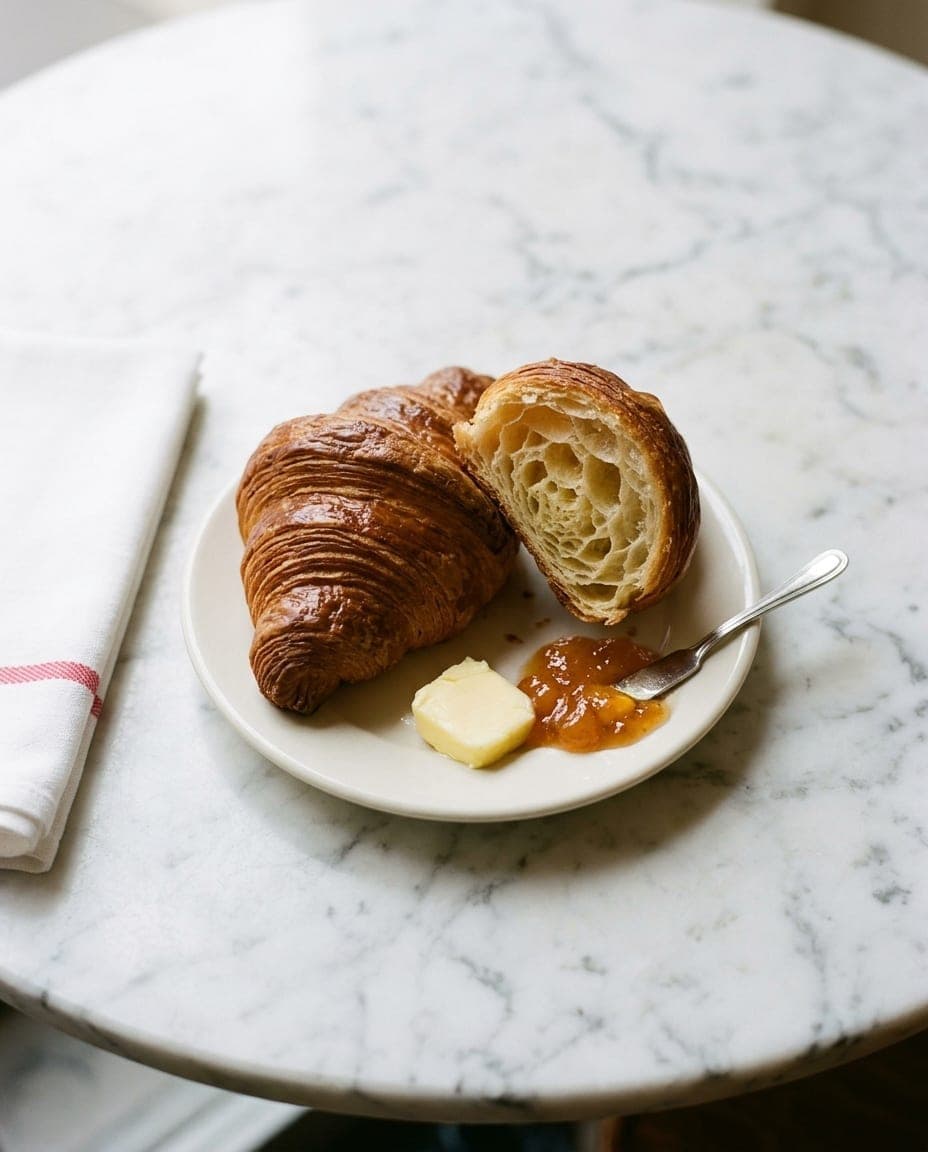
Croissant
A laminated butter pastry from Paris, eaten plain with coffee at a boulangerie
- Vegetarian
- Local name
- Croissant
- Served with
- Butter, jam
- Best eaten at
- A Parisian boulangerie
- Pairs with
- Café crème
What it is
The croissant is a laminated yeast pastry, golden-brown on the outside and airy inside with dozens of thin layers. It is made from a dough folded repeatedly around a block of butter before being rolled into a triangle and shaped into a crescent or left straight. The result is a light, flaky texture that shatters when bitten but yields soft, chewy strands when torn by hand.
In France, this pastry is most closely associated with breakfast or le goûter, an afternoon snack. It is eaten plain, often torn into pieces and dipped into coffee. The word croissant (crescent) refers to the shape; the version made with butter rather than margarine or other fats is sold as croissant au beurre, and in many bakeries the shape signals which is which.
From Vienna to Paris
The croissant has an Austrian origin before it became a French icon. Its ancestor is the kipferl, a crescent-shaped yeast pastry from Austria that can be traced back to at least the 13th century and later became a fixture of Viennese bakeries and coffee houses.
The bridge between Vienna and Paris arrived around 1838–39 with August Zang, a former Austrian artillery officer who opened the Boulangerie Viennoise on rue de Richelieu in Paris. He sold Viennese specialities, including the kipferl, and soon had French imitators. French bakers went on to adapt the pastry by laminating the dough—layering butter between folds. The earliest recipes for the modern laminated croissant appear in French cookery books in the first decade of the 20th century, with a richer, flakier result than its Viennese predecessor.
The legend that the pastry commemorates the Siege of Vienna in 1683, when bakers supposedly alerted the city to an Ottoman tunnel attack, is often told but not supported by any contemporary record. It remains an appealing piece of folklore rather than a verified fact. The documented history runs through Zang's bakery and the later refinement by French bakers.
How it is made without a recipe
The craft of the croissant relies on the technique of lamination, not on a fixed set of measurements. A yeasted dough is prepared with flour, water or milk, yeast, sugar and salt. A block of butter is then placed between sheets of this dough. The baker folds the dough over itself repeatedly, creating layers that separate during baking as the butter melts and the water turns to steam.
The number of folds varies by bakery and by the desired texture, but the principle remains constant: the butter must stay cold until it reaches the oven. If the butter melts too early, the layers fuse and the pastry loses its flakiness. The dough is then rolled into a triangle, cut to size, and shaped. While the traditional croissant au beurre is left straight to indicate the use of real butter, many bakeries now curve their croissants regardless of the fat used, a shift that has blurred the visual rule in some places.
How to eat it
In France, the croissant is rarely cut with a knife and fork. The usual practice is to tear off pieces by hand, dipping them into coffee or spreading butter or jam on the torn sections.
The most traditional place to buy a croissant is a boulangerie, a bakery that focuses on bread and pastry rather than full meals. These are neighbourhood shops where the queue moves quickly in the morning. At a café, the croissant is often accompanied by a café crème, a coffee with steamed milk, or a simple black coffee.
Purists hold that good butter and well-made pastry need nothing more, though butter and jam are a common addition at home and at hotel breakfasts. A good croissant should be crisp on the outside and soft inside; if it is soggy or greasy, the lamination has failed.
Where the story ends
The croissant bridges two culinary traditions. From the kipferl of Vienna to the butter-rich version of Paris, it tells a story of migration and adaptation. The straight or curved shape offers a clue to its ingredients, and the texture speaks to the skill of the baker.
Curious facts
- The straight edge matters. Traditionally, a straight croissant indicates it was made with butter (au beurre), while a curved one often signals the use of margarine or another fat. The convention is still followed in many bakeries, though not everywhere.
- A Viennese ancestor. The kipferl is the predecessor of the croissant, but the modern laminated version took shape in Paris between the mid-19th and early 20th centuries.
- A symbol of France. The croissant has become one of the most recognisable symbols of French baking worldwide.
- Part of the viennoiserie family. In French bakeries the croissant belongs to the viennoiseries, a name that still recalls the Viennese bakers of 19th-century Paris.
- No knife required. In France the croissant is generally torn by hand rather than cut, which keeps the flaky layers intact.
Where to try it
The best place to find a good croissant is a traditional boulangerie in Paris or any other French town. The Île-de-France region, particularly Paris, is where the modern croissant took shape.
Many bakeries label their croissants as au beurre to distinguish them from croissants ordinaires. The straight shape is the traditional indicator of butter, though this rule is not absolute in every shop today.
Where to try it
1 region
 Camper Van Rentals1 destination
Île-de-France
Île-de-France is the smallest region in France, yet it is the most populous, primarily known for Paris, its capital. Beyond the iconic landmarks of the city, this region offers hidden gems such as the medieval town of Provins, a UNESCO World Heritage site, where well-preserved fortifications tell tales of its rich history. The Vexin Français Regional Natural Park showcases picturesque landscapes and charming villages like La Roche-Guyon. Unique culinary experiences abound, with local specialties like Brie cheese and wines from the Île-de-France vineyards. The region also hosts lesser-known châteaux, such as Château de Malmaison, once home to Joséphine Bonaparte. Travelers can explore art in places like Giverny, where Monet's gardens inspire creativity. Each corner of Île-de-France presents an opportunity to dive into local culture and history, making it a region worth exploring at a leisurely pace.
Camper Van Rentals