Runebergintorttu (Runeberg torte)
An almond-rum cake with raspberry jam
- Vegetarian
- Local name
- Runebergintorttu
- Best eaten at
- A Porvoo café
- Pairs with
- Coffee
What it is
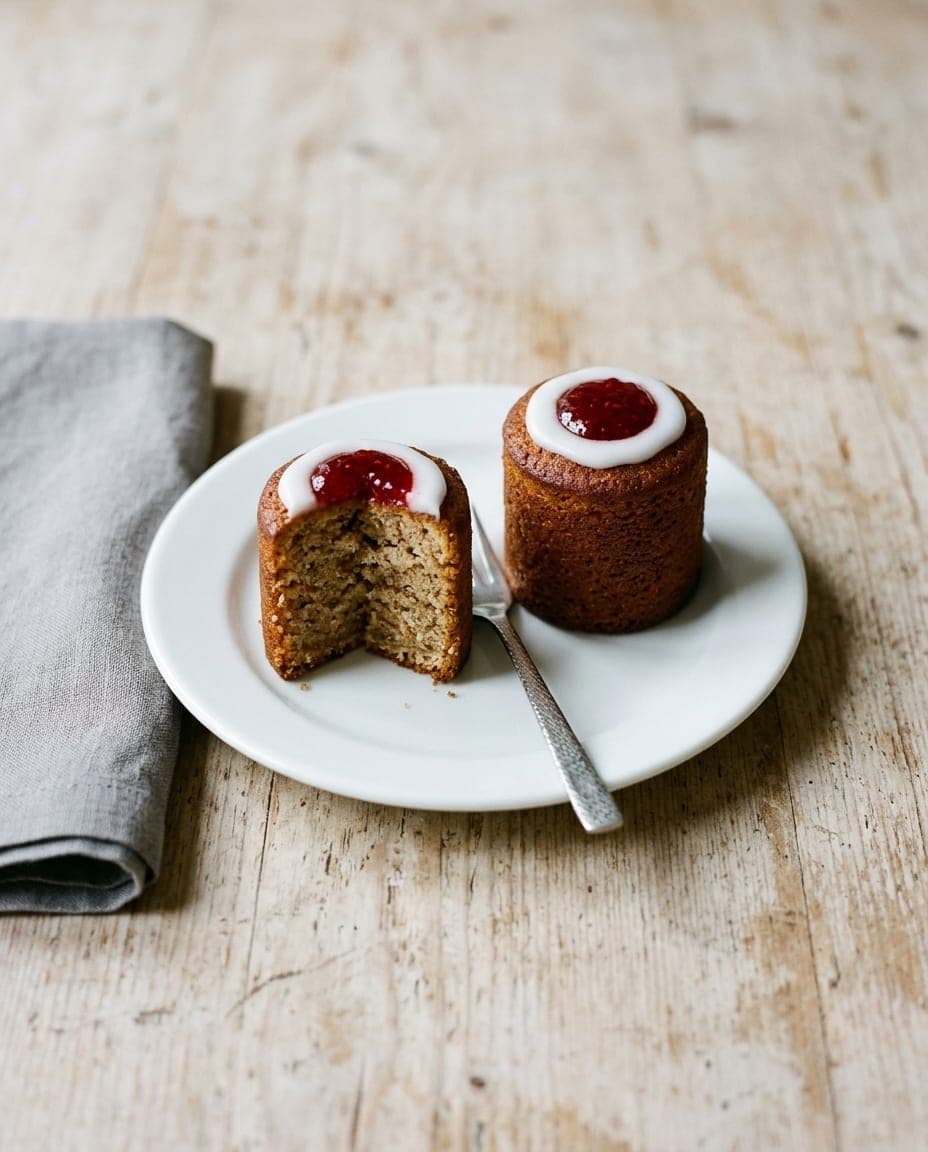
Runebergintorttu is a small, cylindrical cake made from almond meal, flour and breadcrumbs, flavoured with rum or arrack, and finished with a ring of white icing and a central dot of raspberry jam. It is sold across Finland, but it is tied closely to the town of Porvoo in the Uusimaa region. The cake appears in shops and cafés from early January until Runeberg's Day on 5 February, making it one of the most seasonal treats in the country, though some Porvoo cafés sell it all year.
The name honours Johan Ludvig Runeberg, Finland's national poet, who lived in Porvoo from 1837 until his death in 1877. While the cake is now a symbol of Finnish culture, its origins are local to this specific town. Popular legend credits the recipe to Fredrika Runeberg, the poet's wife and a writer in her own right, but her version is believed to be a variation of an earlier recipe by a Porvoo confectioner.
The story behind the sweet
The tale most often told is that Fredrika Runeberg created the cake at their home in Porvoo, using what she had on hand, including almonds and rum, to serve her husband something special. The record points elsewhere: tortes of this kind were being sold in Porvoo by the confectioner Lars Astenius in the 1840s, and the poet is said to have been fond of them from the start. Fredrika's recipe book from the 1850s contains a version that is believed to be based on his; Astenius's original recipe has not survived.
The cakes are topped with jam and icing once they come out of the oven. The recipe became associated with the poet's birthday on 5 February, known as Runeberg's Day, and Helsinki bakeries were selling the tortes by the 1860s. In the weeks leading up to this date, bakeries across Finland stock the cake, but Porvoo remains its spiritual home. Cafés in the town often claim a version close to the original.
What goes into it
The composition of the cake is simple and relies on a few key textures rather than complex layers:
- Almond meal, which gives the cake its distinctive nutty flavour.
- Breadcrumbs or biscuit crumbs and a little flour, which give the dense, moist crumb.
- Butter and sugar, beaten together to create a rich base for the dough.
- Rum or arrack, usually brushed over the baked cakes as a syrup, providing a warming note that complements the almonds.
- Raspberry jam, placed in the centre of the top after baking, adding a tart contrast to the sweet almond crumb.
- White icing, piped in a ring around the jam.
The result is a small, sturdy cake that holds its shape well but melts softly on the tongue. It is not a light pastry; it is substantial enough to accompany a long conversation or a quiet moment by a window.
How to eat it
Runebergintorttu is almost always eaten with coffee. The bitterness of the brew balances the sweetness of the almond and jam, making the combination a classic pairing in Finnish cafés. In Porvoo the coffee houses fill through January and February with people ordering it beside a cup.
The cake is typically sold individually or in small boxes. It is not meant to be shared among a large group; one is usually considered a perfect portion for a single person enjoying a pause in their day. The jam should be eaten with the icing, as the two are meant to be experienced together.
Curious facts
- The mould matters. Traditional versions are baked in small cylindrical metal tins that give the cake its characteristic shape and height.
- A seasonal rhythm. In most of Finland the cakes leave the shelves after 5 February; Porvoo is the exception, where some cafés sell them every day of the year.
- Porvoo is the centre. While bakeries in Helsinki and other cities sell the cake, the cafés of Porvoo are considered the most authentic places to taste it.
- A poet's legacy. Runeberg is said to have been fond of the tortes, and eating one on his birthday has become a national habit.
- The jam varies slightly. Raspberry is the standard, though some bakers experiment with other fillings.
Where to try it
The best place to eat Runebergintorttu is in a Porvoo café during January or early February. The town's historic wooden houses and cobblestone streets provide the right setting for this sweet treat. The older coffee houses bake them fresh in season, and a few keep them on the counter all year. Bakeries across Uusimaa stock them too, though Porvoo is the town the recipe is attached to.
Where to try it
1 region
 Boat Rentals2 destinations
Uusimaa
Uusimaa is Finland's southern coastal region and home to the capital, Helsinki. Its coastline breaks apart into thousands of islands, skerries and inlets, and this archipelago, together with the forests and lakes just inland, gives the whole region its unhurried character. Uusimaa is the most visited part of Finland, yet away from Helsinki the pace drops quickly: small wooden towns, fishing villages and quiet lakeshores sit close enough together that a slow, multi-stop trip is easy to build. The archipelago is the region's defining feature. Boats link small islands off Helsinki and the western coast, many reachable on a half-day trip. Suomenlinna, the sea fortress guarding Helsinki's harbour, is well known among these islands and a UNESCO World Heritage Site, but quieter islands further along the coast reward travellers who stay longer. Life on them still follows old patterns: net fishing, small wooden cottages known as mökki, and saunas built right at the water's edge for a swim before or after. Sauna culture is easiest to feel properly outside the city. Many guesthouses and cottages along the coast keep a wood-heated sauna, followed by a swim in the sea or a lake, a rhythm that shapes the day rather than breaking it up. Inland, this slower pace continues in Nuuksio National Park, west of Helsinki, where marked trails, quiet lakes for swimming, and simple overnight huts draw hikers and canoeists rather than day-trippers in a hurry. Beyond Helsinki, Uusimaa's towns each keep their own character. Porvoo, one of Finland's oldest towns, has a river-side old town of orange wooden warehouses and narrow cobbled streets that are still lived in, not kept as a museum piece. Loviisa, further east along the coast, has a similar wooden core with far fewer visitors. To the west, Hanko stretches along a narrow sand-and-granite peninsula, known for its late-19th-century wooden villas and long beaches. Nearby Raasepori, including the old town of Tammisaari, mixes Swedish-speaking coastal culture with dense archipelago just offshore. Inland, Lohja sits on its own lake, a reminder that Uusimaa's water is not only coastal. Language reflects this coastal history: Finnish and Swedish are both spoken across the region, more evenly than almost anywhere else in Finland, and many towns and villages carry a name in each. Food follows the same coastal and seasonal pattern, with smoked and salted fish from the archipelago, summer berries and mushrooms from the forests, and simple bakery traditions in the old wooden towns. Uusimaa works best as a loop rather than a single base. Three or four days allow time split between Helsinki, one archipelago excursion, and one smaller coastal town such as Porvoo or Raasepori. A week allows a slower circuit: a few nights on the coast, a night inland near Nuuksio for hiking and lake swimming, and time left over for the islands. Distances between towns are short, so there is little need to rush, and most places in the region can be properly explored in a day, leaving room to simply stay longer wherever the pace suits. What ties Uusimaa together is water: sea to the south, lakes inland, and a coastline shaped by centuries of fishing, trade and shipbuilding. The traditions here are practical rather than staged, a sauna built for daily use, a wooden warehouse still used for storage, a rowing boat tied to its own jetty. Visitors tend to slow down here simply because the region already moves at that pace.
Boat RentalsHiking