Jenever
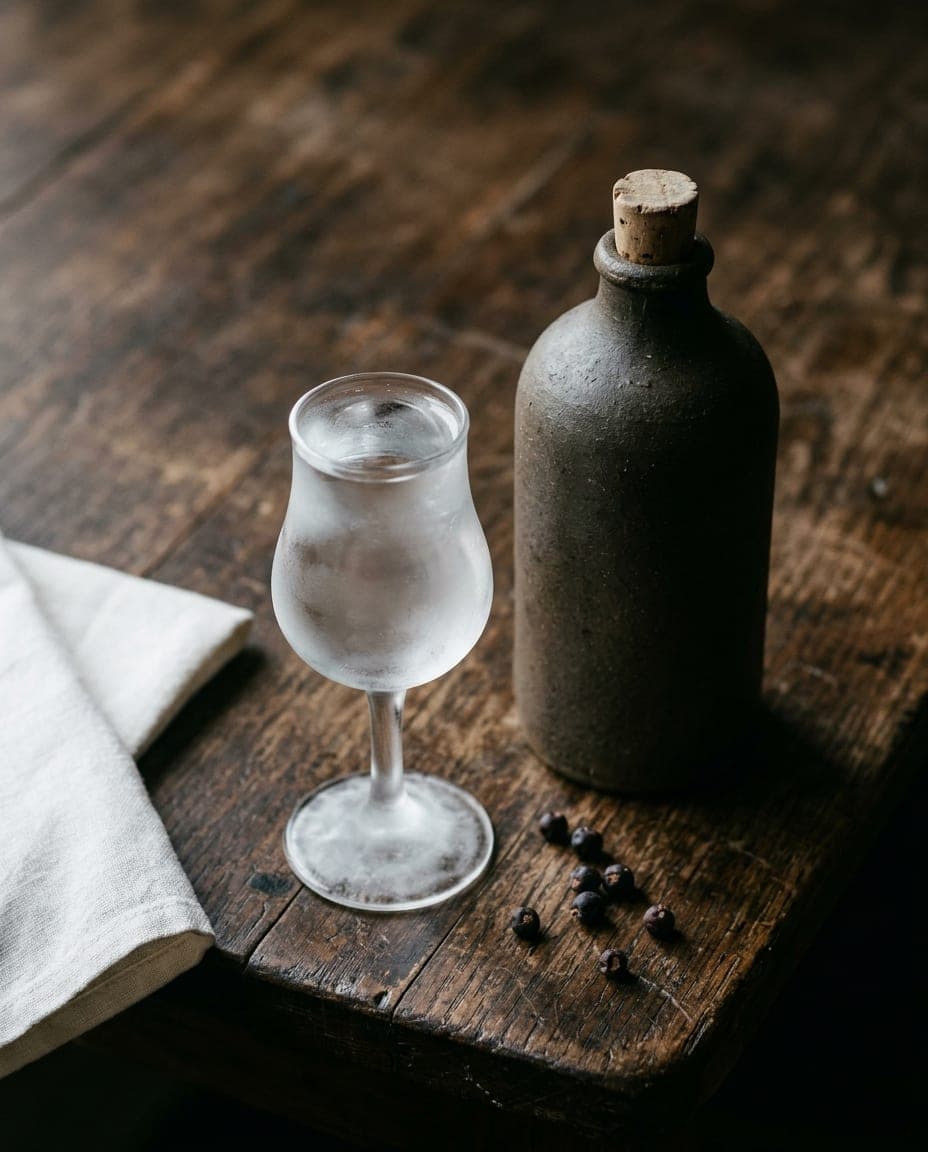
The malted grain spirit of Flanders, served ice-cold in a tulip glass
- Alcoholic
- Local name
- Jenever
- Served
- Often chilled, in a brimming tulip glass
- Best eaten at
- A Flemish jenever café
- Pairs with
- Grey shrimp or cheese cubes
What it is
Jenever is a juniper-flavoured spirit that originated in the Low Countries and serves as the direct ancestor of modern gin. While it shares a family resemblance with the clear, neutral spirits found elsewhere, jenever is distinct in its character, tasting closer to a light whisky than to a dry London gin. It is built on moutwijn (malt wine), a spirit distilled from a fermented mash of malted grains, which is then blended and flavoured with juniper berries. The result is a spirit that feels grainy, slightly sweet and full-bodied, carrying a history that stretches back centuries through the region of Flanders.
In Belgium, this drink holds a special status as a regional speciality rather than a nationwide staple. Its heart lies in Flanders, where it remains a central part of local culture. The name is a European geographical indication reserved for spirits from Belgium, the Netherlands and small border areas of France and Germany, and Belgium also protects regional versions such as Hasseltse jenever, Balegemse jenever and O'de Flander, as well as Walloon péket. It is not merely a cocktail ingredient or a quick drink; it is a beverage with a specific identity, bound up with the landscape and history of the Flemish countryside.
The styles: Oude and Jonge
The most important distinction in jenever lies between its two main styles, oude and jonge. These terms do not refer to the age of the spirit or how long it has sat in a cask. Instead, they describe the recipe and the balance of flavours. Oude jenever is the traditional style, containing a higher proportion of moutwijn, at least 15 per cent. This gives it a fuller, richer, and more malt-forward profile, often with notes reminiscent of young whisky or corn.
In contrast, jonge jenever took hold in the early 20th century to suit a changing palate. It contains less moutwijn and more neutral grain alcohol, giving a cleaner, lighter taste. While still flavoured with juniper, it feels more neutral than its older counterpart. Some versions of both styles are aged in oak barrels, which adds a golden hue and a soft, woody complexity, while others remain clear and bright. Fruit-flavoured variants are also common in Belgium, offering a sweet and aromatic alternative to the classic grainy profile.
The Hasselt tradition
Hasselt, a city in Belgian Limburg, is widely regarded as the capital of jenever. The city has a dedicated jenever museum and a jenever festival, and its own Hasseltse jenever is protected by name. In the surrounding region, the drink is not just a product but a social ritual. It is common to find small bars dedicated solely to the tasting and appreciation of different jenever styles, where the focus remains entirely on the glass and the conversation.
The way jenever is served in these places defines the experience. It is poured, often ice-cold, into a small tulip glass that is filled to the very brim, so full that the surface bulges above the rim. This has led to a well-known custom: the first sip is taken by bending down to the glass on the bar, hands off, rather than lifting it and spilling it. It adds a playful element to the ritual.
How to drink it
Jenever is best enjoyed in a Flemish jenever café, where the atmosphere is relaxed and the focus is on the spirit itself. Jonge jenever is usually served well chilled, while oude is often served cool or at room temperature, and the tulip shape helps to concentrate the aroma of the juniper and grain before the first sip arrives. Because the liquid is served to the brim, the bend-and-sip technique is often observed, though some visitors may simply take a slow sip if they prefer. The goal is to experience the full flavour without distraction.
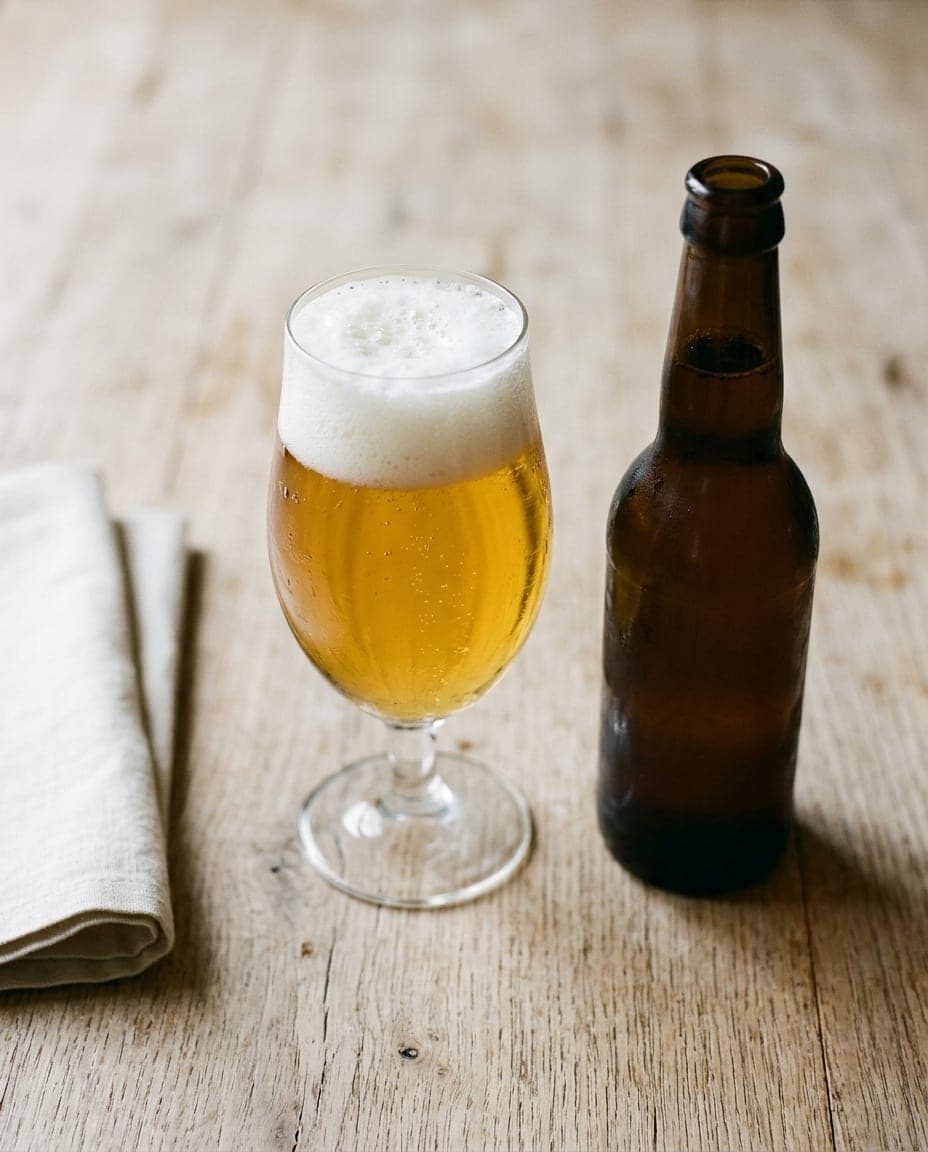
A common pairing for jenever is a small glass of beer placed right next to the spirit, the combination the Dutch call a kopstootje, or 'little head-butt'. This combination allows the drinker to alternate between the cold, sharp spirit and the softer, malty beer. In many places, it is also served alongside grey shrimp or cubes of local cheese. The saltiness of the shrimp or the fat of the cheese cuts through the juniper notes and balances the grainy sweetness of the spirit. A plate of vleeswaren, or cured meats, often accompanies the drink, providing a savoury contrast to the cold glass.
Curious facts
- The name comes from the plant. The word jenever comes, via Dutch, from the Latin juniperus, juniper, the same root that gave English the word gin, reflecting the primary botanical that defines the spirit's character.
- A protected heritage. The production of jenever is covered by a European protected designation, meaning only spirits from Belgium, the Netherlands and small parts of northern France and north-western Germany can legally use the name.
- The bend-and-sip. Because the glass is filled until the spirit bulges above the rim, the first sip is traditionally taken by leaning down to the glass instead of lifting it.
- Not just a mixer. While jenever is used in cocktails, it is traditionally drunk neat as a spirit on its own, often accompanied by beer or food rather than mixed with soda or juice.
- Regional pride. Hasselt in Limburg is the city most associated with jenever, and the local economy has long been tied to the production and sale of the spirit.
Where to try it
The best place to taste jenever is a Flemish jenever café, particularly in and around Hasselt in Belgian Limburg. These small establishments are dedicated to the spirit, offering a wide selection of oude and jonge styles, as well as fruit variants and barrel-aged versions. For a complete evening, order a beer alongside your jenever and let the two drinks complement each other in turn.
Where to try it
1 region
 Wine Tasting7 destinations
Flanders
Flanders is the Dutch-speaking region of northern Belgium, and its short distances between towns hide a slow, layered kind of travel. Villages in Flanders and its larger cities share a way of asking for attention: a market square, a belfry, a stretch of canal reflecting brick gables. The pace here rewards stopping, and the region's compact size makes it possible to settle into a handful of places instead of covering ground. The medieval old towns are the backbone of any Flanders itinerary. Ghent carries the largest and least polished of them, its student population keeping the streets lived-in. Bruges is smaller and more carefully kept, its canal loop and lace-making tradition drawing people who want the postcard version of Flanders done well. Antwerp brings energy to the mix: a working port, a Baroque cathedral, a fashion district, and a diamond trade still run on old trust. Mechelen and Leuven sit close to the bigger cities and carry the same belfry-and-canal character at a quieter volume. Flemish painting shaped much of what these cities still show today. Ghent's cathedral holds an early masterpiece of Flemish painting, and Antwerp's museums keep strong collections from the city's own Baroque painters. These works were made for the churches and guild halls that still stand on the same streets, which gives them a different weight than seeing them somewhere unconnected to their making. Beer culture in Flanders runs deep and steady. Trappist monasteries brew to support their communities, following recipes kept inside their own walls for generations, and abbey beers named after those monasteries fill the menus of ordinary town cafés. A brown café in Ghent or Antwerp — dim, wood-panelled, unhurried — is where this culture is actually lived, over a single well-poured glass at a corner table. Chocolate carries a similar seriousness. Family-run chocolatiers in Bruges, Ghent and Antwerp still hand-dip pralines and temper chocolate by hand, and a short exchange with the person behind the counter often teaches more than any shop sign. A small box eaten the same afternoon suits the tradition better than a large one carried home. Flanders' countryside opens quickly beyond the larger cities into flat farmland, poplar-lined canals, and villages that rarely appear on an international itinerary. Damme, close to Bruges along a canal path, holds a windmill, a church and a handful of houses, and needs little more than that. Further south and east, the villages around Ypres carry the memory of the First World War: cemeteries, memorials, and the Last Post sounded each evening at the Menin Gate sit alongside the region's more familiar reputation for beer and lace. The coast changes the rhythm again. Oostende keeps a working fishing fleet and a long promenade, while smaller resorts such as De Haan hold onto early-twentieth-century villas and quiet dunes once summer ends. The flat sand and open sky offer a clear contrast to the cobbled squares and canal reflections inland. Traditions stay visible through the year. Processions, guild festivals, and beer events give each town its own calendar, kept by the community rather than staged for visitors. Slow travel here means choosing depth over distance. The region's small scale makes it tempting to plan a long list of towns, but it holds together better when explored through fewer stops, each one given room to open up: a market square seen at different times of day, a canal walk repeated at dusk, a return visit to the same chocolate shop once the first box runs out. Ghent and Bruges alone hold enough layers — museums, churches, quiet residential streets away from the centre — to fill a visit, and pairing either with a coastal stop or a village like Damme adds contrast without adding rush. Flanders rewards this kind of attention because so much of its character sits just below the surface: a monastery's own beer recipe, a canal town's working history before tourism arrived, a village whose only claim is a windmill and a church that has stood for generations. Most of it opens up only once the rushing stops.
Wine TastingHikingBoat RentalsLocal Cuisine