Wiener Schnitzel
The breaded veal cutlet Vienna gave its name to
- Local name
- Wiener Schnitzel
- Served with
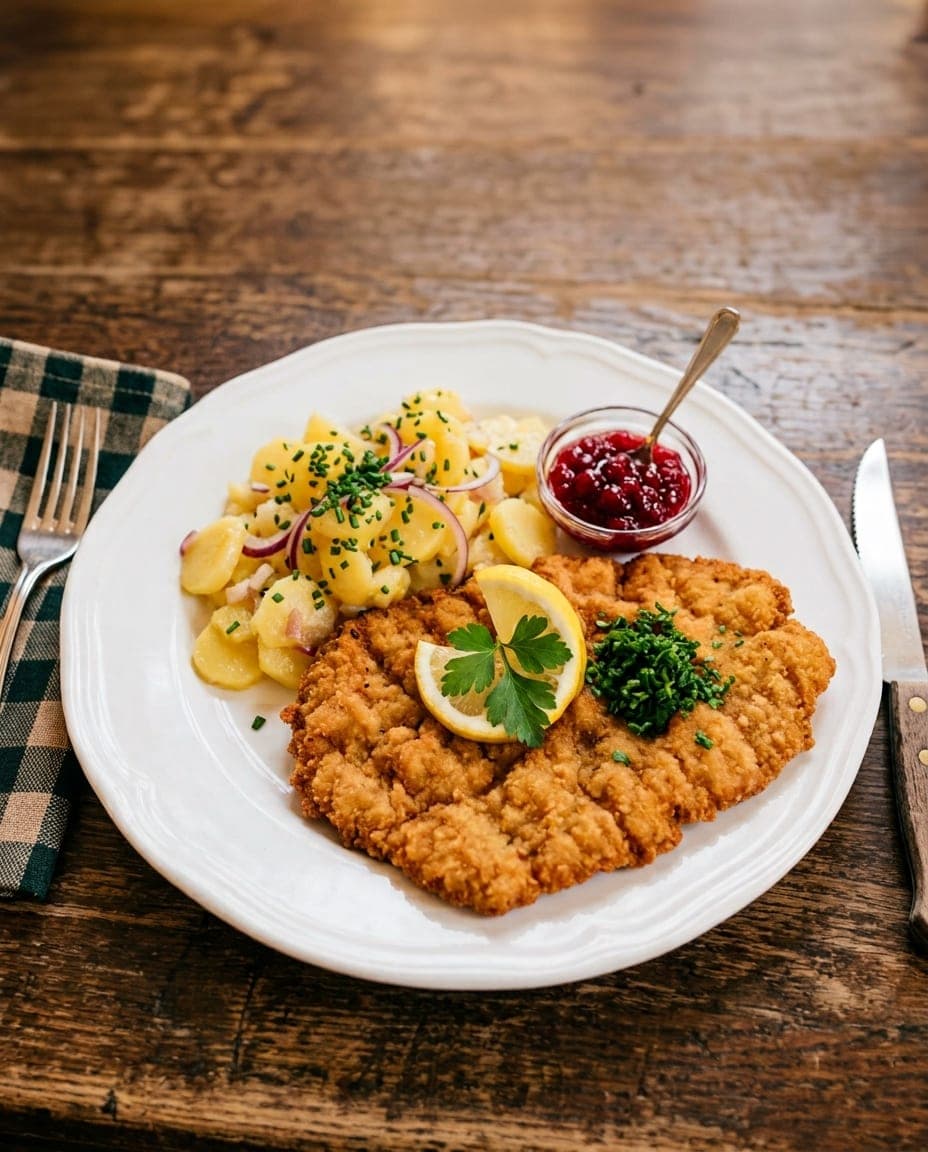
- Potato salad, lemon, lingonberries
- Best eaten at
- A Viennese Beisl
- Pairs with
- Grüner Veltliner
What it is
Wiener Schnitzel is a thin veal cutlet, breaded and fried, and it is the dish most people name when they are asked what Austrians eat. It is eaten all over the country, but Vienna is its home and the source of its name. The meat is pounded until it is almost translucent, then passed through flour, beaten egg and fine breadcrumbs and fried in plenty of hot fat, traditionally lard or clarified butter. A wedge of lemon and a potato salad or a plate of parsley potatoes come alongside.
There is no sauce. The whole dish rests on the contrast between a dry, crisp shell and soft meat, with the lemon squeezed over at the last moment. The test Viennese cooks apply is whether the breading has puffed: in a well-made Schnitzel the coating lifts away from the meat in places and sits over it like a loose blister, rather than clinging to it. A Schnitzel that is thick, heavy or greasy has failed, whatever else is on the plate.
The Milan myth
The story most often told about the dish runs like this: Field Marshal Radetzky, campaigning in Lombardy in the mid-19th century, sent word of a breaded veal cutlet he had eaten in Milan, the cotoletta alla milanese, and the recipe travelled to Vienna with him. It appears in travel guides, on menus and in a great many newspaper columns.
Food historians treat it as a myth. There is no documentary support for it: the earliest version the linguist Heinz-Dieter Pohl could find is in an Italian food guide from 1869, and later writers copied it from there. The name Wiener Schnitzel itself already appears in an Austrian cookbook from 1831. What can be said is less tidy: breaded, fried cutlets were being cooked in Austrian and Italian kitchens long before anyone attached a general's name to them, and the question of which kitchen taught which has no clear answer. Vienna's claim rests on the name and on what the city did with the dish afterwards, not on an inventor.
A name with legal weight
In Austria and Germany the words Wiener Schnitzel carry a legal meaning: a cutlet sold under that name must be veal. The same cutlet made from pork is a different item on the menu and has to say so, usually as Schnitzel Wiener Art — Schnitzel in the Viennese manner — or Wiener Schnitzel vom Schwein, with the pork spelled out. The pork version is cheaper, far more common in everyday cooking, and perfectly respectable; it just has to say what it is.
This is worth knowing before ordering, because the difference often comes down to a few small words on the menu. A Schnitzel listed without a word about the meat, at a price well below everything around it, is not veal.
What goes into it
The list is short, and the method matters more than the shopping:
- Veal, cut from the leg, and beaten out thin and even so that it cooks through in the minute or two the coating needs.
- Flour, a first dry coat so the egg has something to hold on to.
- Egg, beaten, the layer that carries the crumbs.
- Breadcrumbs, fine and dry, which puff and separate from the meat as they fry.
- Lard, clarified butter or a neutral oil, deep enough that the cutlet moves in the pan rather than resting on its bottom.
- Lemon, served alongside, never cooked with the meat.
Many Viennese restaurants add a small spoonful of lingonberry jam, something sweet and sharp against the fried crumb, though purists argue it does not belong on the plate.
How to eat it
Wiener Schnitzel is a main course, usually eaten at lunch or early evening in a Beisl — a small neighbourhood tavern with a short menu, paper-covered tables and no interest in ceremony. The cutlet often overhangs the plate. Squeeze the lemon over it as soon as it arrives, while the coating is still dry enough to take it.
The potato salad served with it in Vienna is dressed with oil, vinegar and stock rather than mayonnaise, sometimes with onion or sliced gherkin; parsley potatoes, boiled and turned in butter and chopped parsley, are the other standard. A glass of Grüner Veltliner, the dry white grown across Lower Austria, is the usual drink, and its sharpness does the same work as the lemon.
Curious facts
- The name is protected, the dish is not. Austrian and German food law reserves Wiener Schnitzel for veal, but nothing stops a cook anywhere from making the same cutlet and calling it something else.
- The Radetzky story came later. The best-known account of the dish's origin first appears in an Italian food guide from 1869, while the name Wiener Schnitzel is already in an Austrian cookbook from 1831.
- The breading should not fit. A coating that sits tight against the meat is the mark of a cutlet fried in fat that was not hot enough or not deep enough.
- Pork is the everyday version. Schnitzel Wiener Art is what most Austrian households actually cook, and what most canteens serve.
- Lemon, not sauce. Nothing is poured over a Wiener Schnitzel. The lemon is the only thing the diner adds.
Where to try it
The dish is on the menu of almost every traditional restaurant in Vienna, and in most of the country beyond it, so the question is less where to find one than which kind of room to eat it in. A Beisl in one of the residential districts, away from the Ringstrasse, is the setting it was made for: a dozen tables, a handwritten specials board, and a kitchen that fries to order. Elsewhere in Austria the same cutlet appears in country inns and mountain restaurants, usually with the potato salad of the region rather than the Viennese one.
Where to try it
1 destination
 Camper Van Rentals
Vienna
Imperial capital with baroque palaces, Ringstrasse, classical music scene.
Camper Van RentalsWine TastingHiking
1 region
- Camper Van Rentals1 destination
Vienna
Vienna stands out as Austria's capital, rich in history and culture. This vibrant city is renowned for its classical music heritage, featuring composers like Mozart and Beethoven. The historic center, a UNESCO World Heritage site, showcases stunning architecture ranging from Gothic to Baroque. Beyond the mainstream attractions, explore the lesser-known neighborhoods like Margareten and Favoriten, where local markets and authentic eateries thrive. The city's coffee house culture, a UNESCO Intangible Cultural Heritage, invites you to savor traditional pastries. For nature lovers, the Vienna Woods offer picturesque hiking trails. This capital is an exciting blend of imperial history and modern creativity.
Camper Van RentalsWine TastingHiking