Mozartkugel
Salzburg's hand-dipped marzipan and nougat sphere
- Vegetarian
- Local name
- Mozartkugel
- Best eaten at
- A Salzburg Konditorei
- Pairs with
- Viennese coffee
What it is
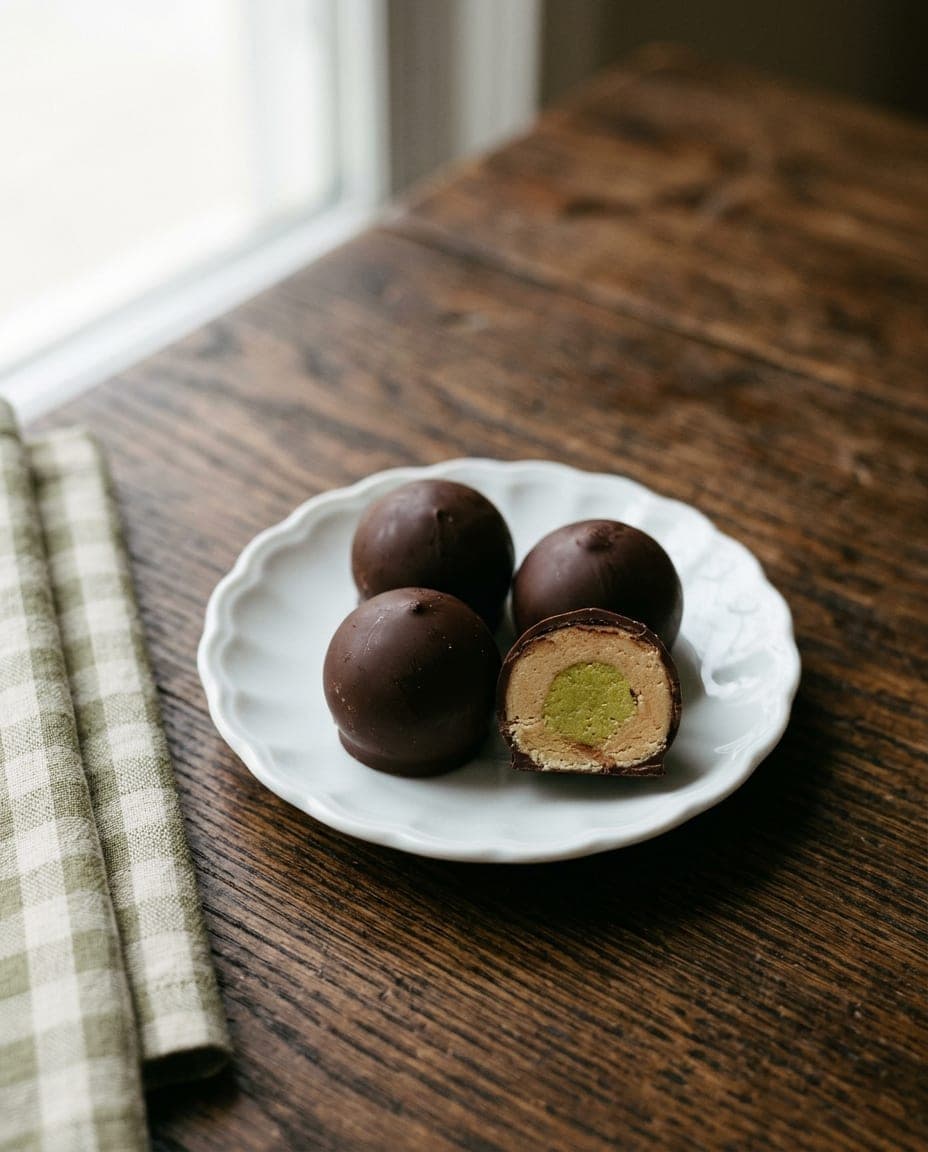
The Mozartkugel is a round praline that sits at the centre of Salzburg's confectionery tradition. It is not a cake or a tart but a perfect sphere composed of three distinct layers: a core of green pistachio marzipan, a surrounding layer of light hazelnut nougat, and an outer shell of dark chocolate. The nougat is sweet and nutty, the marzipan earthier, and the dark chocolate holds the two together without adding much sweetness of its own.
It was created in Salzburg in 1890 and the city is still where the hand-made version comes from, though the name now sits on boxes in every airport in the country. The shape is often the quickest way to tell the two apart: the hand-dipped praline is a true sphere, while most factory ones have a flattened base.
The origin story
In 1890 the Salzburg confectioner Paul Fürst set out to honour Wolfgang Amadeus Mozart, who was born in the city and whose music remains central to its identity. The sweet, first sold as the Mozart-Bonbon, was named after the composer, not because he invented it, but as a tribute to his legacy. Fürst combined familiar ingredients — marzipan, nougat and chocolate — into a new form, and in 1905 it won him a gold medal at an exhibition in Paris.
What followed was a long argument about a word. Several makers wanted Original on the box, the question went through the courts, and the settlement and a final ruling in 1996 left different makers with different wordings — only Fürst's praline may be called Original Salzburger Mozartkugel, while others call theirs echte (genuine) or simply Mozartkugeln. The wording on the foil is therefore a legal fact rather than a description of quality, and reading it is the only reliable way to know what is inside.
How it is made
The traditional Salzburg version is still made by hand, a process that distinguishes it from industrial alternatives. A skilled confectioner begins with a core of pistachio marzipan, which is rolled into a perfect ball. This core is then wrapped in a layer of hazelnut nougat that surrounds the green centre completely. The ball is then pushed onto a small wooden stick, dipped in dark chocolate and stood upright to set.
A key detail of this hand-made process is the method used to remove the praline from the dipping stick. Once the chocolate has set, the stick is pulled away and the small hole it leaves is closed with a dab of chocolate, which can leave a faint round mark on the surface. It is a small sign that the sweet was dipped by hand rather than machine-made. The finished spheres are then wrapped in distinctive silver foil printed in blue, which serves as both protection and identification for the consumer.
Factory production followed during the 20th century and is now what most of the world eats. Many industrial pralines have a flattened base, no stick mark, and foil in gold, red or other colours rather than blue and silver. It is also firmer, and the line between marzipan and nougat is less distinct. These are differences of method, not of honesty: the machine-made version is a perfectly good sweet that is simply not the same object.
What goes into it
Three things, in fixed proportions:
- Pistachio marzipan: The core is marzipan made with pistachios, giving a green, slightly grainy texture and a nutty foundation.
- Hazelnut nougat: A soft, smooth paste of roasted hazelnuts, sugar and chocolate, which surrounds the marzipan core and adds a creamy mouthfeel.
- Dark chocolate: The coating, thin enough that the two nut layers still dominate the taste.
The proportions decide whether it works: too much marzipan and the praline is heavy, too little nougat and there is nothing to carry it. Bitten in half, a good one shows three clear bands and a green centre.
How to eat it
In Salzburg the praline belongs to the afternoon and to a Konditorei, a confectioner's shop with a few marble tables where the sweets sit in a glass case and are sold singly as well as by the box. One with a coffee is the standard order; the coffee's bitterness is what keeps a second one possible.
A hand-dipped praline is also a perishable object rather than a souvenir. It is at its best fresh, which is the practical argument for buying two rather than a tin.
Curious facts
- The stick mark matters. The small chocolate-sealed spot left by the dipping stick is a hallmark of the hand-made version, distinguishing it from machine-made ones.
- The foil wording is legal. Original, echte and plain Mozartkugeln are the outcome of court cases about who may say what, not a scale of quality.
- Regional focus. While known globally, the hand-dipped original is made and sold only in Salzburg.
- A green heart. The pistachio marzipan core gives the praline its characteristic green colour, which peeks through the chocolate when bitten.
- Blue and silver. The original's silver foil with blue print is the quickest way to recognise it on a counter; a 2017 court ruling reserved that wrapping for it.
Where to try it
The hand-dipped version is a Salzburg object and is sold in the confectioners of the old town, within a few streets of the river. The test is whether the praline is round and whether it carries the stick mark; supermarket boxes anywhere in the country hold the industrial kind. Staff in the old-town shops will usually explain the difference before being asked.
Where to try it
1 destination
 Camper Van Rentals
Salzburg
Mozart's birthplace, baroque jewel of Austria
Camper Van RentalsCastlesHikingLocal Cuisine
1 region
 Castles3 destinations
Salzburg
Nestled in the Alps, this region is renowned for its baroque architecture and stunning landscapes. Salzburg is the birthplace of Mozart and boasts a rich musical heritage. The region is characterized by picturesque lakes, including the beautiful Wolfgangsee, and the majestic peaks of the surrounding mountains. Hidden gems like the charming village of St. Gilgen and the historical town of Hallein invite exploration. Salzburg's unique salt mines, dating back to prehistoric times, reveal its historical significance in trade. The region hosts various local festivals, including the Salzburg Festival, celebrating music and theater, making it an intriguing locale for cultural exploration. Ideal for those seeking to connect with both nature and history, this area offers a wealth of experiences off the typical tourist path.
CastlesHikingWine TastingCamper Van Rentals