Stekt strömming
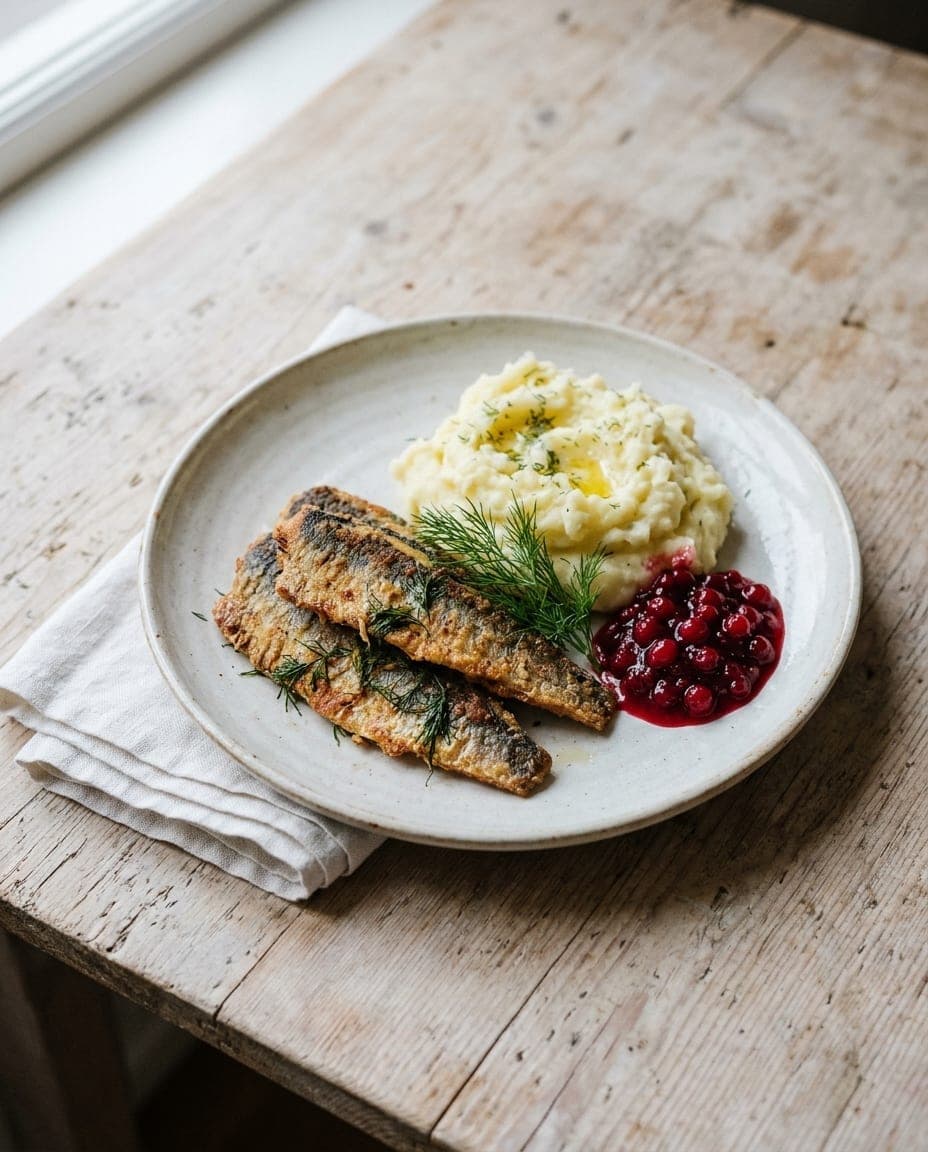
Fried herring with mash and lingonberries
- Local name
- Stekt strömming
- Served with
- Mash, lingonberries
- Best eaten at
- A Stockholm strömming street stall
- Pairs with
- Swedish lager
What it is
Stekt strömming is the name given to small fillets of Baltic herring that have been fried in butter until golden and crisp. The dish is a staple of Swedish home and lunch-restaurant cooking along the east coast, and in Stockholm it is also sold from a street stall by the water. While herring appears in many forms across Scandinavia, this preparation is most closely associated with the capital and its archipelago.
The fillets are typically opened flat and fried together in pairs with their skin side facing outwards. The result is a soft interior contrasted by a crisp, buttery crust. It is served simply: a portion of the fish sits atop a mound of creamy mashed potatoes, with a spoonful of lingonberries and often some chopped red onion against the butter.
The line between sill and strömming
Swedish distinguishes carefully between two types of herring that belong to the same species but differ in habitat and size. Sill refers to the larger herring of the Atlantic side and the southern Baltic, while strömming is the smaller, leaner Baltic herring that lives in the brackish waters of the Baltic Sea. The naming boundary, set by the crown in the 1500s, lies at Kristianopel in the Kalmar Strait, roughly where saltier southern waters give way to the fresher Baltic.
This distinction matters to cooks and diners alike. Because strömming is smaller and contains less oil than its Atlantic cousin, it holds its shape well when fried whole or in fillets. The fish is caught year-round, though the quality varies with the season. In Stockholm, the focus remains on the local Baltic catch rather than imported varieties.
How it is sold in Stockholm
In the capital the dish has a specific home: the street stall by the water, best known in the herring van outside Slussen on Södermalm. The setup is modest, often consisting of a small counter where the fish are fried fresh in large pans of butter.
The serving method is practical for a busy day by the sea. The fish, mash, and berries are packed into a cardboard box or paper tray, allowing the diner to eat while walking or standing near the water's edge. A wooden fork does the rest. It is a meal designed for speed and warmth rather than a formal dining experience.
What goes into it
The ingredients are minimal, relying on the quality of the fish and the fat used for cooking:
- Baltic herring fillets, small and lean, opened flat to ensure even frying.
- Butter, which provides the primary flavour and creates the crisp texture on the skin.
- Rye flour or breadcrumbs, used lightly to coat the fillets before they hit the pan.
- Mashed potatoes, prepared with milk and butter to create a soft base for the fish.
- Lingonberries, either fresh, frozen, or in jam form, offering a sharp, acidic contrast.
The seasoning is restrained, typically limited to salt and white pepper. There are no heavy sauces or garnishes. The dish relies on the natural taste of the herring and the buttery finish.
Curious facts
- Fried in pairs. The fillets are often laid side by side in the pan with their skin facing out, creating a single crispy unit that is easier to handle.
- A waterside tradition. In Stockholm the dish is as much a quayside meal as a lunch plate, eaten at the water's edge, where steam from the frying pans mixes with sea air.
- The Kalmar Strait divide. The name changes at Kristianopel in the Kalmar Strait, a line drawn by the crown in the 1500s; genetic studies put the subspecies boundary at about the same latitude.
- A simple pairing. While often eaten alone, it is often accompanied by a cold Swedish lager, which complements the salty, buttery profile of the fish.
- Not just for lunch. Although popular as a quick meal during the day, the dish is also available in the evening at the Slussen stall, which keeps long hours.
Where to try it
A street stall on the Stockholm waterfront, where the fish are fried to order and handed over in a box with the mash and the berries already in it. The best known of them stands outside Slussen on the Södermalm side and has been there for years.
Restaurants serve a plated version with pickled cucumber and dill, usually as a lunch dish. It costs more and is eaten sitting down, which is a different proposition from standing on a quay with a cardboard box.
Where to try it
3 destinations
 Boat Rentals
Norrtälje
Charming coastal town with historic wooden houses and vibrant archipelago.
Boat Rentals Camper Van Rentals
Stockholm
Archipelago capital with historic sites, vibrant culture, and stunning waterfront.
Camper Van Rentals
1 region
 Boat Rentals7 destinations
Stockholm
Stockholm, the largest city in Sweden, is spread across 14 islands, each with its unique character. The city boasts a rich maritime history, and its archipelago features over 30,000 islands, perfect for exploration. Gamla Stan, its medieval heart, offers narrow cobblestone streets and colorful buildings. The Vasa Museum showcases a 17th-century warship, while Skansen, the world's first open-air museum, presents traditional Swedish life. Nearby, the historic town of Sigtuna is known for its Viking heritage. The region also embraces sustainability, with numerous parks and eco-friendly initiatives, making it a hub for nature lovers and those interested in local culture.
Boat RentalsHikingCamper Van Rentals