Semla
A cardamom bun filled with almond and cream
- Vegetarian
- Local name
- Semla
- Best eaten at
- A Stockholm konditori
- Pairs with
- Coffee
What it is
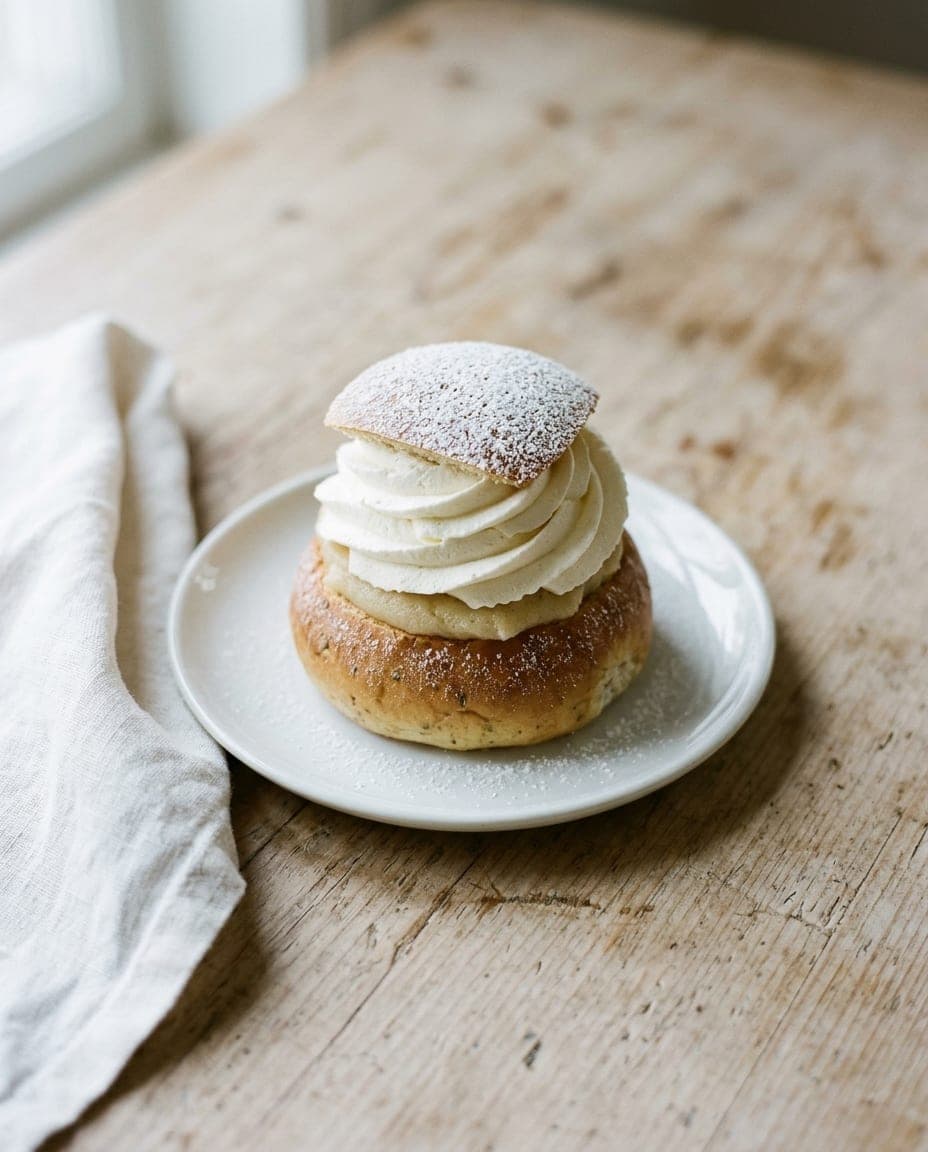
The semla is a sweet yeast bun scented with cardamom, traditionally eaten in Sweden during the period between Christmas and Easter. Buns of this kind are eaten across Northern Europe at the same point in the calendar, but the Swedish one has gone its own way. The pastry begins as a soft, golden wheat bun, its top sliced off like a lid before the inside is hollowed out. The crumb is then mixed with almond paste and milk to form a thick filling, which is returned to the bun along with fresh whipped cream. The lid goes back on and the whole thing is dusted with icing sugar.
While it appears as a simple sweet treat today, the semla carries the weight of religious tradition. It is a pre-Lenten food, tied to the days before the fast. Historically it was the opposite of a fasting food: a last rich thing eaten on the day before the fast began. The bun is most closely associated with Fettisdagen, or Shrove Tuesday, the day before Ash Wednesday. On this specific Tuesday, the consumption of semlor peaks across the entire country, turning bakeries into busy hubs of activity.
The history of the fast-day bun
The origins of the semla are rooted in medieval European baking traditions rather than a single Swedish invention. The word is related to the German Semmel, a plain wheat roll; the Finnish equivalent of the bun is laskiaispulla, filled with jam as often as with almond paste. By the 18th century, the bun was firmly established in Swedish culture as a marker of the pre-Lenten season.
The most famous story concerns King Adolf Fredrik, who died on 12 February 1771 after a very large meal said to have included lobster, caviar, sauerkraut, smoked herring and champagne, finished with hetvägg; later retellings put the number of buns at fourteen. His doctors blamed a stroke and the buns' part in it is debated, but the tale serves as a cautionary anecdote about indulgence before the fasting season. It is an enduring piece of folklore that links the pastry to the Swedish monarchy and adds a layer of dramatic history to its daily consumption.
The logic was simple: eat heavily on the last day before weeks of abstinence. The religion has gone and the timing has stayed, which is why a pastry tied to Lent is still eaten by a country that mostly does not keep Lent.
How it is made
The construction of a semla follows a specific method that distinguishes it from other pastries. The dough is a wheat-based yeast bread enriched with cardamom, which gives it a warm, aromatic flavour distinct from plain brioche or cinnamon rolls. After the dough rises and is baked into round buns, the top third is sliced off to create a removable lid.
The interior of the bun is scooped out, leaving a hollow shell. The removed bread is then mashed together with almond paste, a dense sweet made from ground almonds and sugar, and a small amount of milk to bind it into a creamy consistency. This mixture is placed back into the hollowed bun, followed by a generous dollop of lightly sweetened whipped cream. The lid is returned to its place, covering the filling entirely. The finished product is dusted with icing sugar, which can be thick and white or applied more sparingly.
The oldest way of eating it is in a bowl of hot milk, sometimes with a sprinkle of cinnamon on top. This version is hetvägg. The name looks like "hot wall" in Swedish and is thought to be a mangling of the German heisse Wecken, hot buns. The dry version with cream is now the standard; the hot-milk variation survives mainly among those who keep to older traditions.
Where it is eaten
The semla is a national custom, enjoyed from the northern reaches of Lapland to the southern tip of Scania, where it is often called fastlagsbulle. Stockholm, with its old konditorier, is where the ritual is most visible. In the capital, the konditori, or traditional pastry shop, is the primary destination for the bun. These are not merely bakeries but social institutions where people gather to eat the semla and drink coffee.
The ritual of the fettisdag involves a queue outside the local konditori. On Shrove Tuesday, lines can stretch around the block as people wait to buy their buns. It is common for individuals to purchase multiple semlor in a single visit, not to eat them all at once but to take home or share with colleagues.
While the bun is available in supermarkets and chain bakeries across the country, the experience is considered best in a traditional Stockholm konditori. These establishments often have a long history, some dating back to the 19th century, and they maintain the quality of their dough and fillings with care. The pairing of the semla with strong black coffee is the standard combination, though tea or hot chocolate are also acceptable companions.
A changing season
When the buns may appear is argued about every year. Bakeries now put them out shortly after Christmas, and traditionalists hold that nothing should be sold before Lent is in sight. Fettisdagen itself moves with Easter, falling somewhere between 3 February and 9 March, and the peak is still firmly on that day whatever the shelves say.
What the bun marks now is the end of winter rather than the start of a fast.
Curious facts
- The lid is cut after baking. The top third comes off the baked bun, the inside is scooped out and mixed with almond paste, and the lid goes back on over the cream.
- A national queue. On Fettisdagen, it is not unusual to find long lines outside popular bakeries in Stockholm, where customers often buy several buns at once for home or the office.
- The hot milk version. Before the cream-filled dry version became dominant, the semla was served in a bowl of hot milk with cinnamon, known as hetvägg, a practice that persists in some households today.
- King's fate. King Adolf Fredrik is popularly said to have died after eating fourteen semlor in one sitting; the number is a later embellishment and his doctors blamed a stroke, but the anecdote that links the pastry to Swedish royal history and warns against overindulgence.
- A European cousin. Finland fills its laskiaispulla with raspberry jam as often as with almond paste, and the two countries disagree about it.
- The calendar debate. While semlor are now sold from January, traditionalists argue they should wait until Lent is close, leading to a seasonal dispute over when the buns first appear in shops.
Where to try it
A konditori in Stockholm on or near Fettisdagen, where the queue is the point as much as the bun. The shops are spread through the centre and the residential districts, and most have a following that turns up on the same day every year.
The hot-milk version has to be asked for and not every shop will do it. Outside the season the buns are still around from January, but the day itself is the thing.
Where to try it
1 region
 Boat Rentals7 destinations
Stockholm
Stockholm, the largest city in Sweden, is spread across 14 islands, each with its unique character. The city boasts a rich maritime history, and its archipelago features over 30,000 islands, perfect for exploration. Gamla Stan, its medieval heart, offers narrow cobblestone streets and colorful buildings. The Vasa Museum showcases a 17th-century warship, while Skansen, the world's first open-air museum, presents traditional Swedish life. Nearby, the historic town of Sigtuna is known for its Viking heritage. The region also embraces sustainability, with numerous parks and eco-friendly initiatives, making it a hub for nature lovers and those interested in local culture.
Boat RentalsHikingCamper Van Rentals