Prinsesstårta (princess cake)
Sponge, cream and green marzipan
- Vegetarian
- Local name
- Prinsesstårta
- Served with
- Coffee
- Best eaten at
- A Swedish konditori
- Pairs with
- Coffee
What it is
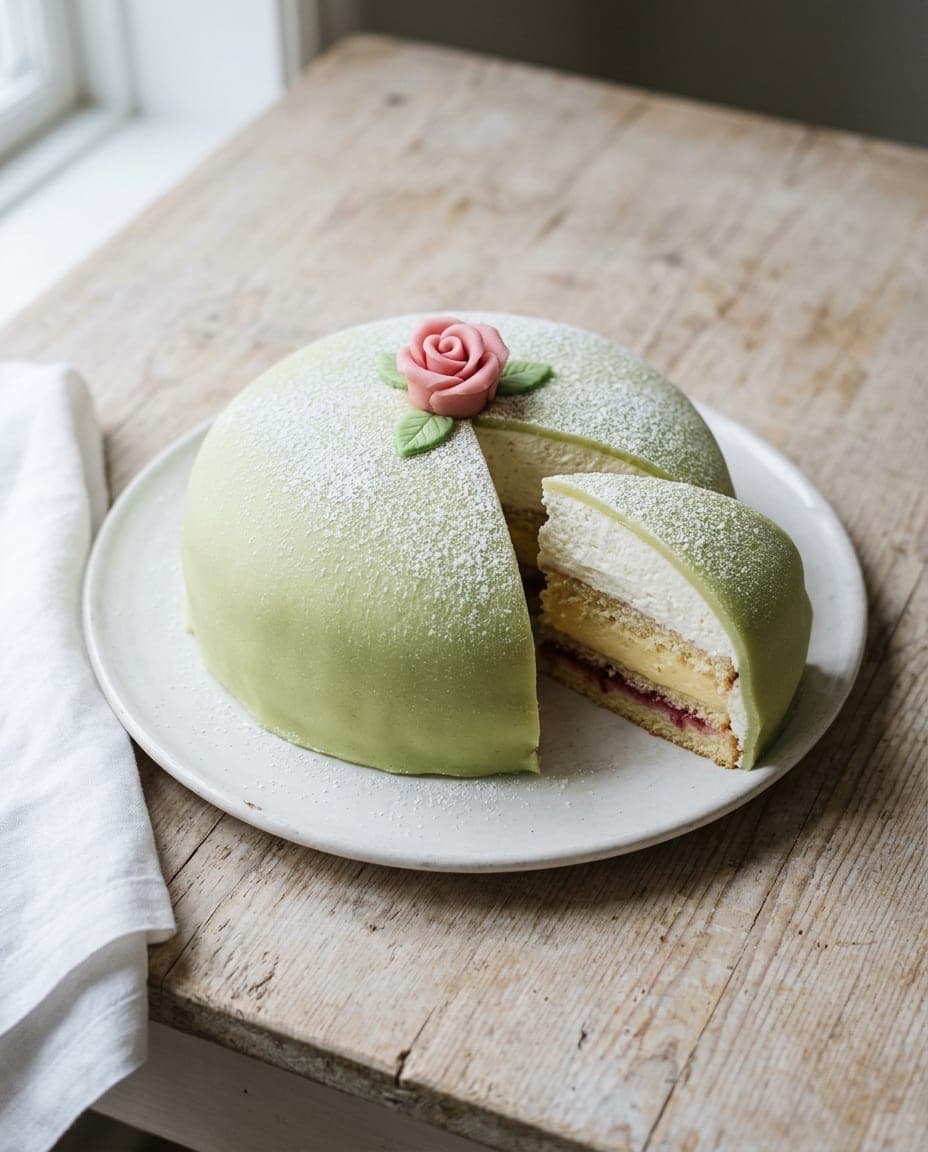
Prinsesstårta is a tall, round cake that looks like a small hill from the side. It consists of layers of sponge cake spread with raspberry jam and vanilla custard, topped with a high mound of lightly whipped cream. The entire structure is then draped in a smooth sheet of green marzipan, dusted with white icing sugar and finished with a single pink marzipan rose in the centre.
The cake is a staple of the Swedish konditori, a traditional bakery-café that serves as a social hub for coffee breaks. While similar sponge cakes exist across Northern Europe, the specific combination of ingredients and the distinctive green coating make this one instantly recognisable. It is not a heavy, dense pastry but a light, airy confection where the texture of the cream dominates the experience.
The most persistent question about the cake concerns its colour. The bright, grassy green of the marzipan covering has no obvious culinary reason. It does not match the raspberry or the vanilla custard inside. No one can say with certainty why this particular shade became the standard for the princess cake, though it is now considered essential to its identity.
The royal origin story
The recipe first appeared in print in the 1948 edition of Prinsessornas kokbok, a cookbook by Jenny Åkerström first published in 1929. Åkerström taught housekeeping and cookery to the three daughters of Prince Carl — Margaretha, Märtha and Astrid, who became in turn a Danish princess, the Crown Princess of Norway and the Queen of the Belgians. The book grew out of her teaching and was meant to help young women manage their own kitchens.
In that edition, the cake was not called prinsesstårta. It was listed simply as grön tårta, or green cake. The name changed later, reportedly because the princesses were fond of it and served it at gatherings. The story suggests that the recipe was a variation of an existing sponge cake that Åkerström adapted for the royal family, but she never claimed to invent the concept from scratch.
The cookbook was reprinted many times and remains a reference point for home bakers today. It cemented the dish's place in the national consciousness, linking it firmly to the Swedish royal family without implying any official commission or royal decree. The cake is a product of domestic cooking rather than high palace cuisine.
A Stockholm tradition
The cake is made all over Sweden, but its natural home is the konditori — the small family bakery-café, many of them decades old — and Stockholm has some of the oldest.
These establishments are central to Swedish social life. They offer a quiet space for conversation over coffee and cake, away from the bustle of the streets. In a traditional konditori it is the default order for anyone who wants cake rather than a bun. The cake is available year-round, though it sees increased attention in September when bakeries celebrate Princess Cake Week.
The association with Stockholm is not tied to a single famous address or a specific brand. Instead, the city's network of independent bakeries has kept the tradition alive through generations. Each bakery guards its own method for achieving the perfect dome shape and smooth marzipan finish, but the core elements remain consistent across the capital.
What goes into it
The structure relies on four elements that must be balanced carefully to hold the tall shape:
- Sponge, usually a light egg-based sponge sliced into three thin layers, which provides a soft structure without adding heaviness.
- Raspberry jam, spread on the bottom layer of sponge; Åkerström's original had no fruit, but jam is now standard.
- Vanilla custard, a thick, creamy filling made from milk, egg yolks, sugar and vanilla, which adds body and moisture.
- Whipped cream, lightly sweetened and aerated to form a high, soft mound that supports the marzipan skin.
The outer layer is a sheet of marzipan coloured with green food dye. It is rolled out thinly and draped over the cream dome before being smoothed by hand. The cake is then dusted with icing sugar and topped with a small, hand-shaped pink marzipan rose. No other decoration is used.
How to eat it
Prinsesstårta is best enjoyed as an afternoon treat alongside a cup of black coffee. The pairing is standard in Swedish konditorier, where the bitterness of the coffee balances the sweetness of the cake and the fat of the cream. It is rarely eaten with tea or wine in its traditional setting.
The cake is usually served in slices rather than whole, as the tall dome can be difficult to manage for a single person. A slice reveals the cross-section: thin sponge layers with jam and custard between them, and the white cream rising above. The green marzipan skin should be cut through cleanly, revealing the soft interior.
It is in the window of any traditional konditori in Stockholm, beside the semlor in late winter and the cinnamon buns all year.
Curious facts
- The colour remains a mystery. No historical record explains why green marzipan was chosen; the original name, green cake, simply describes it.
- A name change in print. The cake was listed as grön tårta in the 1948 edition of the cookbook before acquiring the princesses' name.
- A week of celebration. Swedish bakers hold a dedicated Princess Cake Week every September, when part of the price of each cake has gone to Crown Princess Victoria's Fund for children.
- Not a royal commission. Despite its name, there is no evidence that the royal family ordered the creation of the cake; it was a recipe from a domestic cook's book.
- A structural challenge. The tall dome requires careful assembly to prevent the cream from sliding out, making it a test of skill for any konditori chef.
Where to try it
A konditori in Stockholm, where the cake sits in the window under its dome of green marzipan and is sold by the slice through the afternoon. The older establishments in the city centre and on Södermalm make their own, and each has its own way of getting the dome smooth.
Supermarkets and ordinary bakeries sell it across the country, and it is the standard cake for a Swedish birthday or a graduation; a whole one ordered for a party is as common as a slice with coffee. Princess Cake Week in the autumn is when the bakeries make the most of it, including versions in other colours that traditionalists refuse to acknowledge.
Where to try it
1 destination
 Camper Van Rentals
Stockholm
Archipelago capital with historic sites, vibrant culture, and stunning waterfront.
Camper Van Rentals
1 region
 Boat Rentals7 destinations
Stockholm
Stockholm, the largest city in Sweden, is spread across 14 islands, each with its unique character. The city boasts a rich maritime history, and its archipelago features over 30,000 islands, perfect for exploration. Gamla Stan, its medieval heart, offers narrow cobblestone streets and colorful buildings. The Vasa Museum showcases a 17th-century warship, while Skansen, the world's first open-air museum, presents traditional Swedish life. Nearby, the historic town of Sigtuna is known for its Viking heritage. The region also embraces sustainability, with numerous parks and eco-friendly initiatives, making it a hub for nature lovers and those interested in local culture.
Boat RentalsHikingCamper Van Rentals