Köttbullar (Swedish meatballs)
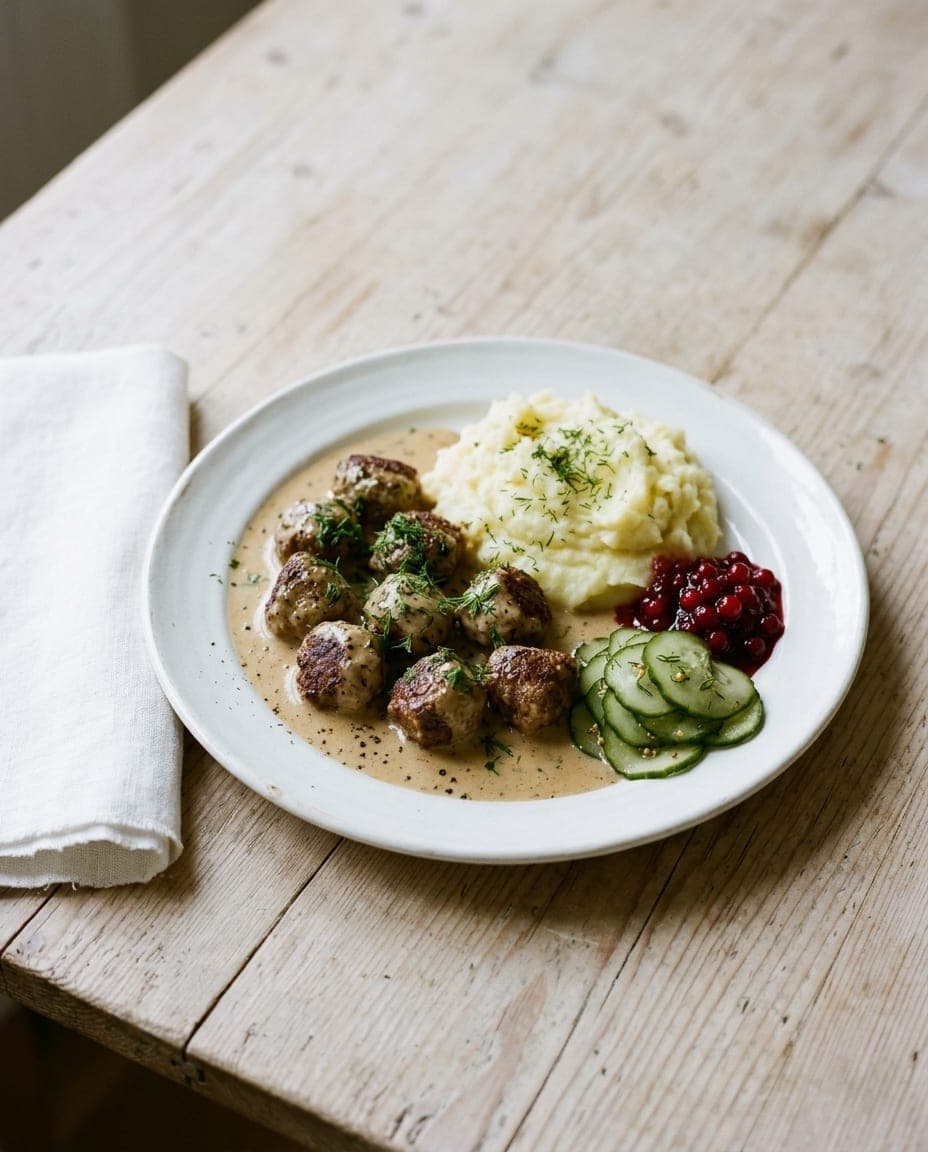
Meatballs in cream sauce with lingonberries
- Local name
- Köttbullar
- Served with
- Mash, lingonberries, gherkins
- Best eaten at
- A Stockholm husmanskost restaurant
- Pairs with
- Swedish lager
What it is
Köttbullar, the plural form meaning "meatballs", are small spheres of minced beef and pork, bound with breadcrumbs soaked in milk and flavoured with grated onion, allspice and white pepper. They are fried in butter until golden brown, then served smothered in a pale cream sauce made from the same pan juices, alongside mashed potatoes, lingonberry jam and pickled cucumber. The dish is often described as Sweden's national comfort food, yet it is more accurately a cornerstone of husmanskost, the traditional everyday home cooking of Sweden.
The identity of köttbullar relies on the balance between its five components. No single element stands alone; the meatballs are merely one part of a complete plate where the sharpness of the lingonberries cuts the fat of the cream sauce, and the soft texture of the mash absorbs the flavour of the butter. It is a dish of simple ingredients prepared with care, appearing on menus from family-run taverns to formal dining rooms across the country.
The story behind the meatballs
The origins of köttbullar are a subject of ongoing debate among food historians, with two main narratives competing for attention. The most persistent tale suggests that the recipe arrived in Sweden from Turkey during the early 18th century, brought back by King Charles XII after his years of exile in the Ottoman Empire following his defeat at Poltava in 1709. According to this account, the king encountered spiced meatballs there and introduced them to the Swedish court upon his return, where they eventually filtered down into common kitchens.
However, other writers point out that recipes for meatball-like fricadelles appear in a Swedish cookbook from 1695, well before Charles XII's travels. These earlier texts describe similar preparations using chopped veal and suet, fried in butter or boiled, suggesting that the concept of spiced minced meat existed independently within Sweden long before any royal visit. The truth likely lies somewhere between these accounts: a tradition may have been reinforced by foreign influence, yet the dish as it is known today evolved through local adaptation rather than direct importation.
Regardless of its specific origin story, the dish became deeply embedded in Swedish culture during the 19th century. As industrialisation drew people into cities like Stockholm, and the meat grinder made mince quicker to prepare, the need for affordable, filling meals grew. Köttbullar offered a way to stretch small amounts of meat with breadcrumbs and milk, creating a substantial portion that could feed a family at a reasonable cost. This practicality helped cement its place in the national diet, transforming it from a potential royal curiosity into a staple of everyday life.
The ingredients and their roles
The character of köttbullar depends on the precise combination of elements that make up the plate. Each component serves a specific function, creating a harmony of textures and flavours that defines the experience.
- Minced beef and pork: A blend of both meats provides the necessary fat content to keep the balls moist, as lean meat alone would dry out during frying. The ratio varies by kitchen, but the combination ensures a tender texture.
- Breadcrumbs soaked in milk: Also known as panade, this mixture binds the meat together while keeping it soft. Soaking the crumbs in milk before adding them to the meat prevents the final product from becoming dense or hard.
- Grated onion and spices: Fresh onion adds a sharp sweetness, while allspice and white pepper provide the warm, aromatic notes that distinguish Swedish meatballs from those of other cuisines.
- Butter for frying: Traditional preparation involves frying the balls in butter rather than oil, which imparts a nutty richness to the exterior.
- Cream sauce: Made by deglazing the frying pan with stock or water and whisking in cream, this sauce captures the browned bits left from the meatballs, creating a cohesive taste that coats every bite.
The plate is completed with sides that offer contrast. Mashed potatoes, often prepared with butter and milk, provide a neutral base for the rich sauce. Lingonberry jam, with its tart and slightly bitter notes, cuts through the heaviness of the cream. Pickled cucumber, usually sliced into thin rounds, adds a final sharp crunch to finish the meal.
How it is eaten
Köttbullar are typically served as a main course at lunch or dinner, particularly during the colder months when warm, hearty food is most welcome. The dish arrives on a large plate where the meatballs are arranged in a cluster, often surrounded by a pool of cream sauce, sometimes with more in a jug to pour over. The mashed potatoes form a bed for the meat, while the lingonberry jam and pickled cucumber sit separately on the side or in small bowls.
The eating process is straightforward but deliberate. Diners usually take one or two meatballs at a time, ensuring they get a bit of sauce with each bite. The jam is often added directly to the plate, allowing the eater to control the balance between sweet and savoury. Some people prefer to mix the jam into the cream sauce before eating, while others keep it separate to taste the distinct tartness against the meat.
A Swedish lager or a light beer pairs well with the dish, as the carbonation helps cleanse the palate of the creamy sauce. In a traditional Stockholm setting, the meal is often accompanied by a glass of water and perhaps a small salad of raw vegetables to add freshness.
Curious facts
- The sides are not optional. A plate without lingonberries and pickled cucumber is an incomplete one; Swedes will say so.
- The Turkish claim remains unproven. Despite the popularity of the Charles XII story, no contemporary documents confirm the king introduced the recipe, leaving the origin open to interpretation.
- Christmas has its own version. Smaller meatballs appear on the julbord, the Christmas table, served warm or cold alongside the herring and the ham.
- The meatball count varies. There is no fixed number of meatballs per serving; some plates hold six, others eight or ten, depending on the size of the balls and the appetite of the diner.
- A global export. The dish gained international fame in the late 20th century when a Swedish furniture retailer began serving it in its store restaurants, introducing it to millions of visitors worldwide.
Where to try it
The best place to experience köttbullar is at a restaurant that specialises in husmanskost, particularly those found in Stockholm or its surrounding suburbs. Establishments in the city centre often maintain classic menus, but the truest versions can be found in neighbourhood taverns where the tradition remains strong. The suburbs have the kind of plain lunch places where it is cooked daily rather than kept on the menu for visitors.
The word husmanskost on a menu is the useful signal: those kitchens are the likeliest to roll the meatballs rather than buy them in, and the difference is in the texture.
Some kitchens use a higher proportion of beef, while others lean towards pork. The sauce might be thicker or thinner depending on the chef's preference. This variability is part of the charm, offering a chance to taste how different cooks interpret the same classic dish.
Where to try it
1 destination

1 region
 Boat Rentals7 destinations
Stockholm
Stockholm, the largest city in Sweden, is spread across 14 islands, each with its unique character. The city boasts a rich maritime history, and its archipelago features over 30,000 islands, perfect for exploration. Gamla Stan, its medieval heart, offers narrow cobblestone streets and colorful buildings. The Vasa Museum showcases a 17th-century warship, while Skansen, the world's first open-air museum, presents traditional Swedish life. Nearby, the historic town of Sigtuna is known for its Viking heritage. The region also embraces sustainability, with numerous parks and eco-friendly initiatives, making it a hub for nature lovers and those interested in local culture.
Boat RentalsHikingCamper Van Rentals