Queso Idiazabal
A hard, smoked sheep's cheese from the Basque highlands
- Vegetarian
- Local name
- Idiazabal
- Served with
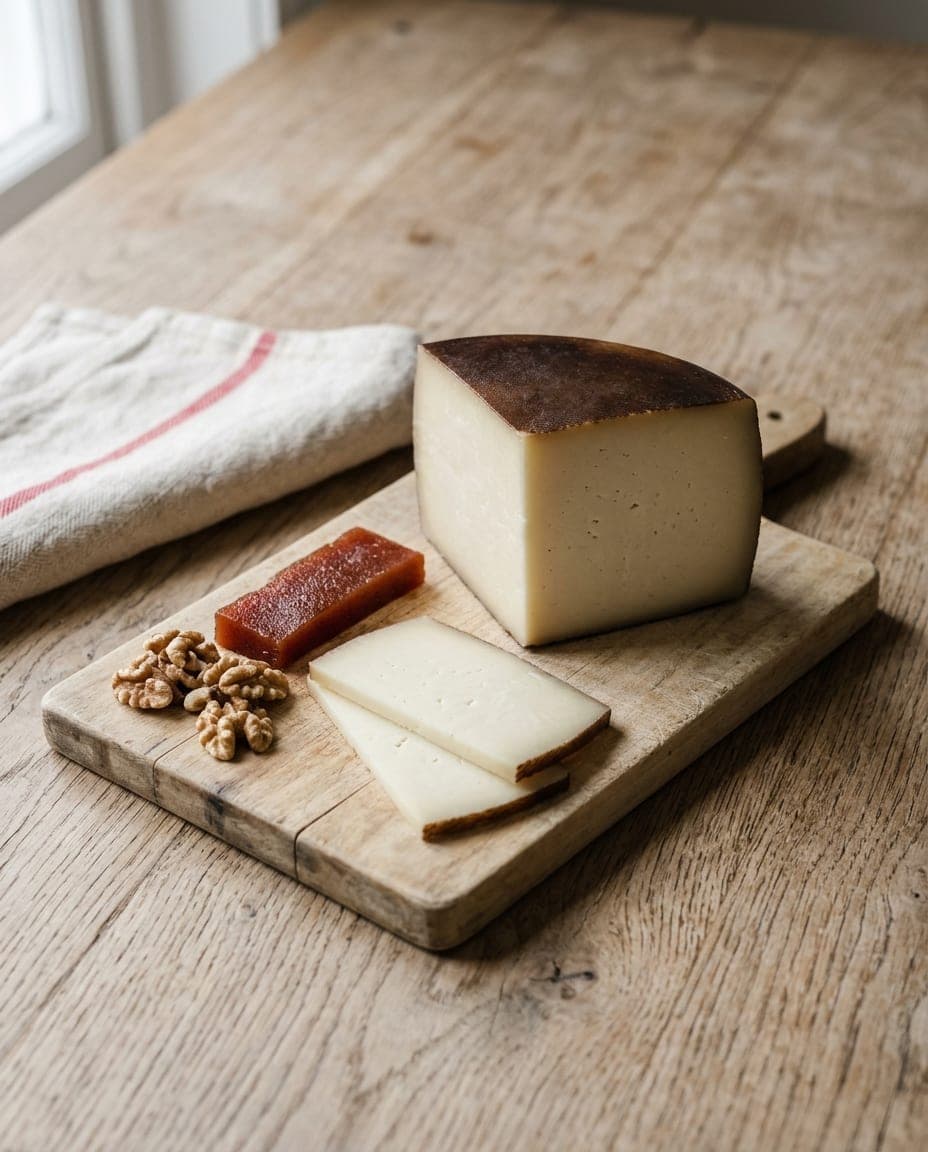
- Quince paste, walnuts
- Best eaten at
- A Basque pintxos bar
- Pairs with
- Txakoli or Rioja
What it is
Idiazabal is a firm, pressed cheese made from the raw milk of sheep in the Basque Country and neighbouring Navarre. It belongs to a small group of cheeses where the smoke was not originally an added flavour but a result of how the wheels were traditionally stored. The rind is hard and ranges from pale yellow to dark brown when smoked, while the paste inside is ivory to pale yellow. The texture is compact and supple when young, becoming harder, drier and sharper as it matures.
The cheese takes its name from Idiazabal, a small town in the Goierri district of Gipuzkoa. Shepherds coming down from the summer pastures of the Urbia and Aralar mountains sold their cheese there at the end of the season, and the town's name gradually came to stand for the sheep's cheeses of the Basque mountains. The key distinction lies in the milk: only raw milk from Latxa or Carranzana sheep is permitted. These are hardy breeds that graze on the steep slopes of the Basque mountains, lending the cheese a distinct character linked to the local landscape.
Idiazabal carries Protected Designation of Origin (PDO) status, which means it can only be produced in a defined area (Álava, Bizkaia, Gipuzkoa and Navarre, excluding the Roncal valley) using set methods. The smoke is the most defining feature for many visitors, yet unsmoked versions follow the same rules and are in fact sold in larger quantities. Both types share the same protected name.
How it came to be smoked
The smoky character of Idiazabal was born from necessity rather than a desire for a specific taste. In the past, shepherds in the high mountain huts had no climate-controlled cellars. Their cheese wheels sat near the hearth, where wood fires burned to keep the huts warm and dry.
The smoke from these fires permeated the cheese over time, helping to dry the rind and giving the wheels a deep, aromatic flavour that became a signature of the region. Today the smoking is deliberate and controlled, using untreated natural wood (beech, hawthorn and cherry are often mentioned), and is applied for a short time before the cheese leaves the dairy. Many producers also sell the cheese unsmoked, simply as Idiazabal.
The tradition is closely tied to the seasonal rhythm of the Basque mountains. Sheep lamb in winter, and milking runs through late winter, spring and early summer, when the flocks move up to the high pastures. The changing diet through the season shows in the milk, and in the character of the cheese.
What goes into it
Idiazabal is defined by its ingredients and the strict rules governing their use. The only milk allowed is raw, meaning it has not been pasteurised, which preserves the natural microorganisms that shape the cheese's development. The breeds used are specific: Latxa sheep, native to the Basque Country and Navarre, or the less common Carranzana breed.
The milk is coagulated with animal rennet. Traditionally, shepherds dried the stomachs of their own unweaned lambs and steeped them in salted water to make it. The curd is then cut, moulded and pressed into wheels, salted, and matured for at least two months; many wheels are aged for considerably longer.
- Raw sheep's milk from Latxa or Carranzana breeds, ensuring a distinct regional flavour.
- Animal rennet, traditionally from lamb stomachs, to coagulate the milk.
- Wood smoke for the smoked version, from untreated natural wood.
- Salt, used to season the cheese and help preserve it during curing.
The final product is a firm wheel whose paste can range from supple in younger cheeses to hard and granular in aged ones. Because it is made with animal rennet, Idiazabal is not suitable for vegetarians.
How it is eaten
Idiazabal is often eaten simply, in thin wedges at the end of a meal or as part of a pintxo, a small bite traditionally eaten at a bar counter in the Basque Country. The cheese is cut into wedges or cubes and often placed on top of a slice of bread.
The classic combination includes dulce de membrillo, a sweet quince paste, which balances the sharpness of the cheese. Walnuts are also frequently added to provide a crunchy texture that contrasts with the firm paste. This trio of cheese, quince and nuts is a classic Basque dessert, often enjoyed alongside a glass of Txakoli or a Rioja wine.
When the cheese is older, it becomes drier and more intense, requiring less accompaniment to appreciate its flavour. It is best served at room temperature, allowing the fats to soften slightly and release their aromas.
Curious facts
- A regional speciality. Idiazabal is produced only in the Basque Country and Navarre, not throughout all of Spain.
- Raw milk only. The PDO rules forbid pasteurised milk, ensuring the cheese retains its natural character.
- Two styles, one name. Both smoked and unsmoked versions carry the same protected designation despite their different flavours.
- Named after a market town. Idiazabal is not a valley or a mountain but the Gipuzkoan town where shepherds once sold their summer cheese.
- A bar staple. It is a fundamental part of the pintxo tradition as well as the Basque cheese board.
Where to try it
The best place to taste Idiazabal is in a Basque pintxo bar, particularly in cities like San Sebastián, Pamplona and Vitoria-Gasteiz, or in the villages of the Goierri around Idiazabal itself. These establishments are often small, crowded spaces where customers stand at the counter and order a variety of small plates.
While the cheese can be found in supermarkets across Spain, the experience changes when it is eaten in its region of origin. In the Basque Country, Idiazabal is often paired with local Txakoli, a slightly sparkling white wine that cuts through the fat of the cheese. A Rioja red is also a popular choice, especially with the older, sharper cheeses.
For those interested in the production process, some shepherd farms in the Basque mountains open their doors to visitors to show how the cheese is made, from milking to the final wheel.
Where to try it
1 region
 Camper Van Rentals1 destination
Basque Country
Basque Country is a unique region known for its distinct culture and language, Euskara. It's the only Spanish region with a coastline along the Bay of Biscay, featuring beautiful beaches and rugged cliffs. The largest city, Bilbao, is home to the modern Guggenheim Museum, but the true essence of Basque life can be found in smaller towns like Getaria, famous for its grilled fish and Txakoli wine. San Sebastián offers culinary delights and stunning beaches, while the historic town of Hondarribia showcases medieval architecture. The region is also rich in festivals, such as the Fiestas de la Virgen Blanca, celebrating local traditions. Its lush landscapes include the Picos de Europa mountains, perfect for hiking. Discovering local gastronomy, including pintxos and Basque cider, adds to the immersive experience.
Camper Van RentalsPanoramic TrainsHikingLocal Cuisine





