Huevos rotos
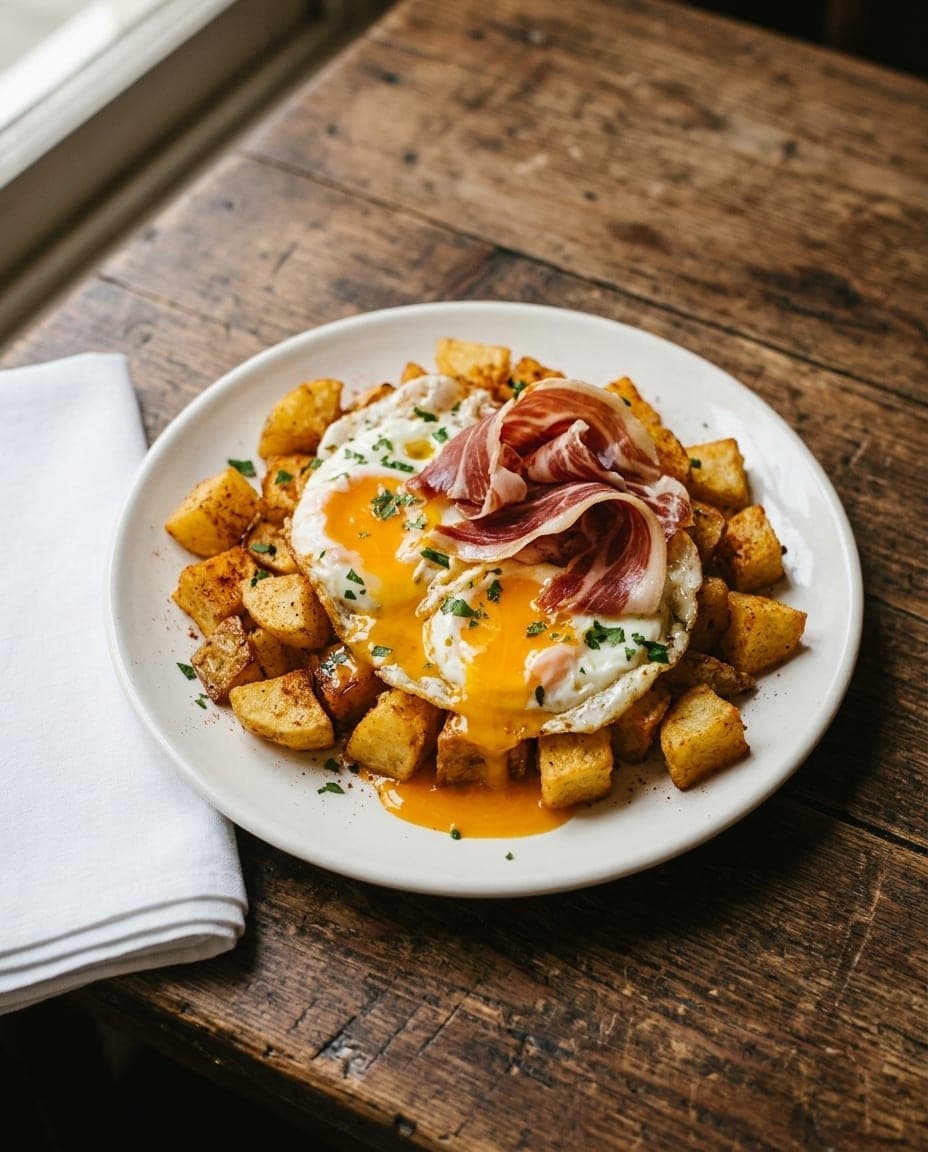
Fried eggs broken over thick chips in a Madrid taberna with jamón
- Local name
- Huevos rotos
- Served with
- Jamón
- Best eaten at
- A Madrid taberna
- Pairs with
- Rioja or a caña
What it is
Huevos rotos, literally "broken eggs", is a dish of simple origins that has become a defining feature of Madrid's taberna culture. It consists of potatoes fried slowly in olive oil until soft and golden, topped with fried eggs, usually two. The eggs are then cut up with a knife and fork so the yolk runs over the potatoes, creating a rich sauce that coats every piece.
The dish is usually ordered as a ración to share among friends, whether as one of several plates or as the centre of a meal. While variations exist across Spain, the version most associated with Madrid relies on a few elements: the texture of the potato, the quality of the oil and eggs, and, in the most popular version, the saltiness of the ham. There is no complex technique here, yet the result depends entirely on the care taken with those few ingredients.
The history of a tavern staple
Fried eggs with fried potatoes are an old staple of Spanish home cooking, born of the practical needs of working-class kitchens, where frying in abundant oil was an efficient way to create a filling meal. Breaking the eggs over the potatoes at the table turned a humble plate into something worth sharing.
In Madrid, the dish became closely linked to the city's tabernas, the traditional neighbourhood taverns that have long served as social hubs. Its fame owes much to a tavern in the Cava Baja, opened in 1974, whose huevos estrellados (another name for the dish) became a Madrid institution and were widely imitated. These establishments are known for their relaxed atmosphere and their focus on simple food, and huevos rotos fits this model perfectly: it is cheap to make, easy to share and deeply satisfying.
Similar dishes appear throughout Spain, but Madrid's tabernas made this one their own. It is not a tourist invention but a genuine local habit, and it does not claim to be gourmet; it claims only to be honest food made well.
What goes into it
The quality of huevos rotos rests on a handful of components, each with a specific role. There are no hidden ingredients or secret spices.
- Potatoes, cut into thick chips or thin slices depending on the house. They are fried gently until soft inside with a golden edge, never dried out or burnt.
- Olive oil, used generously for frying. Good oil matters, as its flavour carries through to the finished plate.
- Eggs, fried hot so the whites blister slightly at the edges while the yolks remain liquid. They are broken just before eating so the yolk runs over the potatoes.
- Jamón, usually jamón serrano or jamón ibérico, torn into pieces and scattered over the top. The saltiness of the ham balances the richness of the oil and egg.
Some versions include chorizo, morcilla or pisto, and the simplest are just potatoes and eggs, but the classic Madrid tavern style is topped with ham, which makes the dish as usually served not vegetarian. It is a plate that demands attention to detail: the potatoes must be tender, the eggs runny and the ham salty enough to cut the richness.
How it is eaten
Huevos rotos is designed for sharing. It arrives at the table on a large plate or in an earthenware dish, still hot from the pan. The eggs are broken up and mixed through the potatoes so that the yolk coats each piece before diners dig in with their forks.
The dish is at its best in a Madrid taberna, where the atmosphere encourages conversation and slow eating. It is common to order it alongside other small plates or as the main focus of a meal. The potatoes should yield easily under the fork, while the egg yolk provides a creamy contrast to their crisp edges.
A glass of Rioja red wine pairs naturally with the dish, its tannins cutting the richness of the oil and ham. Alternatively, a small draught beer, known as a caña, is equally appropriate, particularly on a warm day or late in the evening. In summer a crisp white wine is another common choice.
Curious facts
- The name comes from the action. The term "rotos" refers to the broken eggs, not the potatoes. The eggs are intentionally cut open to release their yolks over the dish.
- Two names, one dish. In Madrid the dish is often also called huevos estrellados, "smashed eggs", though some cooks draw a fine distinction between the two.
- It is a social dish. In Madrid tabernas, it is usually ordered as a plate for the table rather than an individual portion.
- No fixed recipe exists. Every taberna has its own way of cutting the potatoes and frying the eggs. Some use thick chips, others thin slices; some add extra toppings, others rely on the salt of the ham alone.
- It works at any hour. Huevos rotos is served at lunch and dinner and is a popular late-evening order before heading home.
Where to try it
The natural place to eat huevos rotos is a traditional Madrid taberna, where the dish is served in generous portions. These establishments are found throughout the city, from the historic centre to the neighbourhoods of Malasaña and La Latina, where the Cava Baja is lined with old taverns.
The local favourites are the places where the staff are proud of their version of the dish and the potatoes are fried to order. Madrid's tabernas have a reputation for keeping their recipes consistent, making them the ideal setting for this meal.
Where to try it
1 region
 Camper Van Rentals1 destination
Madrid
Madrid, the largest city and capital of Spain, is a vibrant hub of culture and history. Known for its royal palace, the city boasts a rich artistic heritage with museums like the Prado and the Reina Sofia. Beyond the mainstream, explore the Malasaña district, famous for its alternative scene, or the tranquil Retiro Park, a green oasis in the urban landscape. The surrounding region features towns like Alcalá de Henares, birthplace of Cervantes, and El Escorial, a UNESCO World Heritage site. Madrid's culinary scene is diverse, from traditional tapas to innovative cuisine, reflecting its cultural melting pot. The region also hosts various local festivals throughout the year, showcasing its traditions and community spirit.
Camper Van RentalsHiking