Bocadillo de calamares
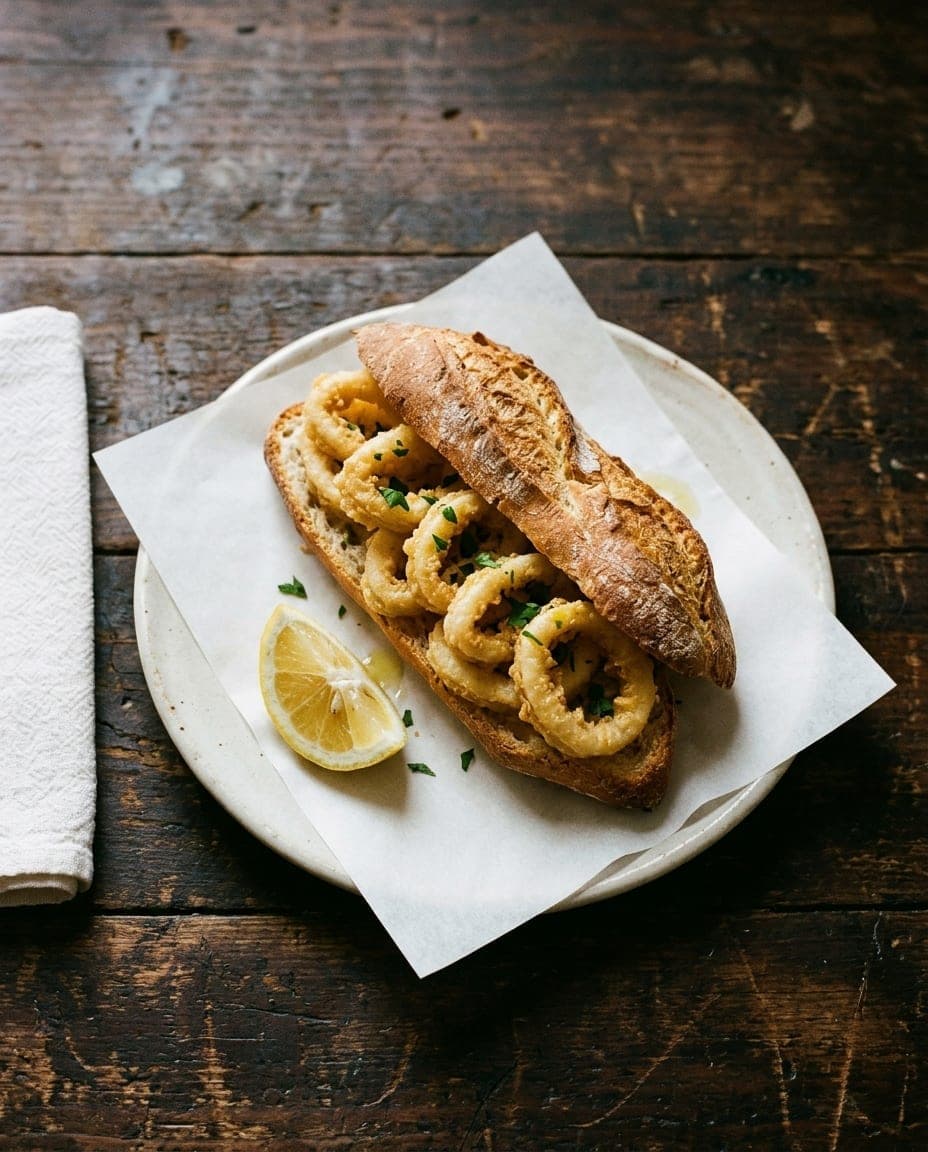
Fried squid rings in a crusty baguette, Madrid's standing-room street food
- Local name
- Bocadillo de calamares
- Served with
- Lemon, mayonnaise
- Best eaten at
- A Plaza Mayor bar in Madrid
- Pairs with
- Caña (draught beer)
What it is
The bocadillo de calamares is the most recognisable form of street food in Madrid. It consists of rings of squid, coated in flour and deep-fried until golden, then stuffed into a crusty white baguette-style loaf. The sandwich is simple in its construction but distinct in its character. There are no hidden fillers, no fresh salads, and no complex sauces. A squeeze of lemon juice or a smear of mayonnaise is the only variation most cooks allow.
The dish defines a specific moment in the Spanish capital. It is not a sit-down meal served at a table with a full wine list. It is food designed for standing, for walking, or for a quick pause while waiting for friends to arrive. The squid rings are crisp on the outside and tender inside, holding their shape even when the bread softens slightly from the heat.
The location is as important as the ingredients. While fried seafood appears in coastal towns across Spain, the bocadillo de calamares belongs firmly to Madrid. The capital lies some 300 kilometres from the nearest coast, yet it claims this seafood dish as its own.
Why a squid sandwich in inland Madrid?
The presence of fried squid in the capital seems unusual at first glance. The explanation lies in the history of food supply. As the seat of the royal court, Madrid drew in provisions from across the country, and Catholic rules on meatless days created strong demand for fish. From the 18th century, supplies of fish and seafood from the northern ports became more regular, and Madrid grew into a major fish market despite its distance from the sea.
Over time, taverns and eating houses in the city centre began serving fried seafood as a quick, cheap snack, and the squid sandwich became so closely linked with the city that it is now simply called "typical Madrid". The dish shares its roots with the broader Spanish tradition of fried fish, but it took on a specific identity in Madrid through its association with the city's bars and plazas. Today much of the squid used is frozen and comes from distant fishing grounds, but the tradition holds.
The squid is usually cut into uniform rings to ensure even cooking. In some kitchens the tentacles are included, but the rings remain the defining feature. The flour coating acts as a barrier against the hot oil, keeping the inside moist while creating a textured crust.
What goes into it
The ingredients are minimal by design, relying on the quality of the raw materials rather than complex preparation. A traditional version contains only:
- Squid, cleaned and cut into rings, sometimes with a few tentacles.
- Flour for the coating, sometimes with a dip in egg first.
- Oil for deep-frying, heated until the squid sizzles immediately on contact.
- A crusty loaf, a barra of white bread with a hard shell and a soft interior to hold the filling.
- Lemon juice or mayonnaise, applied sparingly to cut through the oiliness.
The bread must be sturdy enough to hold the hot filling without collapsing, yet soft enough to bite through easily. A poor-quality roll turns soggy within minutes, ruining the texture that makes the dish desirable.
How to eat it
The ritual of eating a bocadillo de calamares is tied to the physical act of standing in a bar. The sandwich is rarely served with cutlery. Customers order at the counter, receive the food wrapped in paper or on a small plate, and eat while leaning against the bar or standing in a cluster with others.
The Plaza Mayor has long been a meeting point for Madrileños, and the surrounding streets are lined with bars that have served this dish for generations. Locals and visitors alike stand shoulder to shoulder, holding their sandwiches and sipping small glasses of beer.
A caña, a small glass of draught beer, is the traditional companion. The cold, carbonated drink balances the warmth and oil of the fried squid. Lemon adds acidity that cuts the fat of the frying oil; mayonnaise is an alternative for those who prefer a creamy texture, though many purists take the sandwich plain.
The sandwich is meant to be eaten quickly. The bread softens rapidly once it absorbs the oil from the squid, so the ideal moment is immediately after it leaves the fryer. This urgency adds to the appeal; the experience is about the immediacy of the flavour and the energy of the crowd.
The culture of the standing bar
In Madrid, eating standing up at a counter is not a sign of haste or poverty. It is a long-standing social custom. The bars around the Plaza Mayor and in nearby streets such as Calle de la Cava Baja remain the epicentres of this tradition.
These establishments are often small, with limited seating and a focus on speed. The dish has become a symbol of Madrid's identity and of a culture that values community and spontaneity.
Curious facts
- The inland paradox. Madrid lies around 300 kilometres from the nearest sea, yet its signature street food is fried squid, a legacy of historical supply routes.
- The standing rule. It is traditional to eat this sandwich standing at the bar; sitting down is possible but less common in the classic venues.
- A beer pairing. The caña, a small glass of draught beer, is the standard drink choice, its cold bubbles cutting through the oiliness of the fried squid.
Where to try it
The classic experience of a bocadillo de calamares is found in the bars surrounding the Plaza Mayor, which have served the dish for decades and attract both locals and visitors.
Other areas of Madrid also serve excellent versions, notably the bars around Atocha station and in the historic districts near the city centre. However, the Plaza Mayor remains the focal point for this tradition, busiest at midday and on weekends and holidays.
Where to try it
1 destination
 Camper Van Rentals
Madrid
Capital city with vibrant art scene, historic plazas, and culinary delights.
Camper Van RentalsHiking
1 region
- Camper Van Rentals1 destination
Madrid
Madrid, the largest city and capital of Spain, is a vibrant hub of culture and history. Known for its royal palace, the city boasts a rich artistic heritage with museums like the Prado and the Reina Sofia. Beyond the mainstream, explore the Malasaña district, famous for its alternative scene, or the tranquil Retiro Park, a green oasis in the urban landscape. The surrounding region features towns like Alcalá de Henares, birthplace of Cervantes, and El Escorial, a UNESCO World Heritage site. Madrid's culinary scene is diverse, from traditional tapas to innovative cuisine, reflecting its cultural melting pot. The region also hosts various local festivals throughout the year, showcasing its traditions and community spirit.
Camper Van RentalsHiking





