Zwolse balletjes
Hard sugar sweets made in Zwolle since 1845
- Vegetarian
- Local name
- Zwolse balletjes
What it is
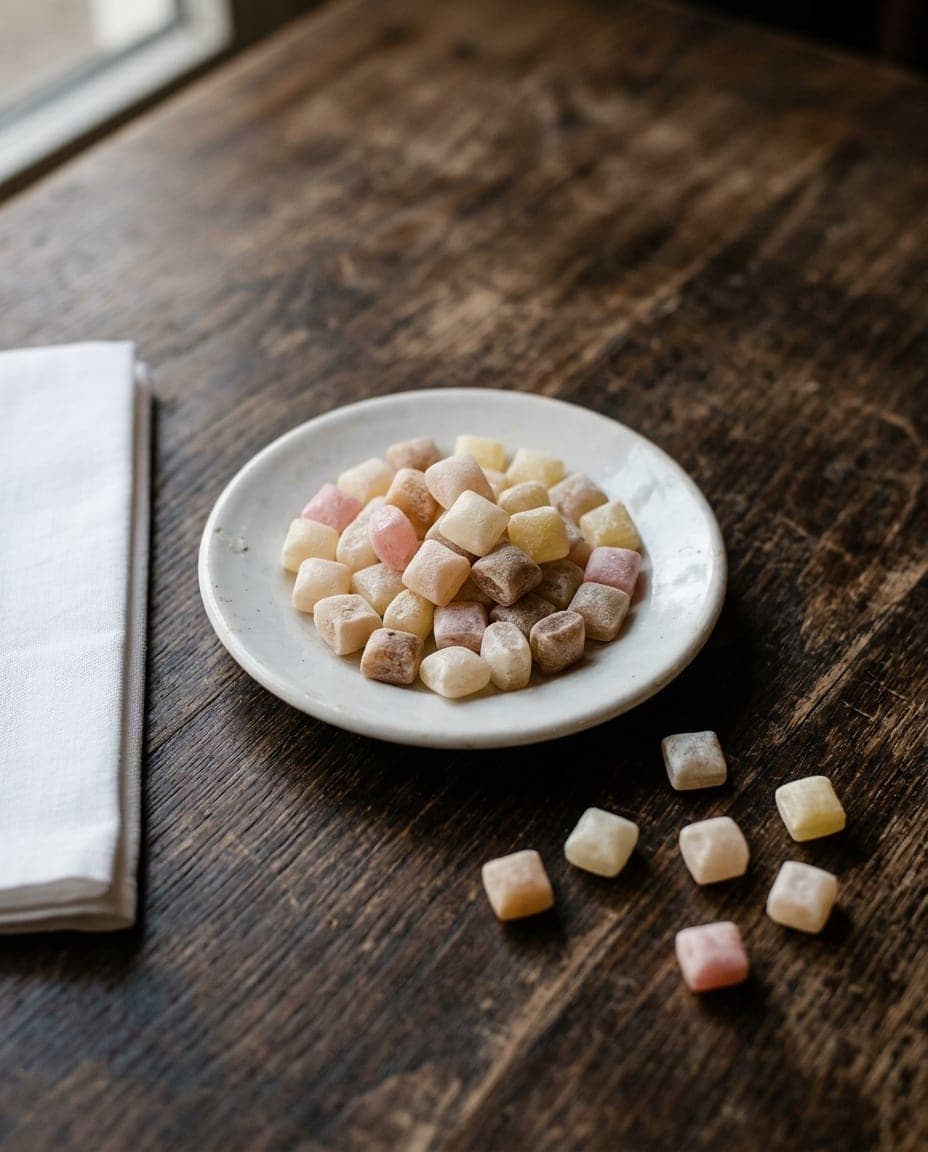
Zwolse balletjes are a traditional hard sweet from the city of Zwolle in the province of Overijssel. Despite the name, they are not balls: balletje is an old Dutch word for a sweet, and the pieces are cut from a slab of sugar dough. Because they are cut, or "stuck", from the dough, they are also known as steken.
These sweets are not soft like modern marshmallows nor chewy like caramel. They are hard and require patience to dissolve in the mouth. They are sold in a traditional paper cone or in a decorated tin, and many Zwolle companies and organisations hand them out as gifts.
The first balletjes were plain sugar. Mocha, cinnamon and vanilla followed, and later a range of fruit flavours. There are no hidden centres or fillings; the entire sweet is one uniform substance.
How it is made
Zwolse balletjes have been made since 1845 in the cellar of a 17th-century building on the Grote Kerkplein, in the shadow of the Grote Kerk. Before then, sweets made there used cane sugar; granulated beet sugar became the base once Dutch sugar beet arrived. The process begins with boiling sugar into a stiff mass, a sugar dough, to which the flavour is added.
The work is still done by hand, in the traditional way, with old equipment in the same cellar. The makers, called stablers, produce a batch about once a week, because the old machine wears quickly and the cellar is hard work. The dough is cut into individual pieces and left to harden.
It is said to be the only sweet in the Netherlands still made in this traditional way on the premises of the shop that sells it, and its making is listed in the Dutch inventory of intangible cultural heritage.
A taste of nostalgia
Zwolse balletjes are less about novelty and more about memory. They are a regional speciality that survives because the tradition has been kept going in one place for more than 175 years. For many people from Zwolle, the taste is inextricably linked to childhood visits to the old town.
They were once a practical sweetener as much as a treat. A steek was held in the cheek while drinking coffee or tea, so the drink flowed past it and was sweetened on the way; afterwards it was put aside for the next cup. Some Zwolle residents still drink their coffee this way.
On market days the shop used to open at seven in the morning for visitors to the livestock market. Once beet sugar made sweets cheap, the balletje became one of some five hundred kinds of Dutch sweets, alongside Haagse hopjes and Zeeuwse babbelaars.
Curious facts
- The name is not about shape. Balletje is an old word for a sweet, not a description of a ball.
- Sweetener in the cheek. Held in the cheek while drinking, a steek sweetened coffee for cup after cup.
- They stay in Zwolle. Production is small and local demand carries it; the sweets are barely known elsewhere in the country.
- Made in a cellar. They are still made by hand in the cellar of the shop where production started in 1845.
- Heritage status. The making of Zwolse balletjes is listed in the Dutch inventory of intangible cultural heritage.
Where to try it
The old sweet shop on the Grote Kerkplein in Zwolle, furnished much as it was in 1845. They are not in supermarkets and not in the national chains.
The transaction is the old kind: a flavour named and a paper cone filled at the counter, or a tin for a gift. They are bought as much for taking home as for eating on the spot, which is why the bags leave the city by the dozen.
Where to try it
1 region

Overijssel
Overijssel, a region in the northeastern Netherlands, is known for its diverse landscapes, from lush forests to winding rivers. The area is home to Zwolle, the capital, recognized for its medieval architecture and vibrant cultural scene. Nearby, the picturesque town of Giethoorn, famous for its canals and thatched-roof houses, offers a glimpse into traditional Dutch life. The region boasts several nature reserves, including De Weerribben-Wieden, ideal for hiking and cycling. Rich in history, Overijssel features remnants of Hanseatic trade, and its local cuisine is highlighted by traditional dishes and local cheeses. With fewer tourists, it provides an authentic experience of Dutch culture and nature.