Hutspot
Mashed potatoes, carrots and onions, eaten on 3 October
- Local name
- Hutspot
- Served with
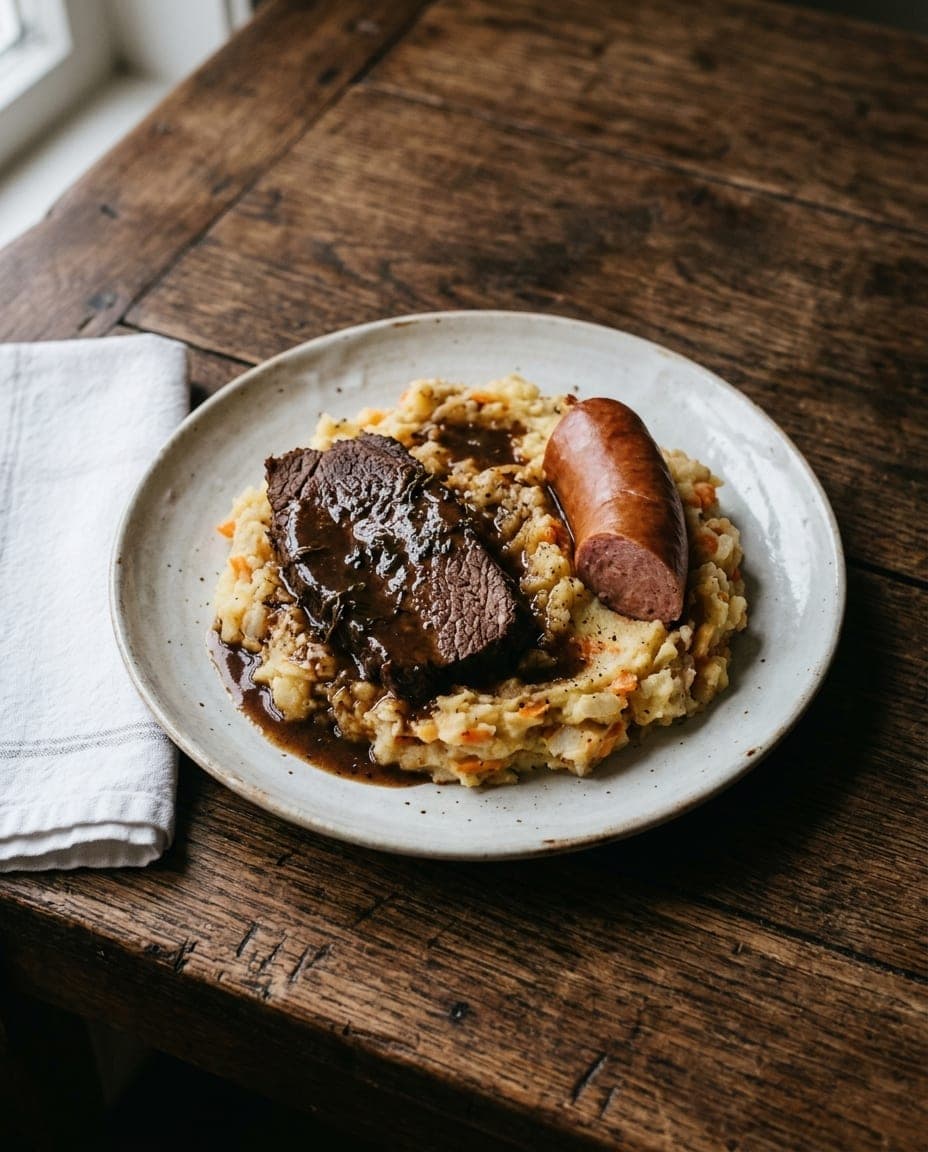
- Klapstuk (braised beef), smoked sausage
- Best eaten at
- A Leiden family table
- Pairs with
- Dutch lager
What it is
Hutspot is one of the three main stamppot dishes of the Netherlands, a category of mashed vegetables that served as a staple for farmers and labourers across the country for centuries. While other versions mix kale or sauerkraut with potatoes, hutspot stands out for its simplicity: potatoes, carrots and onions boiled together until soft, then coarsely mashed into a single mass. It is a dish of plain roots, humble in appearance but deeply savoury in taste.
The dish belongs firmly to the province of Zuid-Holland, where it is not merely a meal but a calendar marker. In Leiden, a city on the River Rhine, hutspot is eaten specifically on 3 October. This date marks the anniversary of the Leidens Ontzet, or "Liberation of Leiden", when the Spanish siege of the city was lifted in 1574. The story holds that the retreating Spanish left a cooking pot of stewed vegetables behind them, and that the starving city ate it. The dish is now served every year around that date to remember the event.
The history of the siege and the pot
The tale of hutspot is tied directly to the Siege of Leiden, which began in October 1573, paused in the spring of 1574 and resumed in May, lasting until October 1574. Spanish forces surrounded the city in an attempt to crush a rebellion against their rule. For months, the people inside faced starvation as food supplies ran low. Plague went through the city alongside the hunger, and thousands of inhabitants are thought to have died.
When the Dutch rebels opened the dikes and flooded the surrounding land, a rebel fleet of flat-bottomed boats sailed in over the water and the Spanish army retreated on the night of 2 October. On 3 October 1574, the siege ended. According to tradition, a boy, usually named as Cornelis Joppenszoon, found a still-warm pot of stew left behind in an abandoned Spanish camp. The starving citizens of Leiden ate the food and celebrated their survival.
Whether the pot actually existed or if it is a folk invention remains unclear. Historians agree that the siege was real and that the city suffered terribly from hunger. They also note that potatoes had barely reached Europe by 1574, so the legendary stew is described as carrots, onions and parsnips with meat. The potato took the parsnip's place much later. Despite these gaps, the story persists. It is a narrative about survival and the relief of finding food after months of scarcity. The annual commemoration keeps the memory alive, with families gathering to cook the dish together.
How it is made
Hutspot begins with the preparation of three vegetables: potatoes, carrots and onions. These are boiled in water until they are soft enough to be crushed. Once cooked, the vegetables are drained and mashed together. The result is a coarse mash, not a smooth purée. Some cooks leave the carrot skins on for colour, while others peel them all. The texture should be substantial, with distinct pieces of vegetable remaining in the mass.
The dish is rarely served plain. It is traditionally accompanied by either klapstuk or smoked sausage. Klapstuk is a marbled cut of beef from the rib section, braised slowly in broth until it is tender and falls apart easily. Alternatively, a thick smoked sausage, known as rookworst, is sliced and placed on top of the mash. The meat provides a salty, savoury contrast to the sweet earthiness of the carrots and potatoes.
How to eat it
The dish is usually eaten at dinner time, often in the autumn when the new harvest of root vegetables arrives. In Leiden, the meal takes on a ritual quality around 3 October. Families prepare hutspot together, sometimes cooking it in large pots that can feed a whole gathering. The mashed vegetables are served on a plate with a generous portion of meat on the side or pressed into the centre.
A glass of Dutch lager is the standard drink to accompany the meal. The beer cuts through the heaviness of the mash and pairs well with the salt of the smoked sausage. Some people also add a little butter or pepper to the dish, though the traditional version relies on the natural flavours of the vegetables and the meat.
When eating hutspot, there is no need for fine silverware. A sturdy fork is enough to break through the coarse mash and scoop up the meat. The dish is meant to be filling and warming, a comfort food that reflects the history of the region. It is not a dish for a quick lunch; it requires time to prepare and time to eat.
Curious facts
- A regional identity. While stamppot is eaten across the Netherlands, hutspot is strongly associated with Leiden and the surrounding areas of Zuid-Holland. Other stamppot dishes go their own way, such as boerenkoolstamppot with kale.
- The potato's arrival. The 1574 pot cannot have held potatoes, which had barely reached Europe. The original hutspot was probably made with parsnips, and the potato replaced them only much later.
- A holiday in one city. 3 October has been a local holiday in Leiden since 1886: many people take the day off, a funfair and market fill the streets, and herring and white bread are handed out at the Waag at dawn.
- The name is a shaken pot. Hutspot comes from hutselen, to shake or jumble together, which describes the method better than any recipe does.
- Klapstuk is the proper meat. The traditional cut is a piece of beef rib braised for hours in broth, not the smoked sausage that supermarkets pair it with now.
Where to try it
Leiden around 3 October, when the whole city eats it and the restaurants and brown cafés put it on whether or not they normally would; a communal hutspot meal is served outdoors on the evening of 2 October. The day itself begins with the handing out of herring and white bread and runs to a funfair and a procession.
The rest of the year it is ordinary winter food across Zuid-Holland and the provinces around it, on the menu of any place serving stamppot. Supermarkets sell it ready-mashed in tubs from October onwards, which is how most of it is eaten now.
Where to try it
1 destination
 Boat Rentals
Leiden
Historic university city with canals, museums, and scholarly heritage
Boat RentalsHiking