Jambon d'Ardenne
Dry-cured ham from the Ardennes forests, traditionally smoked and dried for months
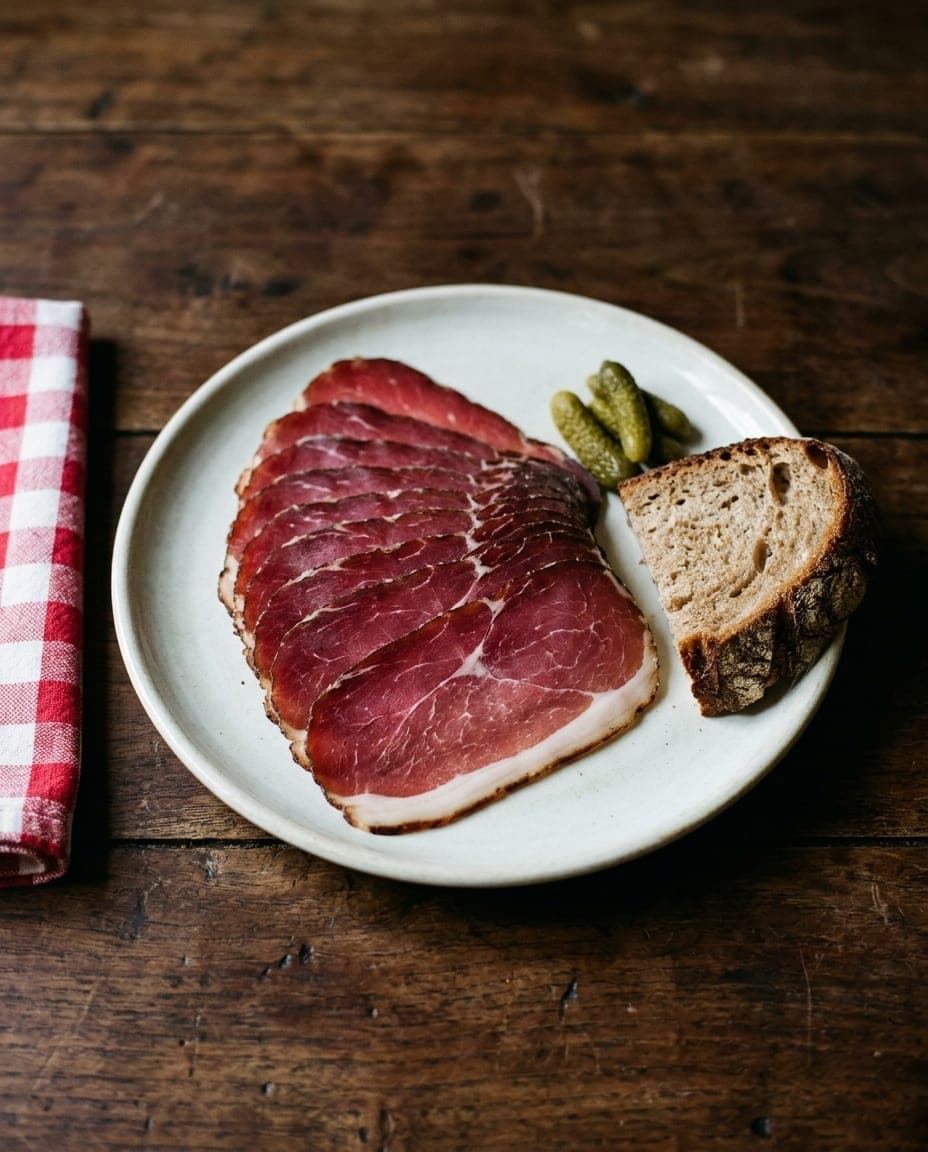
- Local name
- Jambon d'Ardenne
- Served with
- Crusty bread, gherkins
- Best eaten at
- An Ardennes country inn
- Pairs with
- Belgian abbey ale
What it is
Jambon d'Ardenne is a dry-cured ham originating from the forested uplands of the Ardennes in Wallonia. It is not a nationwide Belgian staple but a regional speciality tied to the cool, damp climate of the south. The meat is salted, rested and then dried, a process that takes at least 33 weeks for a bone-in ham. A traditional feature is the light cold smoking, now optional under the rules, which uses only beech or oak wood to impart a subtle aroma without overpowering the natural flavour of the pork.
The result is a ham that is firm and dense, with a deep ruby-red colour and a distinct but gentle smokiness. It differs significantly from the unsmoked hams of southern Europe, such as Italian prosciutto. The smoke is present but restrained, designed to enhance rather than dominate. This balance makes it an ideal cold cut for the Belgian table, where it is sliced paper-thin and served as part of a charcuterie board or alongside simple accompaniments.
The ham has carried a Protected Geographical Indication (PGI) since 1996, building on a Belgian appellation dating from 1974, meaning that only hams produced in this specific region using traditional methods can bear the name. This status protects the identity of the product against imitation, ensuring that the term refers to a genuine article from the Ardennes rather than a generic cured pork product. The designation requires every stage of production to take place in the Belgian Ardennes, although the raw pork legs themselves may come from elsewhere.
How the region shapes the flavour
The character of Jambon d'Ardenne is inseparable from its landscape. The Ardennes are a dense, hilly forest region in southern Belgium, part of the larger geological formation that extends into France and Luxembourg. The climate here is cool and damp, with high humidity levels that are essential for the slow drying process. In warmer, drier climates, the meat would dry too quickly or crack; in the Ardennes, the air allows the ham to lose moisture gradually over many months.
Farmhouses in this area have long relied on the pig as a source of winter sustenance. The tradition of curing meat is broader than just the ham. It includes pâté gaumais, a marinated pork pie from the Gaume district, saucissons such as the saucisson gaumais, and boudins (blood sausages). These products all share a common logic: preserving the harvest of the pig to last through the cold months when fresh meat was scarce. The smoking of Jambon d'Ardenne fits into this system, using local wood resources to preserve the meat and add a layer of flavour that complements the cool air.
The smoke itself is not heavy or acrid. It is described as a gentle aroma, more akin to a whisper than a shout. This subtle influence distinguishes it from the intense smokiness of certain Scandinavian or American hams. The goal was never to mask the meat but to protect it and add a specific regional signature that cannot be replicated elsewhere.
What goes into it
The ingredients are simple, relying on the quality of the raw material and the environment rather than complex additions. The ham is made from the hind legs of pigs; the PGI does not require the pigs to be raised in the Ardennes, only that the ham is made there, and the care taken during curing matters more than breed.
- Pork, specifically the hind leg, which provides the necessary fat content for a juicy yet firm texture.
- Salt, rubbed on dry and sometimes followed by brine, to draw out moisture and begin the preservation process.
- Beech or oak wood, used for the light smoking that gives the ham its characteristic aroma without overwhelming the palate.
- Time, allowing the meat to dry slowly in the cool, humid cellars of the Ardennes.
The deep red hue comes naturally from the curing process and the interaction between the salt and the air. The fat remains white or slightly creamy, providing a rich mouthfeel that balances the leaner muscle fibres. The final product is dry to the touch but yields easily when sliced against the grain.
How it is eaten
Jambon d'Ardenne is almost always served cold. It is sliced as thinly as possible, often by hand or on a traditional meat slicer, to reveal the marbling and the depth of colour. The thin slices are arranged on a plate with crusty bread, typically a rustic loaf from a local bakery. A few gherkins, small pickled cucumbers, provide a sharp, acidic contrast that cuts through the fat.
The combination of ham, bread, and gherkins is a classic way to enjoy the dish. The bread acts as a neutral base that holds the meat without competing with it, while the gherkins offer a necessary bite. Some also serve the ham with slices of melon, where the sweetness complements the savoury smoke.
In cooked dishes, the ham plays a supporting role. It can be added to stews or soups near the end of cooking, allowing the flavour to infuse the broth without breaking down completely. However, its primary status remains that of a cold cut. A glass of Belgian abbey ale, with its complex malt and hop profile, is a natural companion to the meal, pairing well with the smoky notes of the ham.
Curious facts
- A regional shield. The PGI status protects the name Jambon d'Ardenne, ensuring that only hams from the Ardennes region can use the label.
- Smoke as a whisper. Unlike some smoked meats, the smoking of this ham, where it is used, is light and subtle, designed to enhance rather than dominate the flavour.
- Part of a wider tradition. The curing of Jambon d'Ardenne is part of a broader farmhouse culture that also produces pâté gaumais, saucissons, and boudins.
- Cold service rule. The ham is almost exclusively eaten cold, sliced thin to showcase its texture and colour.
- A forest flavour. The use of local beech or oak wood for smoking ties the product directly to the surrounding Ardennes forests.
Where to try it
The most authentic experience of Jambon d'Ardenne is found in the Ardennes region itself, particularly in the province of Luxembourg and the Ardennes parts of Namur and Liège provinces. Country inns in the area often source their ham from local curers who adhere to the traditional methods. These establishments are typically unpretentious, focusing on local produce rather than international trends.
Visitors to towns such as Bastogne, La Roche-en-Ardenne or Bouillon will find the ham on menus at traditional restaurants or in the deli sections of local markets. The key is to look for the PGI label or ask if the ham is from the Ardennes. The ham is sold throughout Belgium, but eating it in the Ardennes, where it is made, is the best way to taste it in context.
Where to try it
1 destination
 Wine Tasting
Namur
Wallonia's capital with hilltop citadel at Meuse-Sambre confluence.
Wine TastingHikingLocal Cuisine
1 region
- Wine Tasting5 destinations
Wallonia
Wallonia, the French-speaking region of Belgium, is known for its rich history and diverse landscapes. It is the largest region in the country, featuring cities like Liège, Namur, and Charleroi, each with unique cultural offerings. The region is famous for its stunning countryside, dotted with picturesque villages, and the Meuse River, which provides scenic vistas and outdoor activities. Wallonia is also home to several UNESCO World Heritage sites, including the Grand-Hornu industrial complex. The area boasts local specialties like artisan cheeses and Trappist beers. For history enthusiasts, the medieval towns of Durbuy and Bouillon offer a glimpse into the past with their ancient castles and cobblestone streets. Wallonia's hidden gems and natural beauty create a compelling backdrop for a leisurely exploration of Belgian heritage.
Wine TastingHikingLocal Cuisine