Kapustnica
The soup that starts Christmas Eve
- Local name
- Kapustnica
- Served with
- Bread
- Best eaten at
- A Slovak family Christmas Eve table
- Pairs with
- Slovak lager
What it is
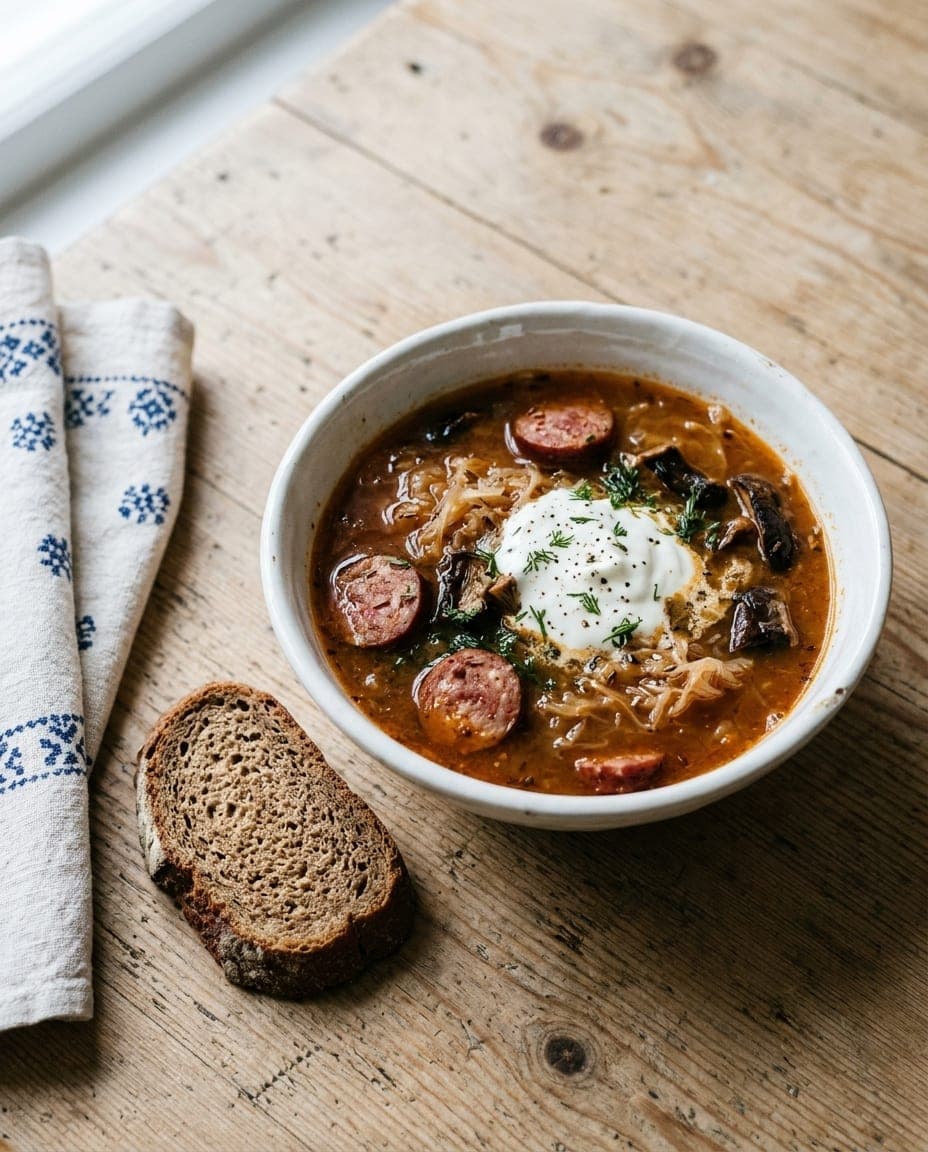
Kapustnica is the defining soup of Slovakia's Christmas season, a deep, sour broth made from fermented cabbage, smoked sausage, dried mushrooms and often dried plums. It appears on tables across the country, from Bratislava in the west to Košice in the east, but its heart beats strongest on 24 December. It is the first cooked course of the family Christmas Eve dinner, after the wafers with honey and garlic and, in most regions, before the fried carp.
It is not a light first course. Thick, sour and smoky, it relies on the sauerkraut's own juice for its acidity, and on the sausage for everything else. Every household holds that its own version is the correct one.
The Christmas Eve tradition
Christmas Eve in Slovakia is traditionally a fast day that ends in a long, fixed meal, and this soup comes near the start of it. Most households cook it on 24 December; the smell of it is what the stairwell of a Slovak apartment block smells of that afternoon.
The order is fixed: wafers, the soup, then the fried carp and potato salad — though in parts of eastern Slovakia there is no carp and the soup is the centre of the meal. Many families make it a day or two ahead, because it improves standing, and the pot is then reheated in portions across the following week.
The arguments are regional and sincerely held. Prunes or no prunes. Mushrooms essential or optional. Cream stirred in at the end or never. And, where the fast is kept strictly, a meatless version made with mushrooms alone, still the rule in a good many households.
What goes into it
The list is short and specific, and nothing on it substitutes well:
- Sauerkraut, the fermented cabbage that forms the body of the soup and provides its characteristic sour flavour.
- Smoked sausage, usually klobása or a similar cured pork sausage, which adds a smoky depth to the broth.
- Dried mushrooms, often boletus or field mushrooms, rehydrated in the cooking liquid to infuse the soup with earthy notes.
- Dried plums or prunes, used by many families to balance the sourness of the cabbage with a subtle sweetness.
- Cream, added in some regions to round out the sharp acidity, though not all cooks use it.
The result is a hearty, warming soup that feels substantial enough to sustain a family through the winter cold. It is not a dish for the faint-hearted; the sourness can be intense, and the texture is thick rather than clear.
How to eat it
In a deep bowl, with bread, and with the sausage and mushrooms stirred up from the bottom — the solids settle and the first spoonful is misleading. A Slovak lager is the usual glass beside it.
At Christmas markets it is sold in paper cups, which is how most visitors meet it: hot, sour and smoky, drunk standing up in the cold.
Curious facts
- Two versions for one evening. Christmas Eve is traditionally a fast day, so households that keep it strictly make the soup with mushrooms and no meat; the smoked-sausage version is the common one elsewhere.
- Regional arguments. Families often debate whether prunes belong in the soup, with some regions viewing them as essential and others seeing them as an unnecessary addition.
- Market presence. Outside the home, the soup is frequently sold in paper cups at Christmas markets, offering a portable version of the traditional dish.
- The sour is the cabbage's own. The sourness comes from the sauerkraut, juice and all, poured into the pot.
- It is better on the second day. Many families cook it ahead deliberately, and the reheated bowl is the one they prefer.
Where to try it
In December, at a Christmas market in Bratislava, Košice or any Slovak town square, sold by the cup from a cauldron — which is the easiest way for a visitor to eat it and not a watered-down version. Traditional restaurants have it on the menu through the month, and many keep it all year.
The question worth asking is what is in it, because the answer differs by thirty kilometres: sausage or mushrooms, prunes or none, cream or not. There is no correct answer, and saying so out loud in company is the fastest way to start a long conversation.
Where to try it
2 regions

Bratislava
Bratislava lies along the banks of the Danube River, marking it as the largest city in Slovakia and the country's political and cultural hub. The city's medieval Old Town boasts a wealth of history, including the iconic Bratislava Castle, which offers panoramic views of the river and surrounding areas. Notably, the region is known for its wine production, particularly the white wines from the Small Carpathians, and the unique culinary offerings such as bryndzové halušky, a traditional potato dumpling dish. Nearby, the Little Carpathians offer scenic hiking trails and vineyards. The region also hosts various local festivals, highlighting traditional crafts and regional food, providing a genuine taste of Slovak culture.

Košice
Košice is Slovakia's second-largest city, offering a rich blend of history and culture. Known for its well-preserved medieval core, the city features the stunning St. Elisabeth Cathedral, the largest in Slovakia. The region is celebrated for its vibrant arts scene, with numerous galleries and theaters showcasing local talent. Nearby, the picturesque town of Prešov is famous for its well-preserved Renaissance architecture and unique folklore traditions. The surrounding mountains, including the High Tatras, provide excellent hiking opportunities and breathtaking landscapes. This area is also known for its wine production, particularly in the Tokaj region, where a unique blend of flavors awaits. Experience local festivals that celebrate the region's heritage, offering insights into Slovak traditions. This destination is ideal for those looking to explore away from the typical tourist crowds, enjoying authentic Slovak culture and hospitality.