Bratislavské rožky (Pressburger Kipferl)
The shape says what is inside
- Vegetarian
- Local name
- Bratislavské rožky
- Best eaten at
- A Bratislava café or bakery
- Pairs with
- Coffee
What they are
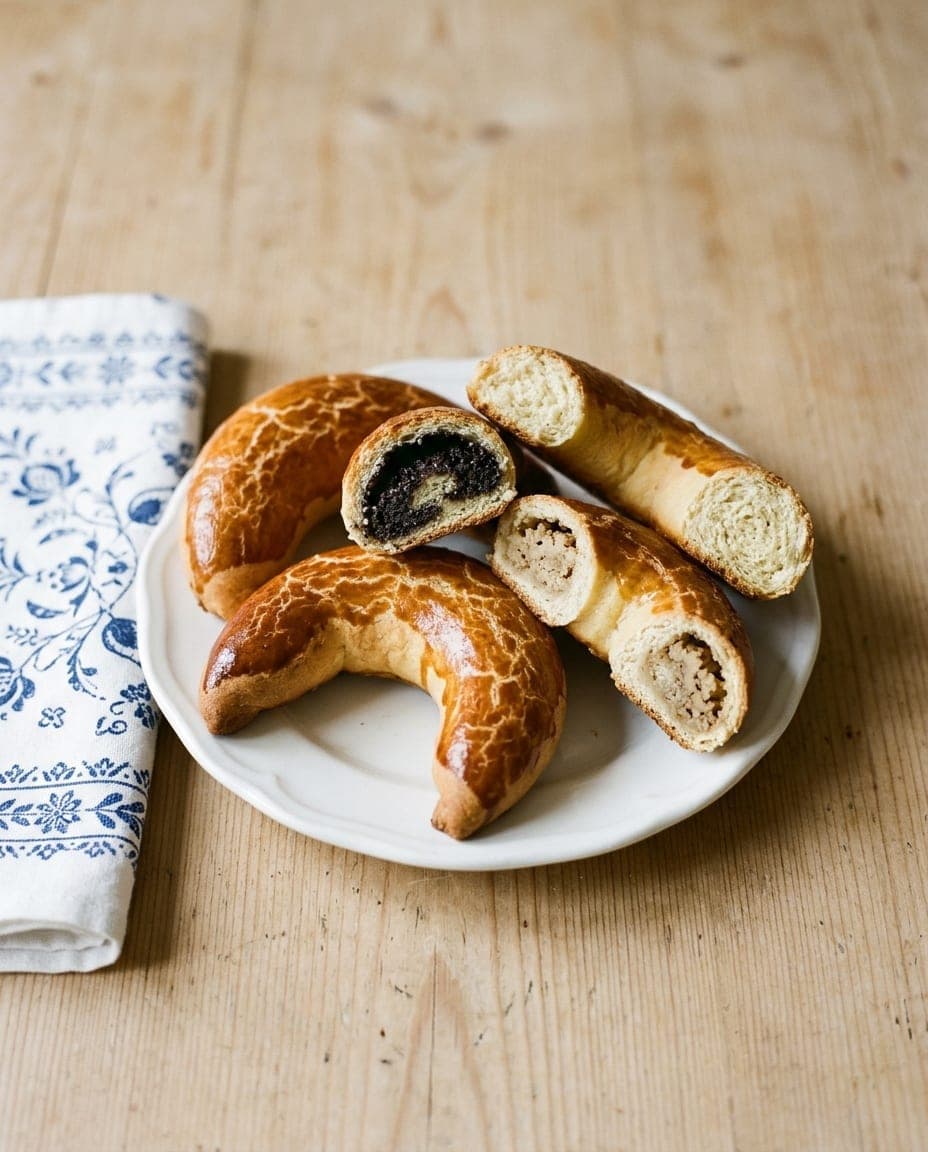
Bratislavské rožky, known in English as Pressburger Kipferl, are sweet, glazed crescent pastries that belong to the city of Bratislava. They appear in bakeries and cafés throughout Slovakia, but the city remains their true home. The pastry consists of a soft, slightly sweet dough filled with a thick paste of either ground walnuts or poppy seeds. Once baked, the surface is brushed with egg wash, creating a marbled, cracked finish that glimmers under the light.
The shape is a code. The poppy-seed version is bent into a horseshoe; the walnut one is left straighter, closer to a C. Knowing that saves asking at the counter, and Bratislava bakers keep to it. The pastry itself is thin and tender around a dense filling, and one is a snack rather than a cake.
The city of three names
The history of the pastry is tied to the city's past as a trilingual hub. Through the 19th century, when the pastry's name took hold in print, Bratislava was known by three names: Pressburg in German, Pozsony in Hungarian, and Bratislava in Slovak. This multilingual identity gave the pastry its own set of names, which are still used interchangeably today depending on the language spoken.
Filled crescents were made all over Central Europe, and this one is a local refinement rather than an invention: the thin tender dough, the dense nut or poppy paste, and the egg glaze that bakes into a cracked, marbled finish. The same pastry is made in Vienna and Budapest under the city's other names. Since 2012 Bratislavský rožok has been registered in the EU as a Traditional Speciality Guaranteed, which protects the recipe and method rather than tying production to the city.
What goes into it
The EU registration sets out the essentials, but within it every baker guards their own method. The variations lie in the filling and the finish rather than the core dough. The essential components are:
- Walnut or poppy seed paste: A thick mixture of ground nuts or seeds, often sweetened with sugar and flavoured with vanilla or lemon zest.
- Rich yeast dough: A lightly sweetened dough, short with butter or lard, that bakes into a tender casing around the filling.
- Egg wash: Applied before baking to create the characteristic marbled, cracked surface that seals in moisture.
The proportions are the opposite of most pastries: a great deal of filling and the thinnest possible casing around it. The sweetness is all in the paste.
When they are eaten
They are sold all year and belong to two seasons: Christmas, when they are on the table with the rest of the baking, and Easter. Boxed, they are a standard present to take to someone's house.
With coffee, in a café, in the middle of the morning or the middle of the afternoon — they are too dry on their own and too sweet with anything else.
Curious facts
- A shape that tells a story. The horseshoe curve of the poppy-seed version and the straighter C-shape of the walnut version help diners identify the filling before taking a bite.
- Three names, one city. The pastry is known by different names in German, Hungarian and Slovak, reflecting the trilingual history of Bratislava in the 19th century.
- Protected status. Bratislavský rožok is an EU Traditional Speciality Guaranteed (2012): the protection covers the traditional recipe and method, so it can be made outside Bratislava.
- Mostly filling. The casing is rolled as thin as it will go, and a good one is more paste than pastry.
Where to try it
A bakery or an old café in central Bratislava, where they are sold singly from the counter and by the box. The older cafés of the city centre keep them beside the other Austro-Hungarian pastries the city shares with Vienna and Budapest.
The test is the glaze: a proper one is marbled and crazed with fine cracks, because the egg wash was applied in two coats and dried between them. A smooth, shiny, uniform surface is a shortcut.
Where to try it
1 region

Bratislava
Bratislava lies along the banks of the Danube River, marking it as the largest city in Slovakia and the country's political and cultural hub. The city's medieval Old Town boasts a wealth of history, including the iconic Bratislava Castle, which offers panoramic views of the river and surrounding areas. Notably, the region is known for its wine production, particularly the white wines from the Small Carpathians, and the unique culinary offerings such as bryndzové halušky, a traditional potato dumpling dish. Nearby, the Little Carpathians offer scenic hiking trails and vineyards. The region also hosts various local festivals, highlighting traditional crafts and regional food, providing a genuine taste of Slovak culture.