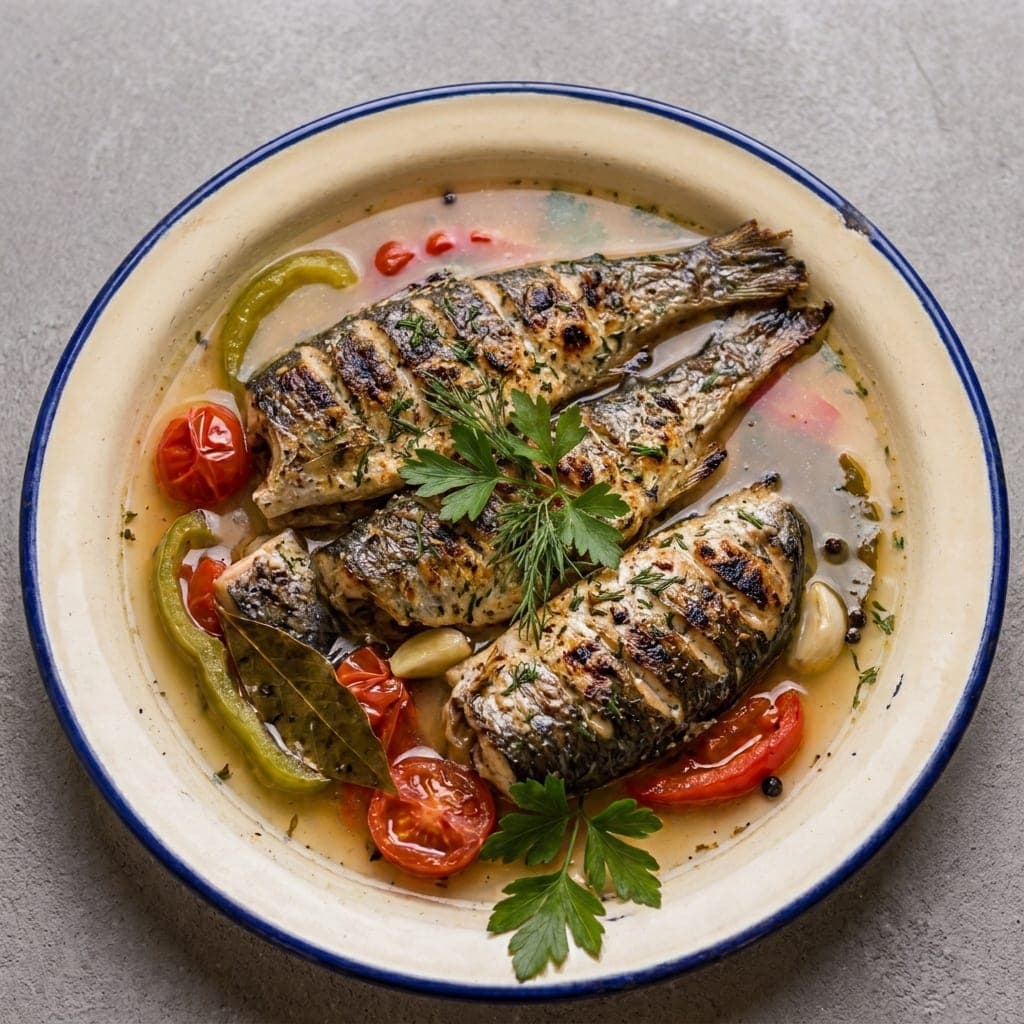
Saramură de pește
Grilled fish, drowned in hot garlic brine
- Local name
- Saramură de pește
- Served with
- Mămăligă, garlic sauce (mujdei)
- Best eaten at
- A Danube Delta pension
- Pairs with
- Romanian dry white
What it is
Saramură de pește is a dish of simple origins that has become a staple along Romania's Black Sea coast and throughout the Danube Delta. The name translates as "fish brine" (saramură is simply brine), but the method involves more than just salting. It is grilled river or sea fish, cooked over hot embers until the skin is charred, then served immediately under a hot, spicy liquid made from water, salt, garlic, chilli and sometimes tomato.
The result is fish that remains moist and tender despite the open fire. The brine penetrates the flesh while it is still warm, infusing it with sharp, savoury notes. It is not a stew in the traditional sense, nor is it a dry grilled fillet. It sits somewhere between the two: a hot, aromatic bath that turns a rustic grill into a meal of deep flavour.
It belongs to the Danube Delta — the vast reed wilderness where the river splits into three arms before the Black Sea — and to the coast around Constanța. It is fishermen's cooking, built from what was always to hand: the catch, coarse salt, garlic, a fire.
The method of brine and fire
The technique relies on the interaction between the heat of the grill and the temperature of the brine. Fish such as carp, pike, perch or zander are caught from the Delta's canals or the coastal waters. They are cleaned, scored to allow the seasoning to enter, and placed over embers or charcoal, sometimes on a bed of coarse salt, until the skin is crisp and the flesh flakes easily.
Once removed from the fire, the fish is not allowed to cool. Instead, it is immediately covered with the saramură liquid. This hot brine is a mixture of water, salt, crushed garlic, chopped chilli peppers, often with roasted tomatoes and peppers, a sprig of thyme or a bay leaf, and occasionally a splash of tomato juice, vinegar or white wine. The heat of the brine warms through the grilled meat without overcooking it, keeping the texture soft while adding a sharp, aromatic punch.
The brine does two things: it seasons the fish all the way through, and it stops a fish cooked over an open fire from drying out — which is the practical sense of it. The garlic and chilli cut the oil of a river fish; the salt does the rest.
How it is eaten
It arrives on a platter or in a wide dish with the brine pooled around it, to be shared. Whole fish, not fillets, and eaten off the bone.
Under it or beside it goes mămăligă, the Romanian cornmeal polenta, which is there to take up the brine. And then mujdei — raw crushed garlic beaten with salt, oil and sometimes a little water or broth — for anyone who finds the brine insufficiently garlicky, which is the usual view locally.
A dry Romanian white, a Fetească Regală among them, is the standard glass; the acidity is what the salt and garlic want.
Curious facts
- The brine is hot. The liquid is poured over the fish while both are still warm from the fire; cold brine would cool the meat and dull the texture.
- Garlic is essential. Without a generous amount of garlic, the dish loses its defining character and becomes merely salted fish.
- It is not pickled. Unlike cured or fermented fish dishes, saramură is fresh and cooked; the salt is used for seasoning and moisture retention, not preservation.
- Regional variations exist. While the core method remains the same, some cooks add tomatoes, roasted peppers or white wine, while others rely solely on garlic, chilli and salt.
- A fisherman's meal. It is generally described as fishermen's food: the day's catch, over the fire they already had lit.
Where to try it
A pension in one of the Danube Delta villages, where the kitchen cooks what the household's boat brought in and the table is on a terrace above the reeds; or a terrace restaurant on the coast around Constanța and south towards Mangalia. These are family places rather than restaurants in the formal sense, and the fish on the grill is the whole menu.
Summer is the season for it, when the grills are outside and the terraces are open. Many Delta villages can be reached only by boat from Tulcea — Sulina, at the far end, is between one and a half and four hours away depending on the boat — which is the reason the villages are still quiet.
Where to try it
1 region
 Boat Rentals1 destination
Constanța
Constanța is Romania's largest coastal city and an important port on the Black Sea. Home to historical sites like the Roman Edifice with Mosaic and the Grand Casino, it reflects a blend of cultures influenced by its long history as a trade hub. The region features a unique mix of Mediterranean and Eastern European atmospheres, with picturesque beaches and charming fishing villages such as Mamaia and Eforie Nord. Beyond the well-trodden paths, the Danube Delta, a UNESCO Biosphere Reserve, offers rich biodiversity and traditional fishing communities. Local festivals celebrate seafood and wine, providing a taste of the region's culinary heritage.
Boat Rentals