Plăcintă dobrogeană
Paper-thin pastry and salty telemea
- Local name
- Plăcintă dobrogeană
- Served with
- Yogurt
- Best eaten at
- A Constanța bakery
- Pairs with
- Tea or coffee
What it is
Plăcintă dobrogeană is a savoury pastry from the Dobruja region of Romania, above all the area around the city of Constanța on the Black Sea coast. It is not a dish found on menus across the whole country, but rather a local speciality that defines the culinary identity of this coastal stretch between the Danube and the sea.
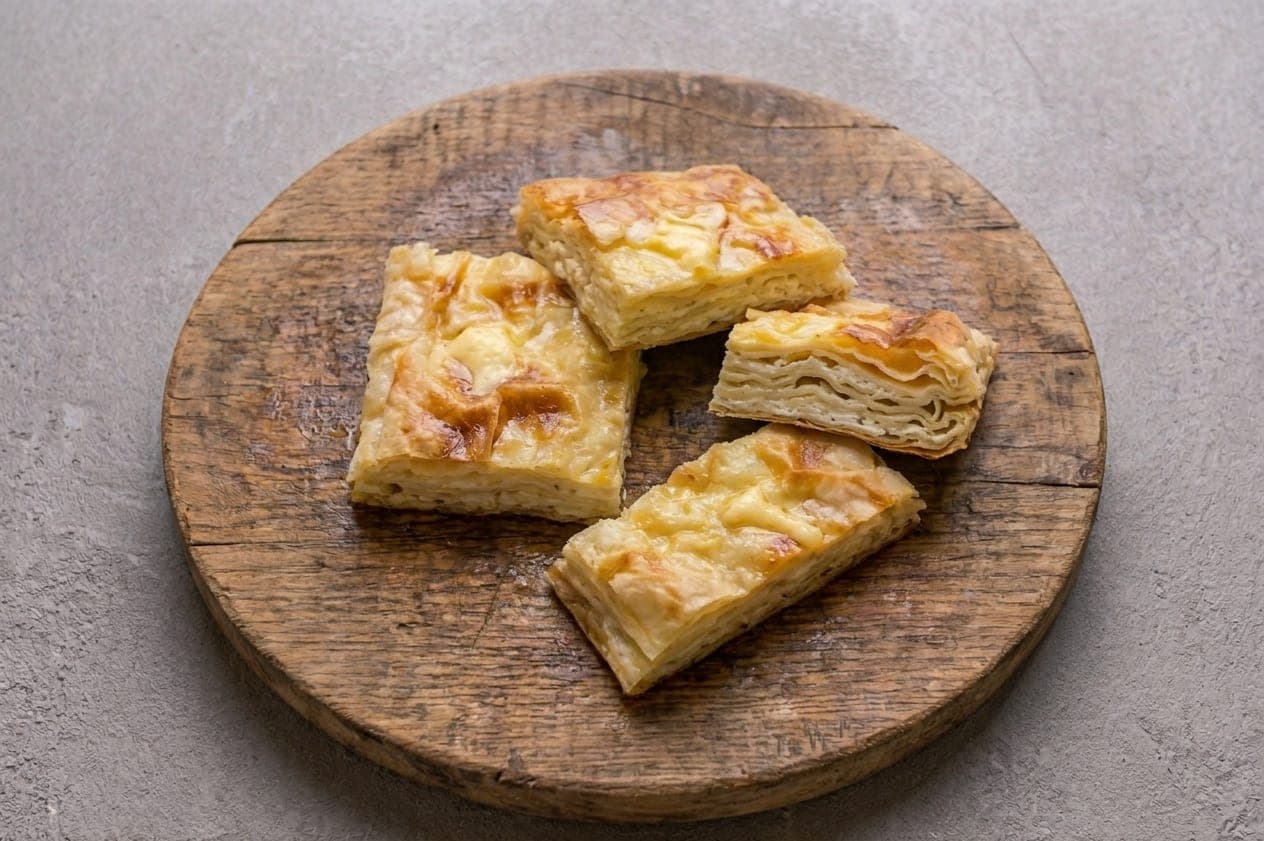
The pie consists of thin sheets of pastry filled with crumbled telemea, a salty brined cheese made from sheep's or cow's milk, mixed with caș, a young fresh cheese, and beaten egg. The dough is stretched so thinly that it becomes almost translucent; the filled sheets are then rolled, pleated and coiled into a spiral in a round tray. It is baked until the top blisters and turns a deep golden brown, creating a crisp, flaky texture.
It is bakery and market food, sold warm in pieces cut from a large round tray, and it is noticeably lighter than the thick-doughed pies of central Romania.
A pastry with Ottoman roots
The technique behind plăcintă dobrogeană reflects the long history of the Dobruja region. For centuries, this area was part of the Ottoman Empire, and the local population includes Turkish and Tatar communities whose culinary traditions remain visible today. The method of stretching dough into paper-thin sheets belongs to the same family as Turkish börek and Bulgarian banitsa, dishes found across the border in Bulgaria and Turkey.
No document records when the Dobrujan version settled into its present form, and the technique is not any one country's: the stretched-sheet method runs from Turkey through Bulgaria into this corner of Romania, and the border drawn through it in the 19th century came long after the method did. The name, though, now is: since 2023 Plăcintă dobrogeană has been an EU Protected Geographical Indication, registered by Romania after almost two years of opposition from Bulgaria, whose share of Dobruja has the same pastry.
How it is made and eaten
The dough is stretched rather than rolled, worked out to the point of translucency and left to dry a little, then filled with the cheese, rolled and coiled, brushed with oil and baked in a round tray until the top blisters. The egg in the filling binds the cheese so it sets rather than runs.
It is eaten warm, in generous pieces, with yogurt or smântână — soured cream — spooned beside it to answer the salt. A tea or a coffee is the usual drink with it. Cold, the pastry toughens, which is why bakeries sell it in batches through the morning rather than keeping a tray all day.
Curious facts
- The dough is stretched thin. Unlike many Eastern European pastries that use thick dough, this version relies on layers so fine they resemble paper when raw.
- Telemea defines the flavour. The cheese is a brined variety, often made from sheep's milk, which gives the pie its distinct salty profile.
- Yogurt is essential. Serving it with plain yogurt or sour cream is standard practice to balance the saltiness of the filling.
- A regional boundary marker. The pastry is specific to Dobruja and is not commonly found in central or western Romania.
- Bakery food, not restaurant food. It is sold over a counter by weight or by the piece, and a restaurant version is the exception.
- Protected since 2023. The name is an EU Protected Geographical Indication; the specification calls for telemea mixed with caș and eggs, coiled in a spiral in round trays.
Where to try it
A bakery in Constanța or in the coast towns south of it — Mangalia among them — where trays come out through the morning and the pieces are sold by weight. Markets in the Dobrujan inland villages sell it too, sometimes from a Tatar or Turkish bakery.
The only timing that matters is heat: a square straight off the tray is a different thing from one that has sat since eight in the morning.
Where to try it
1 destination
 Boat Rentals
Mangalia
Coastal town known for sandy beaches, thermal spas, and ancient ruins.
Boat Rentals
1 region
- Boat Rentals1 destination
Constanța
Constanța is Romania's largest coastal city and an important port on the Black Sea. Home to historical sites like the Roman Edifice with Mosaic and the Grand Casino, it reflects a blend of cultures influenced by its long history as a trade hub. The region features a unique mix of Mediterranean and Eastern European atmospheres, with picturesque beaches and charming fishing villages such as Mamaia and Eforie Nord. Beyond the well-trodden paths, the Danube Delta, a UNESCO Biosphere Reserve, offers rich biodiversity and traditional fishing communities. Local festivals celebrate seafood and wine, providing a taste of the region's culinary heritage.
Boat Rentals