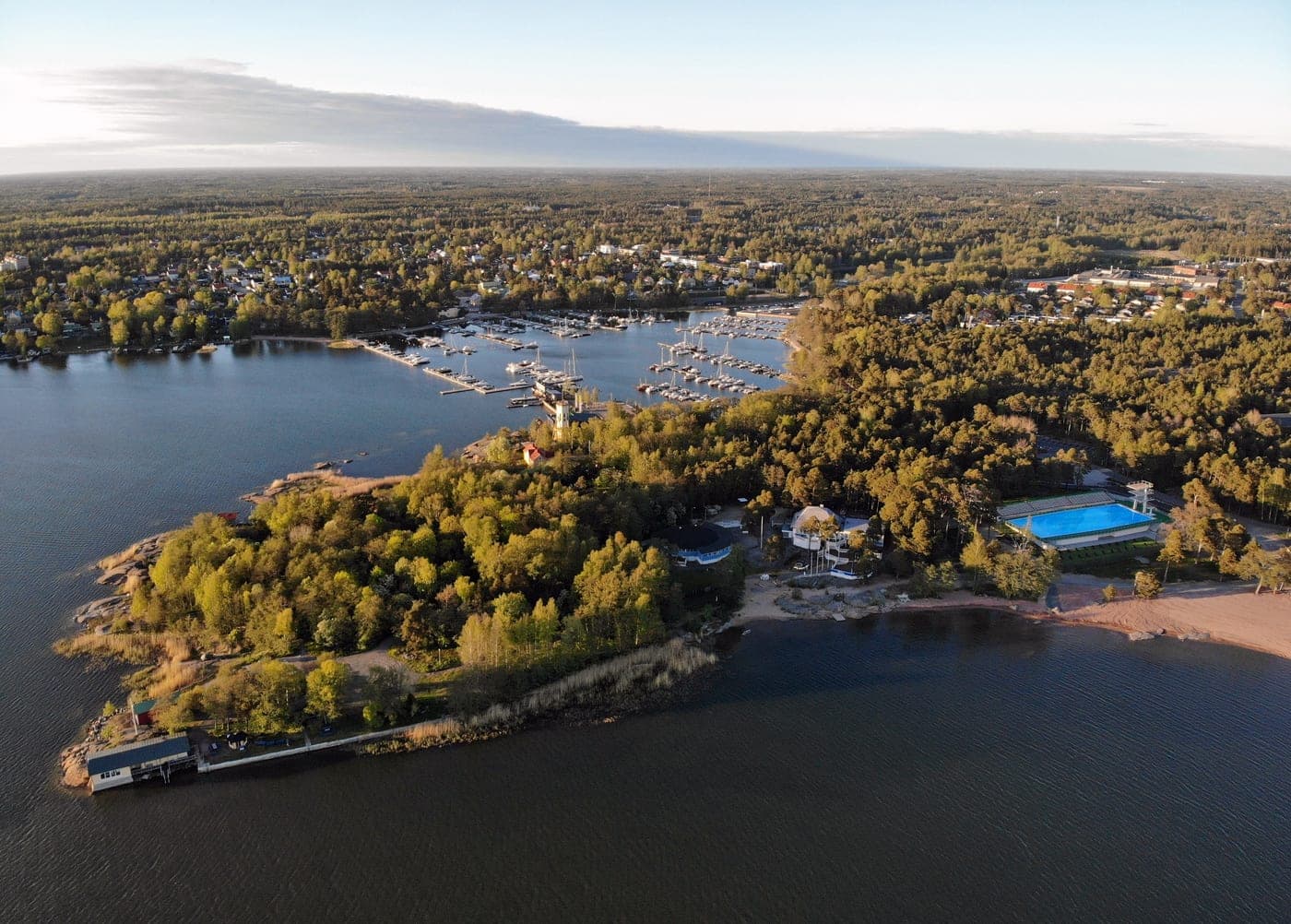
Satakunta stretches along Finland's Bothnian Sea coast, where the land breaks into hundreds of islands and skerries before turning inland to lakes and river valleys. The Kokemäenjoki river reaches the sea here after crossing much of western Finland, spreading into wetlands and one of the country's widest river deltas at Preiviikinlahti — a bay important enough for migrating birds that birdwatchers plan whole mornings around it. Slow travel in Satakunta means letting that geography set the pace: a few days by the water, a sauna at the end of each one, and time to notice how the light shifts through a summer evening.
The regional capital, Pori, sits at the river mouth. Every July it fills with the Pori Jazz Festival, but the rest of the year it keeps a quieter rhythm. A short walk from the centre, the dunes of Yyteri run for several kilometres along the coast, backed by pine forest — one of Finland's longest sand beaches, used as much for early walks as for swimming.
South along the coast is Rauma, whose old town, Vanha Rauma, is a UNESCO World Heritage Site. Its wooden houses, painted in soft, faded colours and packed along narrow lanes, have survived largely intact since the 18th century. Rauma is also one of the last places in Finland where bobbin lace-making is still practised as a living craft rather than displayed behind glass; in summer, lace-makers work in doorways and courtyards, happy to explain a pattern to anyone who stops.
Inland, the region turns toward lakes and forest. Säkylän Pyhäjärvi draws the same cottage families back to the same stretch of shore year after year. Around it and further into Satakunta's forests, the pace drops again: cottage life is built from small routines — chopping wood, heating the sauna, rowing out before dinner — rather than sightseeing.
The archipelago off Rauma runs on an older logic, shaped by fishing rather than tourism. Wooden boathouses and old net-drying racks still stand along parts of the shore, evidence of a working relationship with the sea that predates any resort. Coastal food reflects that history: whitefish and Baltic herring, smoked or pan-fried, appear on menus across the region, usually with a dense, dark rye bread on the side.
Sauna here is a household habit, not a spectacle. Lakeside and coastal saunas sit beside almost every cottage, and the ritual — heat, a plunge into cold water, a pause outside to cool down — is the same whether the water is a lake, a river, or the Bothnian Sea itself.
Three to five days give a real feel for Satakunta without rushing it: a day or two around Pori and Yyteri, a day in Rauma's old town, and the rest spent by a lake or on the coast, with a sauna booked for the evening. Longer stays suit anyone who wants to add the inland forests or spend more unhurried time among the islands.
Below are Satakunta's towns, each with its own share of coastline, forest or lakeshore to take slowly.