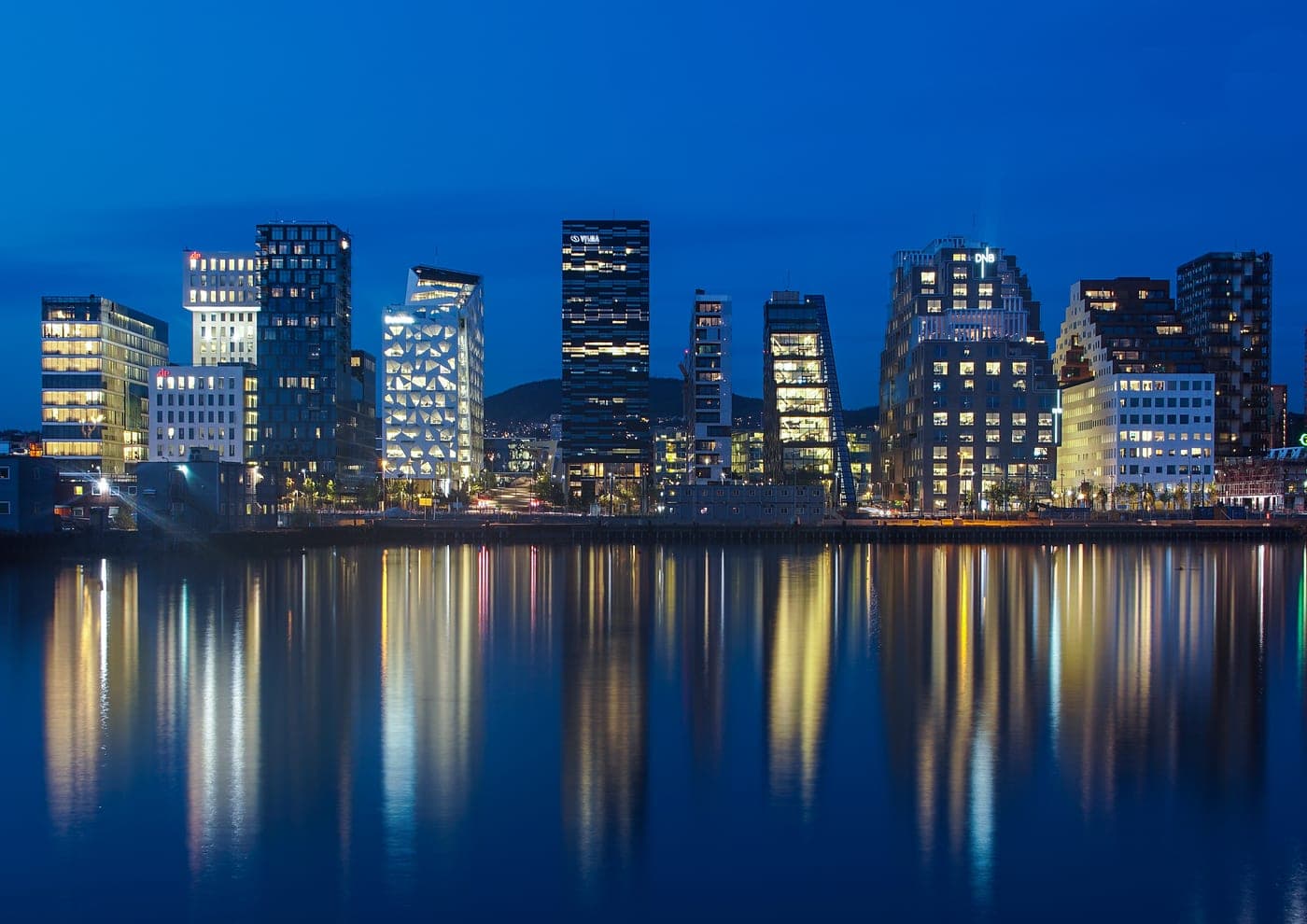
Photo by Jørn Eriksson · license: CC BY 2.0
Oslo sits at the head of the Oslofjord, wrapped on its landward side by the forested hills of Nordmarka. Few European capitals hold this kind of contrast so close together: glass towers and timber-clad harbourfronts a short walk from pine forest, lakes, and marked trails. The city grew from a modest trading post into Norway's political and cultural centre, and it wears both halves of that history openly — medieval stone walls standing a few streets from some of Scandinavia's boldest recent architecture.
Akershus Fortress, begun in the thirteenth century, still looks out over the harbour where the Oslo Opera House now rises like a sloped white iceberg. The Opera House roof is open ground; locals cross it on the way to work as often as visitors climb it for the fjord view. Nearby, the Astrup Fearnley Museum and the National Museum hold Norwegian and international art, while the Munch Museum, in its tall riverside tower, gives Edvard Munch's paintings room they never had before.
Across the water, the Bygdøy peninsula holds a cluster of museums built around Norway's seafaring past: the Viking Ship Museum's excavated burial ships, the polar ship Fram, and the open-air Norwegian Folk Museum, where timber farmhouses and a twelfth-century stave church have been reassembled from around the country. It is a dense, walkable stretch of history, quieter and greener than the city centre.
Oslo's neighbourhoods reward slower attention than the main sights. Grünerløkka, once an industrial district along the Akerselva river, is now a grid of cafés, second-hand shops, and small breweries, with the river itself running through parks and past old textile mills. Further out, Vålerenga and Torshov keep a more residential, low-key character, with wooden houses and neighbourhood bakeries. Frogner, on the west side, is home to Vigeland Sculpture Park, where Gustav Vigeland's granite and bronze figures fill a public park still used for picnics and morning runs rather than treated as a museum piece.
Food in Oslo has shifted noticeably toward local and seasonal produce. Mathallen food hall, in a converted factory building, gathers small producers of cheese, charcuterie, and baked goods under one roof. Along the harbour, Aker Brygge and the newer Tjuvholmen district serve fish straight off the fjord, while further east, Vulkan continues the trend of old industrial buildings turned food destinations. Cinnamon buns, waffles, and dark rye bread remain the everyday staples behind the newer restaurant scene.
Nature is never far from any of this. Sognsvann lake, at the edge of Nordmarka, is a swimming spot in summer and a groomed ski track in winter, both reachable within the city's own boundaries. In the fjord itself, small wooded islands such as Hovedøya carry the ruins of a medieval monastery and grassy shorelines used for summer swimming. Ekebergparken, on a ridge above the harbour, combines outdoor sculpture with one of the clearest views over the fjord and the city rooftops below.
The seasons shape Oslo sharply. Summer brings long daylight, outdoor swimming at harbour spots like Sørenga, and public parks full of evening picnics. Winter turns Nordmarka into a network of cross-country ski trails used by residents rather than kept for tourists, and frozen lakes double as skating rinks. Spring and autumn are quieter, with the forest changing colour and fewer crowds at the main museums.
Environmental thinking runs through much of the city's recent development: the harbourfront has been steadily reclaimed from industrial and port use into public space, cycling infrastructure has expanded, and green roofs and timber construction appear across newer buildings. For a capital its size, Oslo keeps an unusual amount of forest, fjord, and quiet residential streets within easy reach of its centre, making it a place that opens up gradually rather than all at once.
Drop the places you like into one list. The planner orders them by day and works out the distances.
Get slow travel tips delivered to your inbox
A short message when something worth the trip lands. Reply STOP anytime.
By subscribing, you agree to be contacted via WhatsApp. Privacy policyOccasional letters in your inbox — with recommendations, maps and routes.
By subscribing to newsletter, you agree to our privacy policy.